
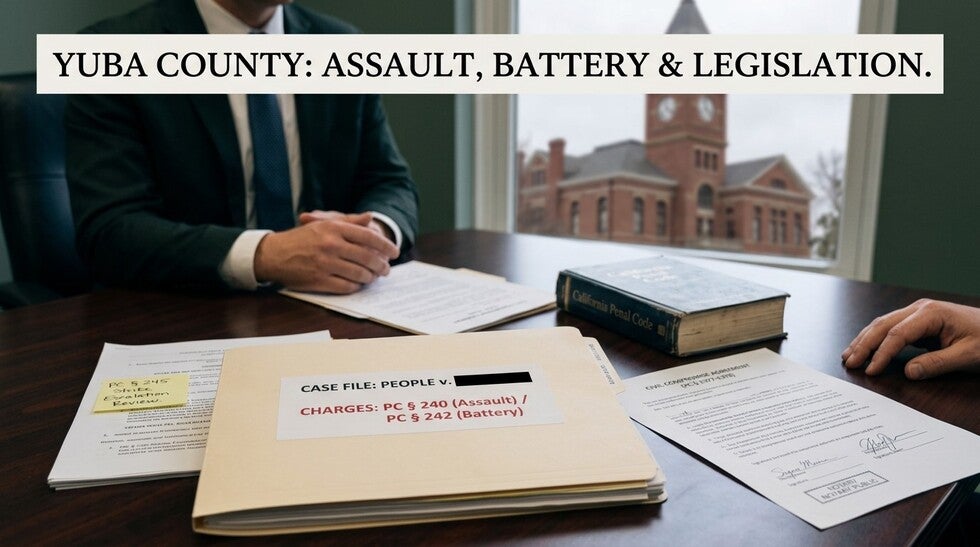
Assault and Battery in Yuba County cases can begin with a shove, a missed punch, a workplace argument, a fight near a ranch or orchard, a Beale AFB-related incident, or a confrontation in Marysville. Under California Penal Code §§ 240 and 242, simple assault and simple battery are usually misdemeanors. But the case can become far more serious if prosecutors allege assault with a deadly weapon or force likely to produce great bodily injury under Penal Code § 245.
The difference between a misdemeanor and a felony often depends on the details: what was said, whether anyone was touched, whether an object was actually used, whether the alleged victim suffered injury, and whether the accused acted in self-defense. In an agricultural county where tools, equipment, vehicles, ladders, poles, and irrigation materials are part of everyday life, the presence of an object near a confrontation should not automatically turn the case into a felony weapon allegation.
What Assault and Battery in Yuba County means under PC § 240 and PC § 242
California Penal Code § 240 defines assault as an unlawful attempt, coupled with the present ability, to commit a violent injury on another person. Assault does not require physical contact. It focuses on the alleged attempt and present ability.
California Penal Code § 242 defines battery as any willful and unlawful use of force or violence upon another person. Battery can involve even slight touching if it is willful and unlawful. The prosecution does not always need to prove a serious injury for simple battery, but injury evidence can affect charging, negotiation, restitution, and sentencing.
Simple battery under Penal Code § 243(a) is generally punishable by up to six months in county jail and a fine of up to $2,000. The penalties can increase when the alleged victim is a protected worker, when serious bodily injury is alleged, or when the case is charged under a different statute.
Defense issues may include:
- Whether the accused acted willfully
- Whether there was actual force or only argument
- Whether the accused had the present ability to commit an assault
- Whether the touching was accidental or legally justified
- Whether the alleged victim was the aggressor
- Whether witnesses, body camera footage, or injuries support self-defense
California assault and battery law is statewide, but local context matters. Defense strategy in Long Beach assault and battery cases, Riverside County PC § 240 and PC § 242 cases, and Bakersfield assault and battery defense may involve the same statutes but different local facts, agencies, and court practices.
Assault and Battery in Yuba County and PC § 245 escalation
Penal Code § 245 can dramatically change an assault case. A prosecutor may charge assault with a deadly weapon, assault with a firearm, or assault by means of force likely to produce great bodily injury. Depending on the subsection and facts, PC § 245 can be charged as a felony or misdemeanor.
A felony PC § 245 conviction can carry serious consequences, including prison exposure, firearm consequences, immigration risk, professional licensing problems, and strike exposure in some cases. Felony assault with a deadly weapon under PC § 245 is listed as a serious felony under California's Three Strikes framework. Assault by means of force likely to produce great bodily injury requires separate analysis, and strike treatment may depend on the charge, findings, injury allegations, and record.
The defense should not accept an aggravated assault label without testing the evidence. Key questions include:
- Was the object actually used or specifically threatened?
- Was the object inherently deadly, or only dangerous based on how it was allegedly used?
- Was there enough force to be likely to cause great bodily injury?
- Were injuries minor, absent, exaggerated, or caused by someone else?
- Was the accused defending themselves or another person?
- Did the alleged victim's statements change over time?
The strongest defense may be reducing the case from PC § 245 to simple assault or battery, defeating the deadly weapon theory, challenging great bodily injury allegations, or showing lawful self-defense.
Wheatland agricultural tools and deadly weapon allegations
In Wheatland and surrounding agricultural areas, confrontations may happen near orchard ladders, harvest poles, pruning tools, irrigation equipment, tractors, trailers, pumps, and field hardware. Those items may be close to workers because they are part of the job, not because anyone used them as weapons.
For PC § 245, the prosecution must prove more than proximity. A tool sitting nearby is not automatically a deadly weapon. The issue is whether the object was used, displayed, swung, raised, thrown, pointed, or threatened in a way that was likely to cause great bodily injury under the circumstances.
A defense investigation should document:
- Where each tool or object was located
- Whether the accused touched, held, moved, or referenced the object
- Whether witnesses saw actual use or only saw the object nearby
- The normal workplace purpose of the item
- Photos or video showing the layout of the orchard, field, shop, or worksite
- Any injuries or lack of injuries consistent with the alleged weapon use
For H-2A workers and other noncitizens, PC § 245 can create immigration concerns because violent offense allegations may affect deportability, admissibility, visa renewal, and future work eligibility. Criminal defense and immigration analysis should happen before any plea is discussed.
Beale AFB service members and military consequences
For Beale AFB service members, a civilian assault arrest can create military consequences at the same time. A case may proceed in Yuba County Superior Court while command, Security Forces, or military investigators evaluate the same incident under military rules.
Depending on the facts, the military side may involve UCMJ Article 128 assault allegations, administrative paperwork, duty restrictions, security clearance review, no-contact orders, or separation proceedings. A civilian felony assault conviction can become powerful adverse information in a military administrative process.
Service members should avoid discussing the facts with law enforcement, command, coworkers, or investigators before receiving legal advice. A statement intended to protect a military career may damage both the civilian and military tracks.
Civil compromise in Marysville battery cases
California Penal Code §§ 1377 and 1378 allow civil compromise in certain misdemeanor cases when the injured person has a civil remedy, appears before the court, and acknowledges satisfaction. If the court grants the request, the misdemeanor may be dismissed. This is discretionary, not automatic.
Civil compromise may be relevant in some simple battery cases where the matter is truly misdemeanor-level, the alleged victim wants compensation or resolution, and the case does not fall into an excluded category. It is generally not available for felonies, domestic violence matters, child or elder victim cases, court-order violations, cases involving officers in the performance of duty, riotous conduct, or offenses committed with intent to commit a felony.
In a small community like Marysville, civil compromise can sometimes resolve a low-level dispute in a way that addresses the harm without creating a criminal conviction. But it must be handled carefully. The defendant should not contact the alleged victim directly or pressure anyone. Communication should go through counsel and lawful court procedures.
Self-defense evidence after Assault and Battery in Yuba County charges
Self-defense is often the most important issue in a Yuba County assault or battery case. Police may arrest the person they believe was the primary aggressor based on limited scene information. That decision may not reflect the full confrontation.
The defense should preserve evidence immediately. Bruises, scratches, torn clothing, damaged property, and surveillance footage can disappear quickly. Body camera footage from responding agencies, 911 calls, dispatch notes, and witness statements may show that the accused was reacting to a threat rather than starting one.
Useful evidence may include:
- Photographs of the accused person's injuries taken immediately and over several days
- Medical records showing defensive injuries
- Videos from homes, businesses, phones, vehicles, or worksites
- Witnesses who saw the beginning of the confrontation
- Prior threats or violence by the alleged victim
- Text messages or calls showing fear, provocation, or mutual conflict
- Photos of the scene and any objects alleged to be weapons
A person accused of assault should not wait for the prosecution to collect all useful evidence. The prosecution is not responsible for building the defense.
Sexual assault, polygraph, and victim-compensation issues
Some assault allegations involve sexual conduct or are charged alongside sex-related accusations. Those cases require separate legal analysis because the elements, defenses, penalties, protective orders, and registration consequences may be very different from ordinary assault and battery.
If prosecutors allege assault with intent to commit a sexual offense, the case may involve Penal Code § 220 defense issues, including whether the evidence proves the required specific intent. In sexual assault investigations, California law also limits improper reliance on polygraph demands, and Penal Code § 637.4 polygraph protections may affect how victim statements are handled. Related agency and compensation records can also matter, and Penal Code § 13956 in sexual assault cases may become relevant when reviewing victim compensation materials and related statements.
The defense must avoid treating a sex-related assault allegation as a routine fight case. Digital evidence, forensic interviews, consent issues, protective orders, and collateral consequences may all require immediate attention.
Custody, jail, and prison assault allegations
Assault cases that occur in custody are different from street, workplace, or home allegations. Jail calls, housing logs, surveillance video, deputy reports, medical records, classification records, and incident reports can all affect the case.
For people already in custody, the stakes may include new criminal charges, probation or parole consequences, disciplinary sanctions, classification changes, and loss of credits. Allegations involving incarcerated people serving life terms can raise much more severe issues, including assault by life prisoners under Penal Code § 4500.
Custody cases require fast preservation of video and records. Surveillance footage and internal records may not remain available indefinitely, and witness access can become difficult once people are moved.
Where assault and battery cases are handled in Yuba County
Yuba County criminal cases are handled at the Superior Court of California, County of Yuba, located at 215 Fifth Street, Suite 200, Marysville, CA 95901. Defendants should rely on the court notice, attorney instructions, and official court calendar for exact hearing details.
A misdemeanor assault or battery case may involve arraignment, protective orders, discovery, negotiation, civil compromise evaluation, readiness conferences, and trial. A felony PC § 245 case may also involve a preliminary hearing, where the prosecution must present enough evidence for the case to proceed.
Protective orders can create immediate problems. A defendant may be ordered not to contact the alleged victim, stay away from a workplace or residence, surrender firearms, or obey other conditions. Violating a protective order can create a new case even if the protected person initiates contact.
What to do after an assault arrest in Yuba County
After an arrest, do not explain the incident to police, the alleged victim, coworkers, command, or witnesses without legal advice. Statements about who started the fight, whether an object was used, or why force was necessary can be taken out of context.
Important steps include:
- Photograph injuries immediately and continue documenting bruising or swelling.
- Preserve messages, voicemails, videos, and location records.
- Identify witnesses who saw the entire incident, not just the ending.
- Document any object alleged to be a weapon and its normal purpose.
- Do not contact the alleged victim directly about a civil compromise.
- For service members, get advice before speaking with command or investigators.
- For noncitizens, address immigration consequences before any plea.
The defense should focus on the exact charge, the evidence, the injuries, the object or force alleged, and the consequences of any conviction.
Assault and Battery in Yuba County lawyers in California
Assault and Battery in Yuba County cases require immediate review of the facts, injuries, witness accounts, self-defense evidence, and possible PC § 245 escalation. A simple battery allegation may be defensible through self-defense, lack of willful force, civil compromise, or negotiation. A felony assault allegation may require aggressive challenge to the deadly weapon, force likely to cause great bodily injury, or strike theory.
Bulldog Law defends serious California criminal cases with attention to local court practice, military consequences, immigration risk, civil compromise options, and the evidence that separates a misdemeanor from a life-changing felony. If you or a loved one is facing assault or battery charges in Yuba County, legal strategy should begin before statements are made, injuries fade, or key video disappears.