
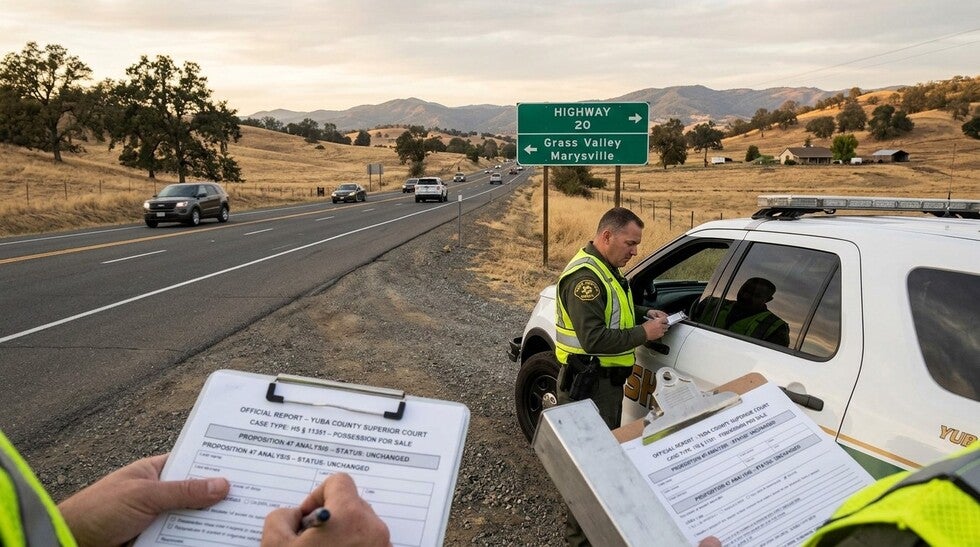
Drug Sales in Yuba County cases are different from simple possession cases because the prosecution is not just claiming a person possessed a controlled substance. Under Health and Safety Code § 11351, prosecutors must prove possession for sale. That sales allegation can turn a case that might otherwise be handled as misdemeanor possession into a felony with immigration, employment, military, licensing, and security clearance consequences.
Proposition 47 reduced many simple drug possession offenses, including many Health and Safety Code § 11350 cases, to misdemeanors. It did not make possession for sale under HS § 11351 a misdemeanor. It also did not make drug sales or transportation for sale under HS § 11352 low-level possession offenses. In Yuba County, the defense often begins with one central question: can the prosecution actually prove intent to sell?
What Drug Sales in Yuba County require under HS § 11351
Health and Safety Code § 11351 applies when the prosecution alleges that a person possessed certain controlled substances for sale, or purchased them for purposes of sale. It is a felony offense. The punishment is generally two, three, or four years, depending on the facts and sentencing law.
Possession alone is not enough. The prosecution must prove knowledge of the substance's presence, knowledge of its nature as a controlled substance, control over it, and intent to sell. Intent is often proven indirectly through police opinions and surrounding circumstances.
Common sales indicators include:
- Quantity of the substance
- Packaging in separate bindles, baggies, or containers
- Scales, pay-owe sheets, or cutting agents
- Cash, especially in small denominations
- Messages that appear to discuss sales
- Multiple phones or encrypted apps
- Prior observed hand-to-hand transactions
Each indicator can be challenged. Quantity may be consistent with personal use. Cash may come from wages or family support. Packaging may reflect how the substance was purchased, not how it was intended to be sold. Messages may be ambiguous, joking, old, or unrelated. A defense lawyer should not let the prosecution turn ordinary facts into a sales theory without testing them.
Drug Sales in Yuba County and what Prop 47 did not change
Prop 47 changed the treatment of many simple possession cases, but it did not protect people accused of selling drugs or possessing drugs for sale. That is why the line between HS § 11350 possession and HS § 11351 possession for sale matters so much.
If the evidence supports only personal possession, the defense may seek dismissal of the sales charge, reduction to simple possession, diversion where legally available, or a resolution that avoids the most serious collateral consequences. But PC § 1000 drug diversion is generally tied to eligible simple possession or personal-use drug offenses, not possession for sale.
For clients comparing charges, Ventura County drug possession under HS § 11350 and Stanislaus County drug possession cases show how possession-only allegations are analyzed differently from sales cases. By contrast, San Joaquin County drug sales under HS § 11351 and Sutter County possession for sale cases involve the same core sales-intent issues that often appear in Yuba County.
Highway 20 and Highway 70 transportation for sale cases
Yuba County drug cases often begin with vehicle stops on Highway 20, Highway 70, Highway 65, or routes connecting Marysville, Wheatland, Olivehurst, Linda, Beale AFB, and nearby counties. When drugs are found in a vehicle, prosecutors may consider HS § 11352 if they believe the drugs were transported for sale.
Health and Safety Code § 11352 punishes selling, furnishing, administering, giving away, importing, or transporting certain controlled substances. Under current California law, “transport” in this statute generally means transport for sale. Many HS § 11352 cases carry three, four, or five years, but transportation between noncontiguous counties can carry higher exposure, including three, six, or nine years when that allegation is legally supported.
The first defense question is often whether the stop and search were lawful. Officers need a valid basis for the traffic stop, detention, search, or later expansion of the encounter. A case may involve dashcam footage, body camera footage, K-9 deployment, consent claims, probation search issues, inventory search claims, or warrant problems.
Potential challenges include:
- No valid traffic violation or reasonable suspicion
- Prolonged detention beyond the reason for the stop
- Unlawful vehicle search
- Invalid consent or coercive questioning
- Unreliable drug dog alert
- Weak proof that the driver knew about the drugs
- Insufficient evidence that transportation was for sale
If the stop or search fails, the drug evidence may be suppressed. Without that evidence, the prosecution may have difficulty proving the charge.
Wheatland agricultural workers and the sales upgrade
In Wheatland and Yuba County's agricultural communities, facts that police describe as sales indicators may have innocent explanations. Agricultural workers may carry cash because of how wages, housing, food, transportation, and remittances are handled. Workers may buy supplies in larger quantities because stores, transportation, and work schedules make daily access difficult.
None of that automatically defeats a sales charge, but it matters. The defense should explain the real context instead of letting law enforcement apply urban drug-market assumptions to rural work settings.
In a Wheatland case, the defense may examine:
- Pay records and cash wage history
- Housing and transportation limitations
- Whether the quantity is consistent with personal use
- Whether packaging was how the substance was received
- Whether there are actual sales messages or only vague communications
- Whether police misinterpreted language, slang, or translation issues
- Whether multiple people had access to the place where drugs were found
The goal is to challenge the prosecution's upgrade from simple possession to possession for sale. That upgrade can determine whether the case becomes a felony, whether diversion is possible, and whether a noncitizen faces immigration damage.
Immigration consequences for H-2A, DACA, and noncitizen defendants
Drug sales allegations can be devastating for noncitizens. A conviction involving trafficking in a controlled substance may be treated as an aggravated felony under federal immigration law. It may also create controlled-substance inadmissibility or deportability problems. For H-2A workers, DACA recipients, lawful permanent residents, and undocumented community members, the immigration result can matter more than the jail exposure.
The immigration analysis must happen before any plea. A reduction from possession for sale to simple possession may improve the analysis, but simple possession can still create immigration problems depending on the substance, record, and status. No one should assume a misdemeanor is safe without an immigration-aware review.
Important immigration defense goals may include:
- Challenging the sales allegation
- Avoiding trafficking language in the record
- Evaluating whether diversion is legally available
- Reducing or changing the charge where supported by the facts
- Protecting DACA renewal, work authorization, or future visa eligibility
- Coordinating criminal defense with immigration counsel when needed
Beale AFB service members and security clearance risk
For Beale AFB service members, contractors, and employees in sensitive positions, a drug sales allegation can create consequences beyond the courtroom. A felony drug conviction may affect security clearance eligibility, duty assignment, weapons access, deployment, command trust, and administrative action.
Security clearance cases are fact-specific. A conviction involving distribution, sale, or trafficking is far more serious than a resolved low-level possession case, but even allegations can trigger review. The defense strategy should consider how the civilian case, command reporting, clearance disclosures, and military administrative consequences interact.
A service member should avoid speaking with law enforcement, command, security personnel, or investigators about the facts without legal advice. An explanation meant to save a career can be used in the criminal case or create additional clearance concerns.
Federal drug trafficking exposure
Some Yuba County drug cases remain state cases. Others can draw federal interest, especially if agents claim there was interstate distribution, large quantity, organized trafficking, firearms, overdose, fentanyl, wire communications, money laundering, or a broader conspiracy.
Federal charges are different from California HS § 11351 and HS § 11352 charges. The penalties, sentencing guidelines, mandatory minimums, discovery process, and negotiation strategy can be much harsher. A person contacted by federal agents should assume the situation is serious even if no federal indictment has been filed yet.
Bulldog Law's guide to federal drug trafficking defense strategies explains common challenges in federal drug cases, while Los Angeles federal drug trafficking defense under 21 U.S.C. § 841 shows how federal controlled substance prosecutions are built differently from California state cases.
School access, nuisance pleas, and related drug consequences
Drug cases can create collateral restrictions beyond the main charge. In some circumstances, drug-related conduct can affect access to school grounds, probation terms, housing, employment, or local nuisance-related resolutions.
A defendant with school-related restrictions or an order connected to drug conduct may need to understand Penal Code § 626.85 school access charges involving drug offenders. In some lower-level cases, prosecutors may discuss alternative dispositions, and drug-related public nuisance plea agreements under Penal Code § 372.5 require careful review before anyone accepts a resolution that seems minor but carries hidden consequences.
The right strategy depends on the client's job, immigration status, military role, school access needs, housing, and criminal history. A plea that looks manageable in court can still be damaging outside court.
Where Drug Sales in Yuba County cases are handled
Yuba County criminal cases are handled at the Superior Court of California, County of Yuba, located at 215 Fifth Street, Suite 200, Marysville, CA 95901. Defendants should rely on the court notice, attorney instructions, and official court calendar for exact appearance details.
A drug sales case may involve arraignment, bail or release conditions, search and seizure litigation, lab testing, discovery, informant issues, phone extraction disputes, preliminary hearing, motion practice, settlement negotiations, and trial. Felony cases may move slowly because the defense needs time to review body camera footage, lab results, phone records, vehicle stop evidence, and expert opinions.
Drug cases often depend on evidence that must be challenged early. If bodycam footage, dispatch records, dashcam video, phone data, or witness information is lost, the defense may lose important leverage.
What to do after a drug sales arrest in Yuba County
After a drug sales arrest, do not explain the drugs, cash, packaging, phone messages, or travel route to officers. People often think they can talk their way back to a possession case. In reality, those statements may give the prosecution the sales evidence it was missing.
Important steps include:
- Invoke the right to remain silent and ask for a lawyer.
- Do not consent to additional searches of a vehicle, phone, home, or storage space.
- Preserve pay records, cash source records, work schedules, and travel information.
- Do not delete messages, apps, photos, or call logs.
- Write down the stated reason for any Highway 20 or Highway 70 stop.
- For noncitizens, get immigration-aware defense advice before any plea discussion.
- For Beale AFB service members, get legal advice before speaking with command or security personnel.
The defense should focus on possession, knowledge, intent to sell, stop legality, search legality, substance identity, quantity, and collateral consequences.
Drug Sales in Yuba County lawyers in California
Drug Sales in Yuba County cases require immediate review because the difference between possession and possession for sale can determine felony exposure, diversion eligibility, immigration consequences, clearance risk, and long-term employment damage. HS § 11351 and HS § 11352 charges should be challenged at the level of proof, not accepted based on police labels.
Bulldog Law defends serious California drug cases with attention to vehicle stops, search and seizure issues, sales-intent evidence, immigration consequences, military concerns, and federal overlap. If you or a loved one is facing a Yuba County drug sales charge, legal strategy should begin before statements are made, phones are searched, or the prosecution's sales theory becomes fixed.