
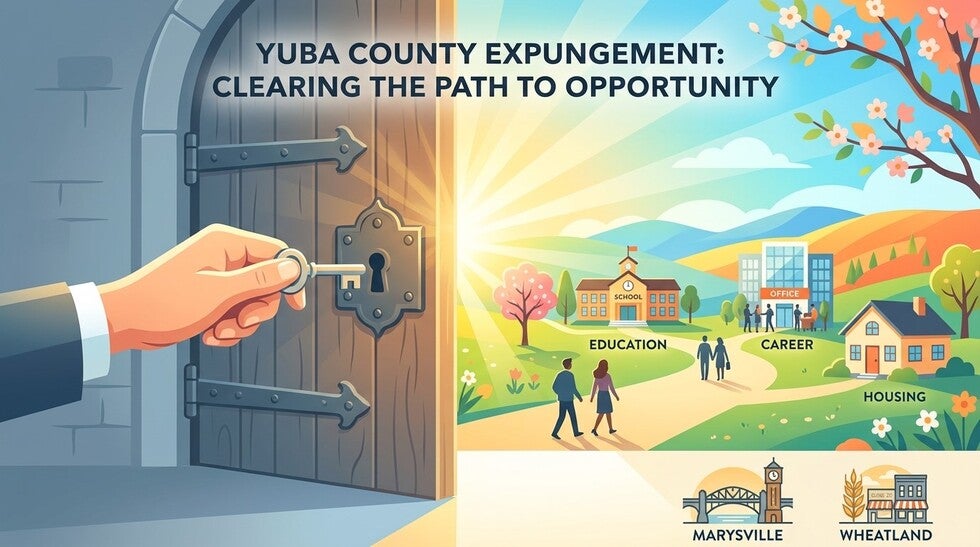
Expungement in Yuba County can help people move forward after probation, especially when an old conviction keeps appearing in employment, licensing, military, immigration, or community settings. A dismissal under Penal Code § 1203.4 does not erase the past, but it can change how the case appears in many record checks and how a person presents rehabilitation.
In Yuba County, this relief can matter for a Beale AFB service member facing a security clearance review, a Marysville healthcare applicant preparing for licensing, a Wheatland worker seeking better employment, or a DACA recipient trying to strengthen a renewal presentation. The key is understanding what PC § 1203.4 does, what it does not do, and whether additional relief should be requested first.
What Expungement in Yuba County means under PC § 1203.4
California expungement is usually a dismissal, not a complete deletion of the record. In a successful PC § 1203.4 petition, the court generally permits the defendant to withdraw a guilty or no contest plea, or sets aside a guilty verdict, enters a not guilty plea, and dismisses the accusations. The court record then shows a dismissal under the statute.
To qualify, a person generally must have completed probation or received early termination of probation and must not be serving a sentence, on probation, or charged with another offense. Some offenses and sentences require different post-conviction remedies. People who served prison terms, people with certain excluded convictions, and people with no-probation misdemeanor cases may need a different statute or a different sequence of relief.
Bulldog Law's expungement and post-conviction relief practice focuses on identifying the right remedy rather than filing a one-size-fits-all petition.
Expungement in Yuba County and the step-by-step relief strategy
The best record-clearance plan may involve more than one petition. For many people, the order matters because reclassification or reduction can improve the record before the dismissal request is filed.
- Review the conviction, sentence, probation terms, fines, restitution, and current court status.
- Determine whether Proposition 47 reclassification, Penal Code § 17(b) reduction, or another remedy should come first.
- Prepare the PC § 1203.4 petition with supporting rehabilitation information when helpful.
- File the petition in the court that handled the case.
- Address any prosecutor objection, probation issue, restitution issue, or hearing requirement.
- Obtain certified copies of the dismissal order for employment, licensing, immigration, or clearance use.
California has expanded some automatic record relief over time, but automatic relief does not solve every case. A person who needs proof of dismissal, a felony reduction, a licensing packet, or an immigration-aware strategy may still need petition-based relief. Bulldog Law's article on California's changing expungement process explains why record relief can be easier than it once was but still requires careful review.
Probation completion, early termination, and common barriers
Probation status is often the first issue. A person who successfully completed probation is in a different position from someone with unpaid restitution, unresolved probation violations, a new pending case, or outstanding terms. If probation was not completed cleanly, the court may still have discretion in some situations, but the petition becomes more complex.
A probation violation can delay or complicate relief. Before filing, counsel should review minute orders, payment history, custody credits, community service, program completion, and whether probation was formally terminated. Bulldog Law's discussion of probation violations under Penal Code § 1203.3 addresses why probation history matters before a dismissal petition is filed.
Some convictions also involve probation restrictions or sentencing rules that affect the original case. Examples include DUI probation under Vehicle Code § 23600, the 0.01 percent DUI probation rule under Vehicle Code § 23154, great bodily injury probation restrictions under Penal Code § 1203.075, and firearm enhancement probation bars under Penal Code § 1203.06.
Prop 47 and PC § 17(b) before expungement
Some people should not begin with PC § 1203.4. If a prior felony is eligible for Proposition 47 reclassification, a Penal Code § 1170.18 petition may convert the felony to a misdemeanor before dismissal. This can matter for employment, licensing, immigration presentation, and future record checks.
If the conviction was a wobbler, Penal Code § 17(b) may allow the court to reduce a felony to a misdemeanor. A reduction can be especially important for people applying for healthcare jobs, security-sensitive work, transportation positions, or supervisory roles where a felony label creates a separate barrier.
For younger clients or older juvenile-related matters, deferred entry of judgment and probation conditions may require separate review. Bulldog Law's article on Welfare and Institutions Code § 794 DEJ probation conditions addresses a different pathway that may intersect with later record-clearing goals.
Where expungement petitions are filed in Yuba County
Yuba County cases are handled at the Superior Court of California, County of Yuba, located at 215 Fifth Street, Suite 200, Marysville, CA 95901. Petitioners should use the court record, case number, attorney instructions, and official filing requirements for the specific case.
A PC § 1203.4 petition may be decided on the paperwork or may require a hearing depending on the case, local procedure, the prosecutor's response, and whether the court needs more information. Petitioners should not assume relief is automatic simply because probation ended. A complete petition should address eligibility and any facts that may concern the court.
Local expungement strategy varies by county. The approach used for PC § 1203.4 relief in Trinity County, Merced County expungement petitions, Orange County PC § 1203.4 cases, and Kern County expungement relief may involve the same California statutes but different local practices.
Beale AFB, security clearances, and military-sensitive employment
For Beale AFB service members, contractors, and employees in security-sensitive roles, expungement must be explained carefully. A PC § 1203.4 dismissal does not mean the conviction disappears for federal security clearance purposes. Clearance forms and investigators may still require disclosure, and failing to disclose can create a separate credibility problem.
What expungement can do is provide documented rehabilitation. A dismissal order may show that probation was completed and that the state court granted statutory relief. In a clearance review, that may support mitigation when combined with time passed, clean conduct, treatment completion, strong evaluations, and responsible disclosure.
For a service member whose DUI, theft, drug, or domestic violence record is affecting renewal, expungement should be part of a broader clearance strategy. The goal is not to hide the conviction. The goal is to present it accurately, with the best available court documentation.
Marysville healthcare applicants and licensing boards
Healthcare applicants in Marysville and the Yuba-Sutter region may need expungement before or during a licensing process. A nursing student, medical assistant, technician, or healthcare administrator may face fingerprint-based review even when a private background check is clean.
Professional licensing boards can have disclosure and review rules that differ from private employers. Expungement may improve the rehabilitation record, but applicants should not assume it removes every duty to disclose. Certified dismissal orders, proof of completed probation, program completion certificates, school records, employment references, and a careful personal statement may all matter.
Healthcare licensing is a practical reason to pursue relief early. Waiting until a board requests documents can delay an application and leave less time to fix record issues.
DACA, immigration, and Wheatland workers
For DACA recipients and other noncitizens, expungement requires caution. California PC § 1203.4 does not erase a conviction for many federal immigration purposes. Immigration law may still treat the conviction as valid, especially for deportability, inadmissibility, controlled substance issues, and certain serious offenses.
That said, expungement can still help in some discretionary presentations, including certain DACA renewal contexts, because it documents rehabilitation and completion of court obligations. The effect depends on the offense, the person's immigration history, the number of convictions, and current federal policy.
Anyone with DACA or a pending renewal should seek immigration-aware criminal defense advice before filing or relying on expungement. Bulldog Law's overview of the DACA program and its article on DACA renewal requirements in California explain why timing, documentation, and criminal history review matter.
What PC § 1203.4 does not fix
Expungement is valuable, but it is not magic. A person should understand the limits before relying on it for a job, license, firearm issue, immigration filing, or government application.
PC § 1203.4 generally does not:
- Seal or destroy the court record in every setting
- Restore firearm rights by itself
- Remove sex offender registration requirements
- Erase immigration consequences in most federal immigration contexts
- Eliminate disclosure duties for government jobs or many licensing applications
- Prevent law enforcement, courts, or prosecutors from seeing the case
- Guarantee that every private background check will update immediately
Because of these limits, the petition should be matched to the person's real goal. A security clearance problem, nursing application, DACA renewal, firearm concern, CDL job, or community reputation issue may each require a different package of documents and advice.
Practical documents to gather before filing
A strong petition starts with accurate records. Many delays happen because the petitioner does not have the case number, probation status, payment history, or proof that court obligations were completed.
Helpful documents include:
- Case number, complaint, plea form, and sentencing order
- Minute orders showing probation terms and completion
- Proof of paid fines, fees, and restitution when available
- Program completion certificates
- Employment records, military evaluations, school records, or licensing documents
- Letters showing rehabilitation, volunteer work, treatment, or community involvement
- DACA, clearance, or licensing deadlines that affect filing strategy
The petition should be filed with a clear purpose. A generic dismissal order may help, but a well-prepared record can better support the person's employment, licensing, clearance, immigration, or family goals.
Expungement in Yuba County lawyers in California
Expungement in Yuba County can help people move beyond old convictions, but the right approach depends on the conviction, probation history, sentence, immigration status, licensing goals, and future plans. PC § 1203.4 may be only one part of the solution, especially when Proposition 47, Penal Code § 17(b), DACA, professional licensing, or federal clearance issues are involved.
Bulldog Law helps clients evaluate California post-conviction relief, prepare record-clearing petitions, and understand the limits of expungement before relying on it. If an old Yuba County conviction is affecting work, school, military service, licensing, immigration planning, or reputation, the next step is a focused review of the record and the relief available.