
Hit and Run in Yuba County cases under Vehicle Code § 20001 often turn on what the driver knew, what the driver did immediately after the crash, and what the evidence shows later. A person can be charged even if they did not cause the collision, but the prosecution still must prove the required legal elements, including knowledge that an accident occurred and that someone was injured or likely injured.
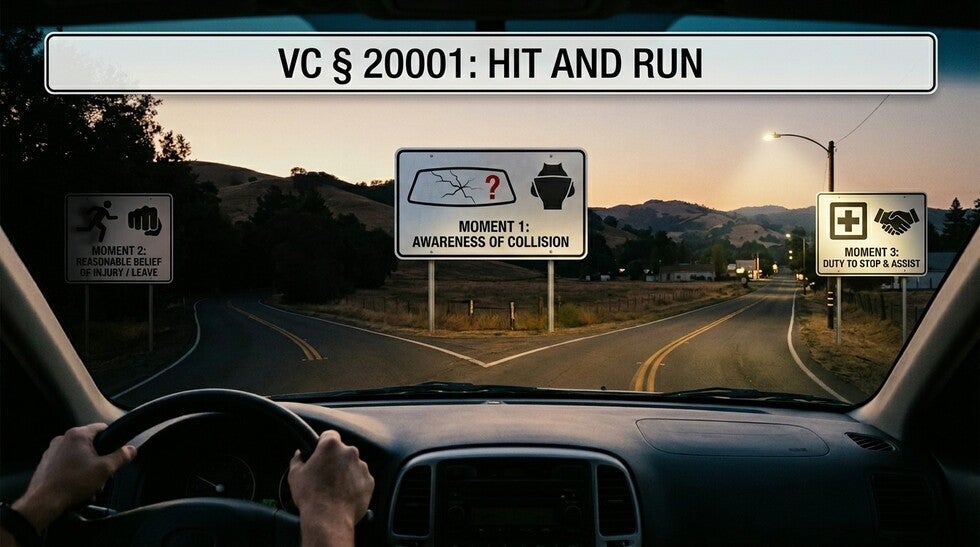
In Yuba County, these cases may arise on Highway 20, Highway 70, rural roads near Wheatland, streets in Marysville, roads near Beale AFB, or agricultural routes where lighting, fog, work trucks, pedestrians, cyclists, and farm equipment can complicate the facts. The defense should begin by separating the case into three moments: the crash itself, the stop-and-aid duties immediately after, and the later investigation.
What Hit and Run in Yuba County requires under VC § 20001
Vehicle Code § 20001 applies when a driver is involved in an accident that results in injury or death to another person and fails to perform the legal duties required after the crash. The driver must stop at the scene or as close as safely possible, provide required identifying information, and render reasonable assistance to an injured person.
The prosecution generally must prove:
- The accused was driving a vehicle involved in an accident
- The accident caused injury or death to another person
- The accused knew they were involved in an accident that injured someone, or knew from the nature of the accident that injury was probable
- The accused willfully failed to stop, provide required information, or render reasonable assistance
This is different from a property-damage-only hit and run. Vehicle Code § 20001 involves injury or death, which makes the case much more serious. Bulldog Law's overview of whether hit and run is a serious criminal offense explains why injury cases require immediate defense attention.
Hit and Run in Yuba County and the knowledge element
The knowledge element is often the heart of the defense. The prosecution does not have to prove the driver knew the exact injury or medical diagnosis. But it must prove the driver knew they were involved in an accident that injured someone, or that the nature of the crash made injury probable.
This matters in cases involving nighttime driving, road debris, minor contact, poor visibility, large trucks, trailers, agricultural equipment, motorcycles, cyclists, or pedestrians. A driver may know something happened without knowing a person was injured. The defense may focus on what the driver could see, hear, feel, and reasonably understand at the moment.
Evidence that may affect the knowledge issue includes:
- Vehicle damage location and severity
- Lighting, weather, fog, and road conditions
- Dashcam, surveillance, or nearby camera footage
- Witness descriptions of the impact
- 911 calls and timing of reports
- Whether the driver stopped nearby, returned, called someone, or sought help
- Statements made before police suggested an injury occurred
A strong defense may show that the driver did not know an injury crash had occurred, or that the facts were not clear enough to prove criminal knowledge beyond a reasonable doubt.
The first moment: the crash itself
The first moment is the collision. The prosecution may focus on the fact that someone was hurt. The defense must focus on what actually happened and what the driver perceived. A crash on a rural Yuba County road may involve dust, tule fog, darkness, uneven shoulders, farm vehicles, or limited lighting. A crash in Marysville may involve parked cars, pedestrians, traffic, or short sightlines.
The defense should not assume the police reconstruction is complete. Important questions include whether the driver was actually involved, whether the accused was the driver, whether the injury came from that collision, and whether another vehicle or condition contributed to the crash.
Hit and run defense is fact-driven across California. Strategies used in Ventura County VC § 20001 cases, Madera County hit and run defense, and Tulare County injury hit and run cases can involve the same statute but different local crash conditions and evidence.
The second moment: stopping, giving information, and helping
The second moment is what happened immediately after the crash. Vehicle Code § 20001 is not primarily about who caused the accident. It is about the legal duties that apply after an injury accident. A driver involved in an injury crash must stop, provide identifying information, and render reasonable assistance when needed.
Reasonable assistance can include calling 911, helping secure medical care, or arranging transportation for medical help when appropriate. The driver's conduct after the collision can become powerful evidence for either side. A person who panicked but quickly called for help may be in a different position from a person accused of hiding the vehicle, repairing damage, or avoiding contact.
The defense may examine:
- Whether the driver stopped close to the scene
- Whether it was unsafe to stop exactly where the collision happened
- Whether the driver called 911, a family member, insurance, or law enforcement
- Whether the driver returned to the scene
- Whether the injured person already had help
- Whether the driver was threatened, confused, injured, or in shock
These facts do not automatically excuse leaving the scene, but they may affect intent, knowledge, charging decisions, and negotiation.
The third moment: the investigation after the crash
The third moment begins after law enforcement identifies a suspect. Officers may inspect vehicles, review license plate reader data, obtain surveillance footage, interview witnesses, search phones, ask repair shops for records, and compare paint transfer or damage. Insurance calls, text messages, body shop visits, and social media posts can also become evidence.
Many people make the case worse by trying to explain before they understand the legal risk. Statements like “I thought I hit a sign,” “I only left because I was scared,” or “I did not think they were hurt” may help in some contexts but harm in others. Any statement should be made only with legal advice.
Later conduct can also create separate problems. Hiding a vehicle, asking someone to lie, deleting messages, or making false insurance statements can lead to additional charges. The safest step is to preserve evidence and speak with counsel before talking to investigators.
Penalties for VC § 20001 in Yuba County
Vehicle Code § 20001 can be charged as a misdemeanor or felony depending on the injury, facts, record, and prosecutor's decision. A nonfatal injury case can carry county jail or state prison exposure, fines, restitution, probation terms, license consequences, and a criminal record.
If the accident results in death or permanent, serious injury, the sentencing exposure can increase. The statute provides a higher punishment range for death or permanent, serious injury cases. A conviction may also affect insurance, employment, professional licensing, immigration status, military service, and future driving privileges.
The defense must also watch for related charges, such as DUI causing injury, vehicular manslaughter, reckless driving, driving on a suspended license, insurance fraud, false statements, or probation violations. The hit and run charge may be only one part of the case.
Where Hit and Run in Yuba County cases are handled
Yuba County criminal cases are handled at the Superior Court of California, County of Yuba, located at 215 Fifth Street, Suite 200, Marysville, CA 95901. Defendants should rely on the court notice, attorney instructions, and official court calendar for exact appearance details.
A VC § 20001 case may involve arraignment, bail or release conditions, discovery, DMV-related issues, restitution claims, insurance evidence, crash reconstruction, preliminary hearing in felony cases, motion practice, negotiation, and trial. The case may also involve contact with the Yuba County District Attorney, CHP, Marysville Police Department, Yuba County Sheriff's Office, or other investigating agencies.
Local representation matters because evidence and logistics differ by community. Bulldog Law serves clients through its Marysville criminal defense presence, its Wheatland legal services, and its broader Yuba County law firm work.
Defenses to VC § 20001 hit and run charges
Defenses depend on the evidence. A driver may have a strong knowledge defense, identity defense, causation defense, or challenge to the claim that they failed to perform required duties. In other cases, the main defense may focus on reducing felony exposure, limiting restitution, avoiding custody, or protecting a license or career.
Potential defenses include:
- The accused was not the driver
- The vehicle was not involved in the injury collision
- The driver did not know an accident occurred
- The driver did not know injury was probable from the nature of the accident
- The driver stopped as close as safely possible
- The driver provided reasonable assistance under the circumstances
- The injury was not caused by the accused driver's vehicle
- Police obtained vehicle, phone, or statement evidence unlawfully
- The prosecution cannot prove the case beyond a reasonable doubt
Comparable VC § 20001 defenses may arise in Santa Clara County hit and run cases, Kern County VC § 20001 matters, and Riverside County injury hit and run allegations, but each case still depends on the crash evidence and the driver's knowledge.
Evidence to preserve after a Yuba County hit and run accusation
Hit and run evidence can disappear quickly. Video may be overwritten, vehicle damage may change, witnesses may forget details, and road conditions may be repaired. Early preservation can make the difference between a felony theory and a defensible case.
Important evidence may include:
- Photos of the vehicle from every angle before repairs
- Dashcam, Ring camera, business camera, or traffic-adjacent footage
- Phone records showing calls, location, or emergency contacts
- Insurance communications and tow records
- Repair shop estimates and photographs
- Weather, fog, lighting, and road condition information
- Witness names and contact information
- Medical evidence if the driver was injured, dazed, or in shock
Do not destroy, repair, repaint, or hide the vehicle without legal advice. Those actions can be misunderstood as consciousness of guilt even when there is an innocent explanation.
What to do after a hit and run investigation in Yuba County
If officers contact you about a crash, do not guess, speculate, or try to talk your way out of the investigation. A person may feel pressure to explain immediately, but hit and run cases turn on precise facts. A mistaken statement can be difficult to fix later.
Practical steps include:
- Do not make statements to police without counsel
- Do not contact the injured person or witnesses about what happened
- Preserve the vehicle and all digital evidence
- Write down what you remember while it is fresh, but keep it private for counsel
- Save insurance, tow, repair, and phone records
- Do not post about the crash online
- Get legal advice before responding to requests for interviews, inspections, or searches
The defense should be built around the three key moments: what happened at impact, what the driver knew and did immediately after, and how the later investigation developed.
Hit and Run in Yuba County lawyers in California
Hit and Run in Yuba County cases require fast investigation because the knowledge element, stopping duties, injury evidence, and vehicle evidence can determine whether a person faces a misdemeanor, felony, or more serious related charge. VC § 20001 allegations should not be answered with rushed statements or assumptions about what police can prove.
Bulldog Law defends serious California driving and criminal cases with attention to crash evidence, knowledge defenses, restitution, DMV issues, court strategy, and long-term record consequences. If you or a loved one is facing a hit and run investigation in Yuba County, defense work should begin before statements are made, vehicle evidence changes, or the prosecution's theory becomes fixed.