
Updated October 2026 | The Bulldog Law | California Criminal Defense
An alibi is evidence that the defendant was somewhere else when the crime was committed. It is the most direct defense in criminal law, because it does not explain or excuse the act; it denies that the defendant was there at all. In California, alibi is not an affirmative defense: under CALCRIM 3400, the prosecution must prove beyond a reasonable doubt that the defendant was present, and alibi evidence that raises a reasonable doubt requires an acquittal. But the defense cannot keep it a secret. Penal Code 1054.3 requires disclosure of every witness the defense intends to call, with their statements, at least 30 days before trial, and an undisclosed alibi witness can be excluded. An alibi that is corroborated by records wins cases; an alibi that is contradicted by them produces a consciousness-of-guilt instruction and loses them.
The Bulldog Law's attorneys hear the word alibi in the first meeting of most cases, because the first thing a person accused of a crime says is where they actually were. Turning that sentence into a defense is work: the time of the offense has to be pinned down, the client's movements documented, the witnesses interviewed before they talk to anyone else, and the records that corroborate them obtained before they are deleted. Done well, an alibi ends a case before trial. Done carelessly, it is the prosecution's best evidence. What follows is how the defense works in California, what the disclosure rule requires, what makes an alibi credible, and the mistakes that turn it against the defendant. Call (888) 928-1609 or message our team before you tell anyone else where you were.
What an alibi is, and what it does
The word is Latin for elsewhere, and the defense is exactly that claim. Every criminal charge includes the element of identity: that the person on trial is the person who committed the act. Most defenses accept presence and contest something else, intent, self-defense, duress, the lawfulness of the search. Alibi contests presence. If the defendant was at work in Fresno at the hour of a robbery in Stockton, nothing else in the case matters.
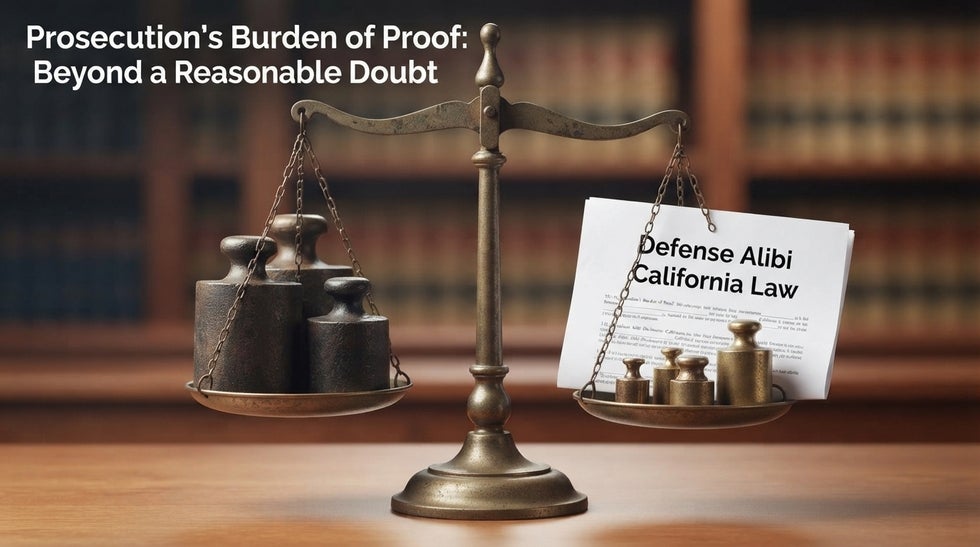
Because it attacks an element rather than excusing the act, alibi is treated differently from affirmative defenses. CALCRIM 3400 tells the jury that the People must prove the defendant committed the crime, that the defendant contends they did not and were elsewhere, and that if the jury has a reasonable doubt about whether the defendant was present when the crime was committed, it must find the defendant not guilty. The defense does not have to prove the alibi by any standard; it has to raise the doubt. The instruction also tells jurors that an alibi need not be proven to be considered, so that a partially corroborated account still counts. In practice our attorneys build an alibi as though the burden were ours, because a jury that hears a confident alibi expects it to be proven, and an alibi that falls short of the proof the jury expected can read as a lie.
Disclosure: California's version of alibi notice
Many states have an alibi-notice statute requiring the defense to declare the alibi, the place, and the witnesses within days of arraignment. California does not, but it reaches the same result through reciprocal discovery. Penal Code 1054.3 requires the defense to disclose, at least 30 days before trial, the names and addresses of all witnesses, other than the defendant, it intends to call, together with any relevant written or recorded statements of those witnesses, any reports of experts, and any real evidence it intends to offer. An alibi witness is a witness the defense intends to call, and the alibi witness's statement to the defense investigator is a statement that must be produced.
The rule cuts both ways, and the defense's rights under Penal Code 1054.1 are the mirror image: the prosecution must disclose its witnesses, their statements, the defendant's statements, all relevant real evidence, and any exculpatory evidence, which includes evidence that supports the alibi, such as surveillance footage that does not show the defendant, or a witness who described someone else. Our attorneys request that evidence specifically in alibi cases, because the prosecution's own file often contains the corroboration.
The consequences of nondisclosure are real. A court may exclude an undisclosed witness, instruct the jury on the failure to disclose, or grant a continuance to let the prosecution investigate, which gives the prosecution time to find the flaw. The strategic consequence is subtler: once the alibi is disclosed, the prosecution investigates it, interviews the witnesses, pulls the records, and arrives at trial prepared to attack it. An alibi should be disclosed when it is ready to withstand that, and not before the defense has done the same investigation itself.
What makes an alibi credible
Juries are skeptical of alibis for a simple reason: anyone can say they were elsewhere, and the witnesses are usually people who care about the defendant. An alibi becomes evidence when it is anchored to things that do not care.
The time. The alibi has to cover the actual window of the offense, which is often different from the time in the complaint. Our attorneys fix the window first, from the 911 call, the dispatch log, the surveillance timestamps, and the witness statements, before asking where the client was, because an alibi for 9 p.m. is useless if the crime happened at 10:30.
The records. Cell phone location data and tower records. Text messages and call logs. Credit and debit card transactions. Rideshare and delivery app histories. Transit card taps and toll records. Doorbell and security camera footage, from the client's home and from businesses along the route. Work time clocks, badge swipes, and job-site logs. Social media posts with location metadata. Gym check-ins. Hospital and pharmacy records. Each one is obtained by subpoena or preservation letter before it is overwritten, and our attorneys send those letters in the first week, because surveillance systems overwrite in days and carriers purge in months. The subpoena process is how most of this arrives.
The witnesses. A witness with no relationship to the defendant, a cashier, a coworker, a neighbor, a stranger at the next table, is worth several relatives. Family and partners are called too, and prepared for the cross-examination about motive that is coming, but their accounts are matched to the records before anyone testifies. Witnesses who are reluctant are a problem addressed early; our page on witnesses who refuse to testify covers the tools.
Consistency. The client's account, the witnesses' accounts, and the records must agree on the details that can be checked, and the account must have been consistent from the beginning. An alibi that appears for the first time months after arrest, after the client gave police a different story, is attacked on that basis alone, which is one more reason the client's first statement about where they were should be made to counsel and not to a detective; the right to remain silent protects the alibi as much as it protects anything else.
How the prosecution attacks an alibi
Prosecutors treat a disclosed alibi as a map. They interview every witness, looking for the one whose account differs. They subpoena the same records the defense did, looking for a gap, a transaction that places the defendant closer to the scene, a phone that was off. They argue the timeline: the crime took ten minutes, the alibi location is fifteen minutes away, and the records have a twenty-minute hole. They argue motive: every witness is a relative, a friend, or a partner. And they argue that the alibi was manufactured, which is the attack that does the most damage, because it comes with an instruction.
CALCRIM 362 tells the jury that if the defendant made a false or misleading statement relating to the charged crime, knowing it was false, the jury may consider it as evidence of consciousness of guilt. A fabricated alibi, or one the jury believes was fabricated, converts a defense into evidence for the prosecution, and a defendant who testifies to an alibi that the records contradict has done worse than remain silent. The witness who lied is exposed to perjury under Penal Code 118, and a defendant who arranged the lie to subornation of perjury under Penal Code 127. Our attorneys do not present an alibi they have not verified, and the verification sometimes produces the conversation nobody wants: the alibi does not hold, and the defense is something else.
Where the alibi is used
Before charges. An alibi presented to the investigating detective or the filing deputy, through counsel, with records attached, is the fastest way to end a case, and it happens more often than people expect in identification cases, where the police have a description and a suspect and little else. Our attorneys present it in writing, with the corroboration, without the client being interviewed.
At the preliminary hearing. Penal Code 866 allows the defense to call witnesses whose testimony would negate an element, and presence is an element. An alibi witness at the preliminary hearing, with records, has produced dismissals and has produced the prosecution's reassessment of a weak identification. It also previews the witness for the prosecution, which is the trade-off.
At trial. The alibi is presented through the witnesses and the records, the defendant's testimony is a separate decision made with counsel, and the argument is the reasonable doubt instruction. Alibi cases are also the ones in which identification evidence is attacked on its own terms, the lineup, the lighting, the cross-racial identification, and the two defenses reinforce each other; an alibi plus a shaky identification is a case with the markers of one that will not survive, and if it reaches a jury, it is the kind of case that produces an acquittal or a hung jury rather than a conviction. The circumstantial evidence the prosecution uses to place the defendant at the scene is evaluated against the direct evidence that places them elsewhere, and where the placement evidence came from an unlawful search or stop, the exclusionary rule removes it. For non-citizens, an alibi that ends a case ends the immigration exposure with it, which is why our attorneys treat the investigation in those cases as urgent from the first day.
Frequently asked questions
What is an alibi in legal terms?
Evidence that the defendant was somewhere else when the crime was committed, and therefore could not have committed it. The word is Latin for elsewhere. An alibi is not an excuse or a justification; it is a direct denial of the prosecution's claim that the defendant was present, and it attacks the element of identity. In California the prosecution keeps the burden of proving the defendant was there, and the defense does not have to prove the alibi true.
Does the defense have to prove an alibi?
No. Alibi is not an affirmative defense in California. The jury instruction, CALCRIM 3400, tells jurors that the prosecution must prove beyond a reasonable doubt that the defendant was present and committed the crime, and that if the alibi evidence raises a reasonable doubt about that, they must find the defendant not guilty. The defense only has to raise the doubt. In practice, the stronger the alibi evidence, the more a jury expects, so the defense builds it as if it carried the burden.
Do I have to tell the prosecution about my alibi before trial?
In California, yes, if you intend to call witnesses to prove it. Penal Code 1054.3 requires the defense to disclose the names and addresses of the witnesses it intends to call, and any statements they made, at least 30 days before trial. There is no separate alibi-notice statute as in some states, but the reciprocal discovery rule has the same effect: an alibi witness sprung at trial without disclosure can be excluded. Documents and records the defense intends to use are disclosed the same way.
Can a family member be an alibi witness?
Yes, and it is the most common alibi witness there is. Jurors discount family and partners because they have a motive to help, and prosecutors cross-examine them on that motive. A family alibi becomes persuasive when it is corroborated by something that cannot lie: a timestamped photo, a purchase, a text message, a doorbell camera, a work log, a third party who happened to be there. The witness's account should match the records before anyone testifies to it.
What happens if an alibi turns out to be false?
Two things. The jury may be instructed that a false or misleading statement by the defendant, including a fabricated alibi, can be considered as evidence of consciousness of guilt, which is often more damaging than no alibi at all. And a witness who lied under oath has committed perjury under Penal Code 118, while a person who arranged the false testimony has committed subornation of perjury under Penal Code 127, each a felony. Our attorneys verify every alibi before it is disclosed for exactly these reasons.
Related reading from our attorneys
- Nine signs a criminal case is weak
- Circumstantial vs. direct evidence
- Duress and necessity as defenses
You were somewhere else? Tell us first, and tell us everything
The Bulldog Law's defense attorneys investigate, document, and present alibi defenses in cases across California, sending preservation letters in the first week and presenting verified alibis to prosecutors before charges are filed where the evidence allows. Visit our criminal defense page, call (888) 928-1609, or reach us online.