
Updated October 2026 | The Bulldog Law | California Criminal Defense
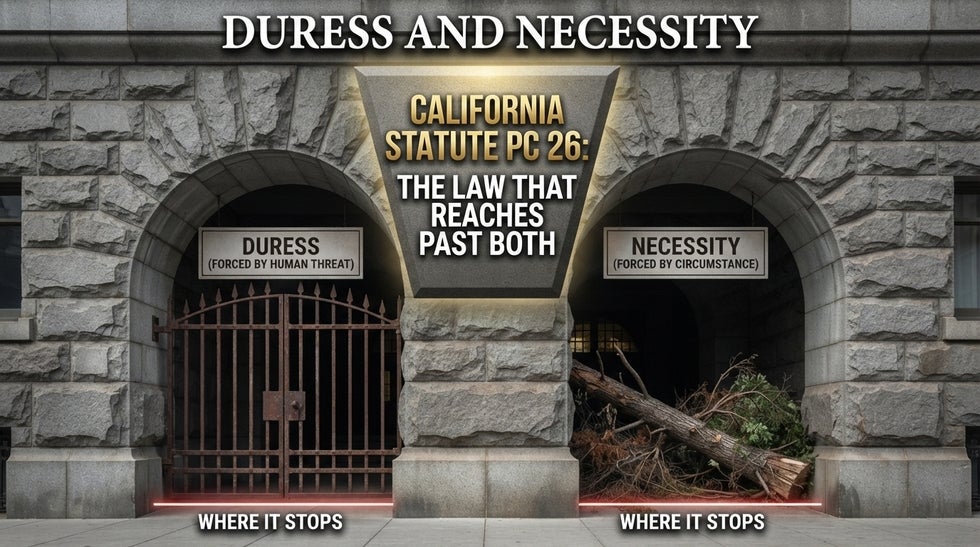
Duress is a defense for a person who committed a crime because someone threatened to kill or seriously injure them, immediately, if they refused. Penal Code 26 says such a person is not capable of committing the crime, and once the defense is raised the prosecution must disprove it beyond a reasonable doubt. It is a complete defense with two hard limits: the threat must be immediate, leaving no reasonable chance to escape or seek help, and it does not apply to murder. Necessity is the companion defense for a crime committed to prevent a greater harm from circumstances rather than from a person, a fire, an emergency, an attack on someone else, with no adequate legal alternative; the defendant must prove it by a preponderance of the evidence.
For human trafficking victims, Penal Code 236.23 creates a third defense that drops the immediacy requirement entirely.
The Bulldog Law's attorneys raise duress in cases that look nothing alike: the courier who drove a load because the people who gave it to him showed him a gun, the teenager who held the door during a gang robbery because the alternative was a beating, the woman who signed the fraudulent documents her partner put in front of her, the trafficking victim arrested for the crime she was trafficked into.
The defense is powerful where it fits and useless where it does not, and the difference is usually the word immediate. What follows is what each defense requires, where the courts have drawn the lines, and how the defenses are actually built. Call (888) 928-1609 or message our team if you were forced into the conduct you are charged with.
Duress under Penal Code 26
Penal Code 26 lists the classes of persons not capable of committing crimes, and the sixth is persons, unless the crime be punishable with death, who committed the act or made the omission charged under threats or menaces sufficient to show that they had reasonable cause to and did believe their lives would be endangered if they refused. California's jury instruction, CALCRIM 3402, turns that into elements: the defendant acted because of a threat or menace; the threat was of immediate danger to the defendant's life; a reasonable person in the defendant's position would have believed their life was in immediate danger; and the defendant actually believed it.
The instruction tells the jury that the prosecution must prove beyond a reasonable doubt that the defendant did not act under duress, which makes duress unusual among defenses: the defendant has only to raise it with some evidence, and the burden shifts.
The immediacy rule
Immediacy is where duress lives or dies. The threat must be of present, immediate harm, such that the defendant had no reasonable opportunity to escape, to refuse, or to go to the police. A threat to kill the defendant's family next month, a general atmosphere of fear in a gang, a drug supplier's reputation for violence, an abuser's history: none is immediate, and California courts have refused duress instructions on each of them. The defense is strongest for conduct committed in the threatener's presence, under a weapon, with the threat spoken and the harm minutes away, and it weakens with every hour and every mile between the threat and the act.
A person who committed a crime over days or weeks under a continuing threat generally cannot claim duress, and the ongoing-coercion cases are the reason the trafficking and intimate partner battering doctrines described below exist.
Threat to the defendant's life
The statutory language refers to the defendant's own life, and the instruction speaks of danger to the defendant. California appellate decisions have been divided on whether a threat to another person, a child, a spouse, supports duress, and some have allowed it; the safer route for threats to third parties is necessity, which expressly covers harm to others. The threat must be of death or great bodily injury.
A threat to expose a secret, to fire the defendant, or to end a relationship is coercion in the ordinary sense but not duress in the legal one; the extortion statutes punish the person who made such a threat, but they do not excuse the person who yielded to it.
Reasonable belief, and the defendant's own fault
The belief in the danger must be both actual and reasonable, judged from the standpoint of a reasonable person in the defendant's situation. A person who joined a criminal enterprise knowing it used violence, and was then threatened into a crime, has a weaker claim than a stranger; courts have held that a defendant who placed themselves in a position where duress was foreseeable may be denied the defense. The point is argued most often in gang and drug organization cases, and it cuts hardest against the defendant who had been a willing participant before the threat.
Where duress does not go: murder
Penal Code 26 excludes crimes punishable with death, and the California Supreme Court held in People v. Anderson in 2002 that the exclusion covers all murder, not only capital murder, and that duress does not reduce murder to manslaughter. The court's reasoning was the common law's: a person threatened with death is expected to die rather than kill an innocent, and allowing the defense would give every organized killer a way to compel accomplices. Anderson left two openings.
Duress may be relevant to whether the defendant actually premeditated and deliberated, which can reduce first-degree murder to second; and duress remains a full defense to the underlying felony in a felony murder prosecution, which after the SB 1437 reforms narrowed felony murder is a live argument for an aider who was forced into the robbery that someone else turned into a killing. Our attorneys' pages on murder prosecutions and the murder and manslaughter line cover the doctrines duress interacts with.
Necessity: pressure from circumstances
Necessity excuses a crime committed to prevent a significant harm when there was no legal way to prevent it. CALCRIM 3403 sets six elements the defendant must prove by a preponderance of the evidence: the defendant acted in an emergency to prevent a significant bodily harm or evil to themselves or someone else; there was no adequate legal alternative; the act did not create a danger greater than the one avoided; the defendant actually believed the act was necessary; a reasonable person would have believed so too; and the defendant did not substantially contribute to the emergency. The classic cases: driving on a suspended license to get a dying person to a hospital, breaking into a cabin to survive a storm, taking a car to flee an attacker, a prisoner escaping a specific and immediate threat of harm.
Three differences from duress matter in practice. Necessity covers harm to anyone, not only the defendant. It does not require that the threat come from a person. And its emergency requirement, while real, is less rigid than duress's immediacy; the question is whether a legal alternative existed, not whether the harm was seconds away. The price is the burden: the defendant proves necessity, and a jury that is unsure rules for the prosecution. Necessity is also, like duress, unavailable for murder, and it fails whenever a legal alternative, calling 911, leaving, waiting, was available; the Good Samaritan protections our attorneys describe elsewhere exist in part so that calling for help is always the legal alternative.
Beyond both: coercion over time
The immediacy rule leaves out the people most completely controlled: the trafficking victim committing the crimes she was trafficked for, the abused partner carrying out an abuser's scheme, the child soldier of a gang. California has addressed each separately.
Trafficking victims. Penal Code 236.23, enacted in 2016, creates an affirmative defense for a person who was a victim of human trafficking, as defined in Penal Code 236.1, and who committed the charged crime as a direct result of being a victim at the time. The defendant proves it by a preponderance, there is no immediacy requirement, and the defense applies to any crime except serious and violent felonies committed with a weapon or causing great bodily injury. Penal Code 236.14 lets a trafficking victim petition to vacate nonviolent convictions, prostitution and drug offenses most often, that resulted from the trafficking, and to seal the arrest records. These are the provisions our attorneys use for clients whose entire criminal history was created by a trafficker.
Abused partners. Where the person who forced the conduct was an intimate partner, the pattern of abuse and control is admissible under Evidence Code 1107 and supplies the reasonableness of the defendant's fear, extends duress's reach, and, where duress still fails on immediacy, supports the low-term sentencing presumption. Our attorneys' page on intimate partner battering explains that body of law.
Everyone else. Where neither statute applies and the threat was not immediate, the coercion is mitigation rather than defense: it is presented at sentencing, in the negotiation, and in the argument against enhancements and mandatory terms that the judge now has discretion to strike. A courier who carried drugs under a threat to his family, which is not duress, is nonetheless a courier with a far better sentencing argument than one who did it for money.
Building the defense
Duress and necessity are proven by the defendant's account, and the account has to be corroborated. The threatener's identity, their capacity to carry out the threat, the weapon, the words, the setting, the timeline that shows no opportunity to escape: our attorneys document each from witnesses, messages, phone records, injuries, and the defendant's conduct immediately afterward, which should look like a person who was frightened, not a participant.
The defense also has a cost. Raising it concedes the act; a defendant who claims duress admits committing the crime and argues excuse, so the choice between duress and a denial is made early and with care. And the account is given to counsel, not to police; the right to remain silent protects a defendant who was coerced exactly as it protects one who was not, and an explanation given at the scene, out of fear of the people who are still nearby, rarely matches the one given later.
Where the defense fits, it is a complete one, and it frequently reaches the co-defendant whose role the prosecution describes under aiding and abetting principles: the person who held the bag, drove the car, or stood by, and did so because someone with a gun told them to. Where it does not fit, the facts still belong in the case, because a prosecution built on a frightened participant's conduct is one with the weaknesses a jury notices, and because for a non-citizen the difference between a conviction and a dismissal is the difference the immigration consequences turn on.
Frequently asked questions
What does duress mean in criminal law?
Committing a crime because someone threatened to kill or seriously injure you, right then, if you didn't. California's Penal Code 26 says a person who acted under threats or menaces sufficient to show they had reasonable cause to believe their life would be endangered if they refused is not capable of committing the crime. It is a complete defense, not a reduction, and once the defense raises it the prosecution has to disprove it beyond a reasonable doubt.
Is duress a defense to murder in California?
No. Penal Code 26 excludes crimes punishable with death, and the California Supreme Court held in People v. Anderson in 2002 that duress is not a defense to any murder, and does not reduce murder to manslaughter either. The reasoning is that the law expects a person to die rather than kill an innocent. Duress can still negate the specific intent or premeditation required for first-degree murder in some circumstances, and it remains a defense to the felony that underlies a felony murder charge, which matters after SB 1437.
What is the difference between duress and necessity?
Duress is a threat from a person; necessity is pressure from circumstances. Under duress, someone forced you to commit the crime by threatening your life. Under necessity, you committed the crime to prevent a greater harm, a fire, a medical emergency, an attack on someone else, and there was no legal alternative. Duress requires an immediate threat to your own life; necessity covers threats of serious harm to anyone and allows more time. The burdens differ too: the prosecution must disprove duress, but the defendant must prove necessity by a preponderance of the evidence.
Does the threat have to be immediate for duress?
Yes. California requires that the threat be of immediate danger, such that the defendant had no time to escape or seek help. A threat to harm you next week if you don't commit the crime today is not duress, however real the threat. Courts have rejected the defense where the defendant had any reasonable opportunity to go to police or get away, which is why duress is argued most successfully for crimes committed in the abuser's or the captor's presence.
Can a human trafficking victim use duress?
California gives trafficking victims something stronger. Penal Code 236.23 creates an affirmative defense for a person who was a victim of human trafficking and committed a crime as a direct result of being trafficked, with no immediacy requirement and no exclusion for most serious crimes. It must be proven by a preponderance of the evidence. Penal Code 236.14 separately allows a trafficking victim to vacate past convictions for nonviolent offenses committed because of the trafficking. These provisions reach the coerced conduct that duress, with its immediacy rule, often does not.
Related reading from our attorneys
- Battered woman syndrome and intimate partner battering
- Aiding and abetting under Penal Code 31
- SB 1437 and felony murder resentencing
Forced into it? The defense exists, and the details decide it
The Bulldog Law's defense attorneys raise duress, necessity, and the trafficking-victim defense in drug, fraud, robbery, and homicide cases across California, and pursue Penal Code 236.14 vacatur for clients whose records were built by a trafficker. Visit our criminal defense page, call (888) 928-1609, or reach us online.