
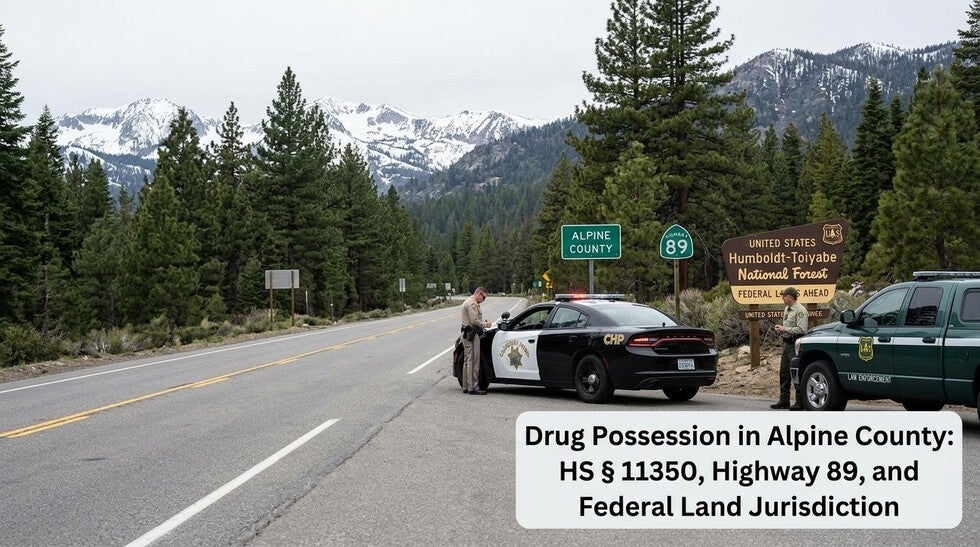
Drug Possession in Alpine County can begin with a traffic stop on Highway 89, a search near a trailhead, a seasonal worker contact near a resort, a campsite investigation, a school incident, or a law enforcement encounter on public land. Under Health and Safety Code § 11350, California generally prohibits possession of certain controlled substances without a valid prescription or legal authorization.
Alpine County cases are unusual because the county is rural, mountainous, sparsely populated, and surrounded by major recreation corridors. A drug possession case may involve state court in Markleeville, federal land questions, search-and-seizure issues, diversion eligibility, employment concerns for seasonal workers, and the practical reality of facing criminal charges in a very small community.
What Drug Possession in Alpine County means under HS § 11350
Health and Safety Code § 11350 generally applies to possession of certain controlled substances, including many narcotics and unauthorized prescription medications. After Proposition 47, simple possession for personal use is usually treated as a misdemeanor in California, although a person's record, the substance, the charge, related allegations, and federal jurisdiction issues can affect the outcome.
To prove simple possession, prosecutors generally must show:
- The accused possessed a controlled substance.
- The accused knew of its presence.
- The accused knew of its nature or character as a controlled substance.
- The substance was in a usable amount.
- The possession was not legally authorized by a valid prescription or other lawful basis.
A comparison with Imperial County drug possession under HS § 11350 shows why the same statewide statute can raise different factual issues depending on geography, law enforcement patterns, border proximity, transportation routes, and local court practice.
Drug Possession in Alpine County and Highway 89 stop challenges
Many Alpine County possession cases begin with a vehicle stop. Highway 89, Highway 4, roads near Markleeville, mountain passes, forest access routes, and resort traffic corridors can generate stops for alleged speeding, lane movement, equipment violations, expired registration, unsafe turns, or suspected impaired driving.
The stop must be lawful. Officers must have a valid basis to stop the vehicle, and they generally may not prolong a traffic stop without lawful justification. A drug case can be weakened or dismissed if the stop, detention, search, or questioning violated constitutional protections.
Defense questions include:
- What traffic violation did the officer claim?
- Does dashcam or bodycam footage match the report?
- Was the driver detained longer than necessary for the traffic issue?
- Did officers ask for consent to search, and was consent voluntary?
- Was there probable cause to search the vehicle?
- Did a passenger, backpack, console, or shared area create possession issues?
- Were statements obtained after Miranda warnings were required?
On mountain roads, lane movement, slow driving, stopping patterns, or roadside positioning may have innocent explanations tied to curves, weather, darkness, snow, gravel, wildlife, or unfamiliar terrain.
Federal land jurisdiction in Alpine County drug cases
Alpine County includes significant federal land and recreation areas. When a drug contact occurs on national forest land or another federal site, federal agencies may become involved, and federal law may apply. That does not mean every backcountry drug contact automatically becomes a federal case, but location and agency involvement must be analyzed immediately.
Federal simple possession is commonly addressed under 21 U.S.C. § 844. Federal cases can involve different procedures, different plea options, different sentencing considerations, and different collateral consequences than a California misdemeanor possession case. California's Proposition 47 framework does not control a federal prosecution.
Defense work should determine:
- The exact GPS or roadway location of the contact.
- Whether the location was federal, state, county, private, or mixed-use land.
- Which agency initiated the contact.
- Whether state officers, federal officers, or both were involved.
- Whether the case was cited into state court, federal court, or handled administratively.
- Whether the alleged conduct is simple possession, distribution, trafficking, or public-nuisance conduct.
The jurisdiction question should be resolved before assuming the case will proceed under ordinary California misdemeanor drug-possession practice.
Possession versus sales or trafficking allegations
Simple possession is different from possession for sale, transportation for sale, or drug trafficking. Prosecutors may look at quantity, packaging, scales, cash, messages, multiple substances, pay-owe sheets, weapons, prior history, and travel patterns when deciding whether to argue the case is more than personal use.
A defense to a sales upgrade may show that the evidence is consistent with personal use, shared possession, addiction, lack of knowledge, or lawful prescription use. The difference matters because sales and trafficking allegations carry far more serious consequences than HS § 11350 personal possession.
Federal exposure becomes more serious when the government alleges distribution, interstate activity, large quantities, organized conduct, or drug activity on federal land. Defense planning for federal drug trafficking charges must address search issues, quantity, intent, informants, phone evidence, money trails, and whether the government can prove more than mere possession.
Broader drug trafficking defense may also become relevant if an Alpine County stop leads to accusations involving transportation, distribution, or multi-person conduct rather than personal-use possession.
PC § 1000 diversion and small-county consequences
Some defendants charged with eligible nonviolent drug possession offenses may qualify for pretrial diversion under Penal Code § 1000. If diversion is granted and successfully completed, the case may be dismissed. Eligibility depends on the charge, prior record, current allegations, public safety concerns, and statutory requirements.
In Alpine County, the practical value of diversion can be especially important. A conviction can affect seasonal employment, resort work, guiding, hospitality, public-facing jobs, school opportunities, professional licensing, and housing. In a small community, the formal court outcome may also affect reputation even when the case is not widely publicized.
Diversion strategy should focus on:
- Eligibility under PC § 1000 or other applicable programs.
- Proof that the case is personal-use possession, not sales.
- Treatment or education needs.
- Employment and housing consequences.
- Immigration consequences for noncitizens.
- Whether federal jurisdiction limits California diversion options.
Diversion is not automatic, and completion requirements should be taken seriously. Missing classes, testing positive, failing to appear, or picking up a new case can jeopardize dismissal.
Seasonal workers, resorts, and background checks
Alpine County's population changes with recreation seasons. Ski resort employees, hospitality workers, guides, campground workers, river recreation staff, and seasonal employees may face consequences beyond court fines or probation. A drug conviction can affect background checks, housing tied to employment, professional references, and future seasonal hiring.
For a seasonal worker, the defense should evaluate whether a dismissal, diversion resolution, reduction, or non-drug disposition is possible. Even a misdemeanor can create problems if the job involves driving, guest safety, youth programs, outdoor supervision, equipment handling, or employer licensing rules.
When appropriate, defense mitigation may include proof of stable work, employer support, treatment participation, negative drug testing, school enrollment, family support, or a plan to avoid future incidents.
School and youth-related drug allegations
Drug allegations involving students, school events, school grounds, or youth activities can create additional legal and disciplinary consequences. A young person may face juvenile court, school suspension, expulsion, athletic consequences, counseling requirements, or probation conditions.
Families dealing with California school drug enforcement laws should treat the school process and the court process as connected. Statements made to administrators, school resource officers, or peers can affect later proceedings.
Important school-related defense issues include:
- Who possessed the substance.
- Whether the student knew what it was.
- Whether the search was lawful under school standards.
- Whether law enforcement was involved.
- Whether the case belongs in juvenile court, diversion, or school discipline only.
- Whether the school is seeking suspension or expulsion.
Early action can protect both the legal record and the student's education.
Drug-related public nuisance plea issues
In some lower-level drug cases, prosecutors may consider alternative dispositions that avoid a traditional controlled-substance conviction. One possibility in some counties is a drug-related public nuisance theory, depending on the facts, local practice, and whether the court accepts the negotiated resolution.
A negotiated outcome involving drug-related public nuisance plea agreements under PC § 372.5 may be considered when the facts support a non-sales, nonviolent resolution and the defense is trying to reduce the long-term harm of a drug conviction.
This type of strategy must be used carefully. Immigration consequences, licensing issues, probation terms, dismissal eligibility, and future background checks should be reviewed before any plea is entered.
How Alpine County compares with other drug possession courts
California drug possession law is statewide, but local facts matter. Alpine County cases may involve mountain-road stops, federal land questions, seasonal employment, recreation settings, and a small courthouse environment.
Larger and more urban counties can present different patterns. Sacramento County drug possession under HS § 11350 may involve urban policing, probation searches, and larger court calendars. Riverside County drug possession defense under HS § 11350 may involve desert corridors, larger jail systems, and regional task forces. Tehama County drug possession cases under HS § 11350 may involve rural highways and Northern California enforcement patterns. Long Beach drug possession defense under HS § 11350 may involve port, urban, and municipal policing issues.
An Alpine County defense should focus on the exact location, agency, search basis, substance, possession evidence, and whether state or federal law controls the case.
Where Drug Possession in Alpine County cases are handled
State drug possession cases in Alpine County are handled at the Superior Court of California, County of Alpine, located at 14777 State Route 89, Markleeville, CA 96120. Defendants should rely on official court notices, attorney instructions, and court communications for hearing dates, courtroom assignments, and appearance requirements.
A state HS § 11350 case may involve arraignment, discovery, bodycam review, lab testing, diversion eligibility review, motions to suppress, negotiations, trial readiness, and sentencing if the case does not resolve earlier. If a case proceeds federally, the court location, procedure, prosecutor, and sentencing framework may be different.
Because Alpine County has a small court system, preparation should be specific and organized. The defense should be ready to explain the stop, search, location, substance, possession theory, employment consequences, and diversion plan with evidence.
Defenses to Drug Possession in Alpine County charges
Drug possession defenses depend on the facts. A case may turn on constitutional issues, possession, knowledge, lab testing, prescription authorization, or whether the prosecution is overcharging personal-use conduct as sales or trafficking.
Potential defenses include:
- Illegal stop, detention, or search.
- No knowing possession.
- The substance belonged to someone else.
- The accused did not know the substance was present.
- The accused did not know the substance was controlled.
- The amount was not usable.
- Valid prescription or lawful authorization.
- Lab testing does not prove the charged substance.
- Statements were obtained unlawfully.
- The evidence supports diversion or reduction rather than conviction.
The defense should also evaluate immigration consequences, professional licensing, school discipline, resort employment, probation status, and whether federal land jurisdiction changes the available options.
What to do after a drug arrest in Alpine County
After a drug arrest or citation, do not explain where the substance came from, who owned it, how often you use it, or whether you planned to share it without legal advice. Statements about ownership, knowledge, and intent can become the prosecution's strongest evidence.
Important steps include:
- Invoke the right to remain silent.
- Do not consent to additional searches.
- Write down the exact stop or contact location.
- Preserve court papers, citations, and release documents.
- Identify whether the contact occurred on federal, state, county, or private land.
- Save prescription records if medication is involved.
- Preserve employment documents if a conviction could affect work.
- Appear at all court dates unless counsel confirms otherwise.
Early defense work can protect diversion eligibility, challenge unlawful searches, and prevent a minor possession allegation from becoming a larger criminal case.
Drug Possession in Alpine County lawyers in California
Drug Possession in Alpine County requires careful review of HS § 11350, Highway 89 stop evidence, search legality, federal land jurisdiction, possession proof, lab testing, diversion eligibility, seasonal employment consequences, and small-county court strategy.
Bulldog Law defends California drug possession cases involving simple possession, search challenges, diversion, federal land questions, school allegations, public nuisance resolutions, trafficking upgrades, and record-sensitive outcomes. If you or a loved one was arrested or cited for drug possession in Alpine County, legal defense should begin before statements are made, deadlines pass, or jurisdiction assumptions define the case.