
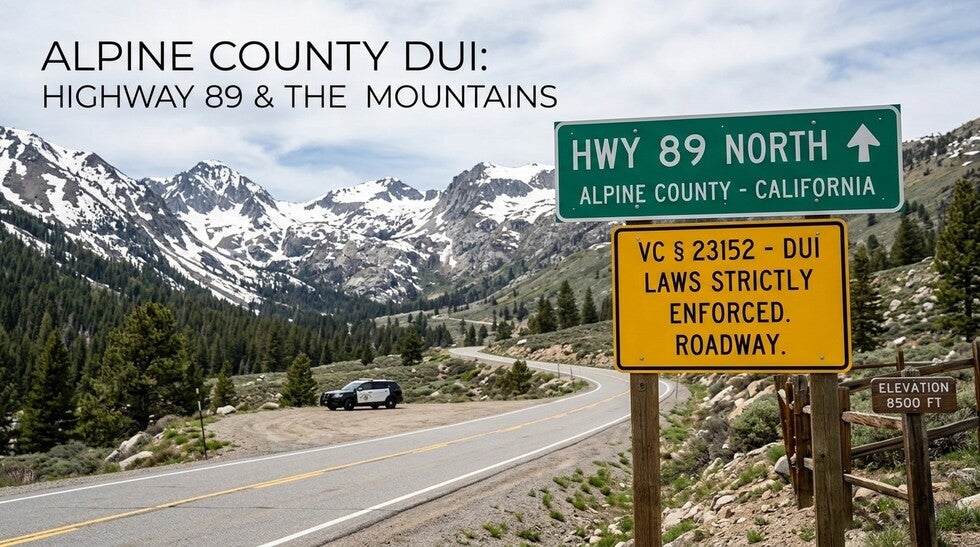
DUI in Alpine County is different from a DUI arrest in a large urban county. Under Vehicle Code § 23152, California prosecutors may charge a driver with driving under the influence of alcohol, driving with a blood alcohol concentration of 0.08 percent or higher, driving under the influence of drugs, or driving under the combined influence of alcohol and drugs. But in Alpine County, the facts often involve mountain highways, high elevation, snow, fatigue, recreation, and a courthouse serving California's least populous county.
A stop on Highway 89, Highway 4, Monitor Pass, Ebbetts Pass, or a road near Markleeville, Kirkwood, Bear Valley, Grover Hot Springs, or the Carson River should not be treated like a flat-road DUI stop in a city. The defense must examine the driving pattern, the reason for the stop, the field sobriety test location, chemical testing, timing of alcohol absorption, altitude-related fatigue, weather, and DMV deadlines from the first day.
What DUI in Alpine County means under VC § 23152
Vehicle Code § 23152 covers several DUI theories. A person can be charged under VC § 23152(a) for driving under the influence of alcohol, even if the prosecution does not rely only on a 0.08 percent BAC. A person can be charged under VC § 23152(b) for driving with a BAC of 0.08 percent or higher. Separate subdivisions cover drugs, combined alcohol and drug influence, commercial drivers, and passenger-for-hire situations.
The prosecution may rely on:
- Driving pattern.
- Officer observations.
- Field sobriety tests.
- Preliminary alcohol screening results.
- Breath or blood chemical test results.
- Statements about drinking, medication, drugs, or timing.
- Open containers or other physical evidence.
General California DUI defense strategies still apply in Alpine County, but the facts must be evaluated through the realities of mountain driving, weather, elevation, and recreational fatigue.
DUI in Alpine County and the Highway 89 stop
Highway 89 is one of Alpine County's most important routes. It connects Markleeville with mountain recreation, Lake Tahoe routes, Monitor Pass, and roads leading toward Nevada. DUI stops may involve alleged weaving, unsafe speed, failure to maintain lane, improper turns, equipment issues, or driving too slowly for conditions.
The stop itself can be the most important issue. Officers must have a lawful basis for the traffic stop, and they must not unlawfully extend the detention beyond its proper scope. On a low-traffic mountain road, the exact reason for the stop matters because a vague claim of “poor driving” may not match dashcam footage, weather, road grade, curves, or lane markings.
Defense questions include:
- What Vehicle Code violation did the officer claim?
- Did the video show the same conduct described in the report?
- Were lane movements caused by snow, gravel, curves, or narrow shoulders?
- Was the stop based on a traffic violation or a general profile of late-night recreation traffic?
- How long did the officer detain the driver before beginning the DUI investigation?
- Were statements made before Miranda warnings were required?
If the stop, detention, or arrest was unlawful, the defense may seek suppression of evidence.
Elevation, fatigue, and field sobriety tests
Alpine County DUI investigations often happen at elevations far above sea level. Markleeville sits in the Sierra Nevada, and routes around Kirkwood, Monitor Pass, and Ebbetts Pass can involve higher elevation, cold weather, dark roads, uneven shoulders, snow, gravel, and steep grades. Those conditions can affect how field sobriety tests look and how officers interpret balance, coordination, speech, and fatigue.
Field sobriety tests were not designed for every surface or every physical condition. A walk-and-turn or one-leg-stand on a sloped shoulder, loose gravel, snow-packed roadside, or poorly lit mountain turnout may produce clues that have little to do with alcohol impairment.
Important defense issues include:
- Surface slope and stability.
- Lighting and weather.
- Footwear and clothing.
- Fatigue from skiing, hiking, rafting, fishing, or camping.
- Dehydration or altitude effects.
- Medical conditions, injuries, or age.
- Officer instructions and test standardization.
The defense should compare the officer's report with video, photos, weather data, and the driver's physical condition that day. A person who looks tired after a long ski day or river trip is not automatically impaired within the meaning of VC § 23152.
Rising BAC after ski lodges, hot springs, and river recreation
Timing can matter in Alpine County DUI cases. A person may drink after skiing, hiking, rafting, soaking at hot springs, or spending the day outdoors, then be stopped shortly after leaving. Alcohol may still be absorbing during the drive, meaning a later breath or blood test may not accurately reflect BAC at the time of driving.
A rising BAC defense depends on the facts. The defense must reconstruct the timeline of drinking, food, physical activity, driving, stop, arrest, and chemical testing. The argument is stronger when the test occurs after driving and when the drinking timeline supports continued absorption.
Helpful evidence includes:
- Receipts from restaurants, lodges, or stores.
- Witnesses who observed drinking times.
- Food and water intake.
- Activity level before driving.
- Time of departure and stop.
- Time of breath or blood test.
- Body weight, sex, and relevant medical factors.
When appropriate, a forensic toxicologist can evaluate whether the test result overstates the BAC at the time of driving.
Chemical testing and refusal allegations
Breath and blood tests are not immune from challenge. A breath machine must be maintained and used properly. A blood sample must be collected, stored, transported, and tested correctly. Drug DUI cases may require toxicology interpretation because the presence of a substance does not always prove impairment at the time of driving.
Refusal allegations can create separate consequences. A driver accused of refusing a chemical test may face enhanced penalties and license issues, but the defense should examine the advisement, the driver's understanding, language barriers, injury, confusion, medical condition, and whether the officer followed required procedures. Chemical test refusal defense can be especially important after mountain collisions or cold-weather stops where confusion and stress are real factors.
The defense should obtain calibration records, maintenance logs, blood draw documentation, lab reports, bodycam footage, and the exact refusal admonition given by the officer.
DMV deadlines, license suspension, and DUI programs
A DUI arrest can trigger a DMV administrative process separate from the criminal case. The driver generally has only 10 days to request a DMV hearing after receiving notice of administrative suspension. Missing that deadline can lead to license consequences before the court case is resolved.
License consequences may involve suspension, restricted license eligibility, ignition interlock device requirements, proof of insurance, and alcohol education programs. DUI program requirements and DMV compliance often become central for Alpine County drivers because transportation options are limited and losing a license can affect work, family, medical care, and court compliance.
For a person already on DUI probation, the rules are stricter. A driver on DUI probation who faces the VC § 23154 0.01 percent probation rule may face a violation even when the new facts do not look like a standard DUI case.
DUI diversion and realistic alternatives
DUI diversion has been heavily litigated in California, and standard misdemeanor DUI diversion is generally unavailable in most cases under current appellate authority. That does not mean every DUI case must end in the harshest possible outcome. Reduction, dismissal after suppression, negotiated terms, treatment, DMV strategy, and charge-specific defenses may still matter.
Defense planning around DUI diversion in California should be realistic and court-specific. In Alpine County, a strong defense may focus on the stop, field sobriety test reliability, chemical testing, rising BAC, weather, road conditions, or a negotiated outcome that protects driving privileges and employment.
When a DUI becomes more serious
Most VC § 23152 cases are misdemeanor DUI cases. However, DUI exposure can become more serious if someone is injured, if there are multiple prior DUI convictions, if the driver has a prior felony DUI, or if the case involves probation violations, refusal allegations, children in the car, or high BAC allegations.
A collision with injury may move the case toward DUI with injury under VC § 23153, where causation and bodily injury become major issues. When prior convictions are alleged, fourth DUI charges under VC § 23550 and prior felony DUI enhancements under VC § 23550.5 can change punishment exposure. If injury and prior convictions are combined, DUI causing injury with prior convictions under VC § 23560 may become part of the sentencing analysis.
The defense should verify every alleged prior. Court records, plea forms, dates, out-of-state convictions, wet reckless dispositions, and constitutional validity can all affect whether a prior conviction lawfully increases exposure.
How Alpine County differs from other DUI courts
Alpine County DUI cases are shaped by local geography, weather, elevation, and a very small court system. That does not change the elements of VC § 23152, but it changes how facts should be investigated and presented.
By comparison, Solano County felony DUI cases under VC § 23153 may involve freeway traffic, Bay Area commuter routes, and different collision patterns. Yolo County felony DUI defense under VC § 23153 may involve university-town issues, agricultural roads, and larger regional enforcement patterns.
Alpine County defense should focus on the actual facts: highway grade, snow, lighting, shoulder condition, elevation, fatigue, timing, and whether the officer's report matches objective evidence.
Where DUI in Alpine County cases are handled
DUI cases in Alpine County are handled at the Superior Court of California, County of Alpine, located at 14777 State Route 89, Markleeville, CA 96120. Drivers should rely on court notices, attorney instructions, and official court communications for exact hearing dates, courtroom assignments, and appearance requirements.
A DUI case may involve arraignment, DMV hearing, discovery, bodycam review, chemical test records, motion practice, negotiations, trial readiness, and sentencing. In a small county, detailed preparation can matter because the court may be familiar with local roads, weather patterns, and recurring enforcement locations.
Defendants should not assume the case will disappear because Alpine County is small. A DUI conviction can still create statewide DMV consequences, insurance problems, probation terms, fines, DUI school, ignition interlock issues, and future enhancement risk.
What to do after a DUI arrest in Alpine County
After a DUI arrest, do not explain drinking, medication, fatigue, skiing, driving, or test decisions without legal advice. Statements made to officers, DMV personnel, or prosecutors can become evidence.
Important steps include:
- Request the DMV hearing within the required 10-day window.
- Write down the exact route, stop location, weather, lighting, and road conditions.
- Document skiing, hiking, river activity, hot springs use, fatigue, food, and water intake.
- Preserve receipts, photos, videos, and witness names.
- Save medical information that may explain balance, speech, or appearance.
- Identify whether the field sobriety tests were done on slope, gravel, snow, or uneven shoulder.
- Do not delete texts, location history, or ride records.
- Appear at all court dates unless counsel confirms otherwise.
Early evidence collection can make the difference between a generic DUI report and a defense built around what actually happened in Alpine County.
DUI in Alpine County lawyers in California
DUI in Alpine County cases require careful review of VC § 23152, Highway 89 and Highway 4 stop evidence, high-elevation field sobriety conditions, chemical testing, refusal allegations, rising BAC, DMV deadlines, DUI program requirements, and prior conviction risk.
Bulldog Law defends California DUI cases with attention to traffic stops, mountain-road facts, blood and breath testing, DMV hearings, refusal allegations, probation violations, injury escalation, and courtroom strategy. If you or a loved one was arrested for DUI in Alpine County, the defense should begin before DMV deadlines pass, video disappears, or the officer's report becomes the only version of the facts.