
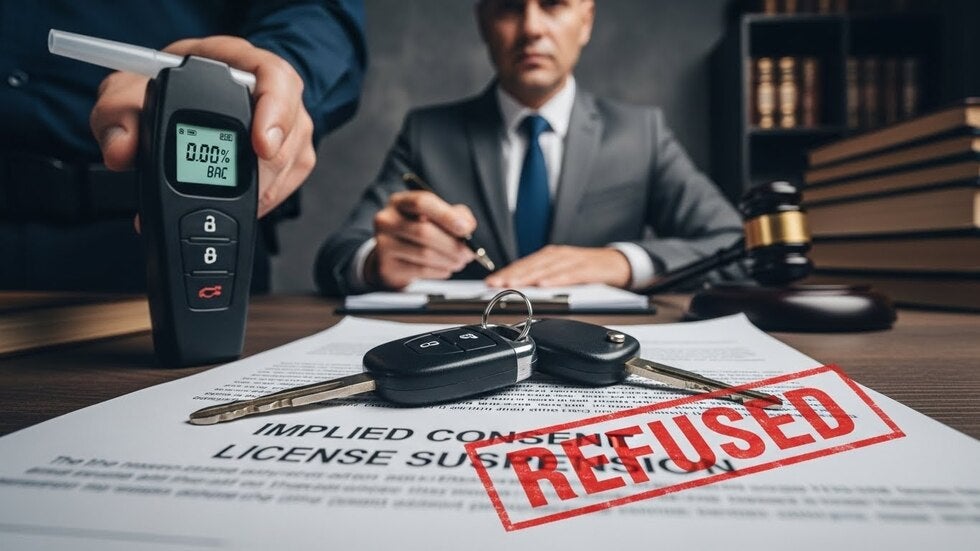
Refusing a chemical test during a DUI arrest can feel like the right decision in the moment, but California's implied consent law creates severe administrative penalties that can devastate your driving privileges even if you're never convicted of DUI. The automatic license suspension for test refusal operates independently of any criminal proceedings, meaning you face two separate battles: one in criminal court and another with the Department of Motor Vehicles.
As DUI defense attorneys who regularly handle refusal cases, we understand that the decision to refuse testing often stems from fear, confusion, or misunderstanding about your rights during a DUI arrest. Unfortunately, California's implied consent law is unforgiving, and the consequences of refusal can be more severe than the penalties for taking the test and failing.
The reality is that California's implied consent system is designed to pressure drivers into providing evidence against themselves, while simultaneously punishing those who exercise what they believe are their constitutional rights. Understanding how this system works and your potential defenses is crucial for anyone facing refusal penalties.
Understanding California's Implied Consent Law
California Vehicle Code Section 13353 operates on the legal fiction that by driving on California roads, you've given "implied consent" to chemical testing if lawfully arrested for DUI. This implied consent theory allows the state to impose administrative penalties for test refusal without the due process protections required in criminal proceedings.
The Foundation of Implied Consent
The implied consent law represents a significant erosion of traditional Fourth Amendment protections against unreasonable searches. By linking the privilege of driving to consent for chemical testing, California has created a system where exercising your constitutional right to refuse searches results in immediate punishment.
This system creates a coercive environment where drivers must choose between providing evidence that could lead to criminal conviction or facing automatic license suspension. For many people, this choice occurs during the most stressful moments of their lives, when clear thinking and legal analysis are nearly impossible.
Key aspects of implied consent:
- Consent is deemed given automatically upon driving in California
- Refusal triggers immediate administrative penalties
- Penalties operate independently of criminal proceedings
- Constitutional protections are significantly limited
Types of Chemical Tests and Refusal Scenarios
California law requires drivers to submit to blood, breath, or urine testing when lawfully arrested for DUI. The choice of test method typically belongs to the arresting officer, though drivers may request a specific type of test in certain circumstances.
Understanding what constitutes "refusal" under California law is crucial because the definition extends beyond explicitly saying "no" to include passive resistance, failure to provide adequate samples, or attempting to delay testing beyond reasonable timeframes.
Scenarios that constitute refusal:
- Explicitly declining to take any chemical test
- Failing to provide adequate breath samples after proper instruction
- Attempting to condition testing on speaking with an attorney first
- Delaying testing without reasonable justification
- Taking some tests but refusing others when multiple tests are requested
The Escalating Penalties for Chemical Test Refusal
California's refusal penalties increase dramatically with each subsequent violation, creating a system where repeat refusals can result in license revocations lasting several years. These penalties apply regardless of whether you're ultimately convicted of the underlying DUI charge.
First-Time Refusal Penalties
For drivers with no prior DUI-related violations, refusing a chemical test results in a one-year license suspension. This suspension begins immediately and cannot be reduced through restricted license programs that might be available for DUI convictions.
The one-year suspension for first-time refusal often exceeds the penalties that would apply if you had taken the test and failed. This harsh penalty structure is designed to discourage refusals and ensure maximum evidence collection for DUI prosecutions.
First refusal consequences:
- One-year license suspension with no restricted license eligibility
- Suspension begins immediately upon DMV determination
- Independent of any criminal court proceedings
- No credit for time served if later convicted of DUI
Enhanced Penalties for Repeat Offenders
Drivers with prior DUI-related violations face increasingly severe penalties for chemical test refusal. The lookback period for determining prior violations extends ten years, meaning that old convictions can still trigger enhanced refusal penalties.
Second refusals typically result in two-year license revocations, while third and subsequent refusals can lead to three-year revocations. These extended periods can create severe hardship for individuals who depend on driving for employment or family obligations.
Repeat refusal penalties:
- Second refusal: Two-year license revocation
- Third refusal: Three-year license revocation
- Ten-year lookback period for determining priors
- No restricted license eligibility during revocation periods
Recognition of Out-of-State Convictions
California's implied consent law recognizes prior DUI-related convictions from other states when determining appropriate refusal penalties. This means that drivers with out-of-state DUI history face enhanced penalties even if their prior violations occurred decades ago or in states with different legal standards.
The interstate recognition of prior convictions creates particular challenges for drivers who may not realize that old out-of-state cases still affect their California driving privileges. This can result in unexpectedly severe penalties for individuals who believed their driving record was clean.
Procedural Requirements and Due Process Protections
While California's implied consent law creates harsh penalties for test refusal, it also includes specific procedural requirements that create opportunities for challenging refusal determinations when officers fail to follow proper procedures.
The Admonition Requirement
California law requires arresting officers to inform drivers of the consequences of refusing chemical testing before requesting test submission. This admonition must include specific information about license suspension penalties and must be delivered in a manner that ensures driver understanding.
The admonition requirement serves as a crucial due process protection because it ensures that drivers make informed decisions about test submission. When officers fail to provide proper admonitions or provide incomplete or misleading information, refusal determinations may be invalid.
Required admonition elements:
- Clear explanation of license suspension consequences
- Information about the duration of suspension for refusal
- Notice that refusal will be used against the driver in court
- Explanation that suspension occurs regardless of criminal case outcome
Timing and Circumstances of the Admonition
The timing and circumstances of the admonition can significantly impact its validity. Officers must provide the warning at appropriate times and under circumstances that allow drivers to understand and process the information being provided.
Admonitions given during medical emergencies, when drivers are unconscious or severely impaired, or in other circumstances that prevent understanding may not satisfy due process requirements. Additionally, rushed or incomplete warnings may invalidate subsequent refusal determinations.
The "Change of Mind" Rule
California law establishes that once a driver refuses chemical testing, subsequent agreement to take tests doesn't cure the initial refusal. This "change of mind" rule means that officers are not required to administer tests after initial refusal, even if drivers reconsider their decision.
This rule creates strategic implications for both drivers and defense attorneys because it means that hesitation or initial reluctance can be interpreted as refusal even if drivers ultimately agree to testing. Understanding this rule helps drivers make more informed decisions during DUI arrests.
Defense Strategies for Chemical Test Refusal Cases
Despite the harsh penalties associated with test refusal, experienced DUI attorneys can often identify defenses that challenge refusal determinations or mitigate their consequences. These defenses typically focus on procedural violations, constitutional issues, or factual disputes about what actually occurred during the arrest.
Challenging the Adequacy of Admonitions
One of the most effective defenses against refusal penalties involves challenging whether officers provided adequate admonitions about the consequences of test refusal. Courts have held that incomplete, misleading, or untimely warnings can invalidate refusal determinations.
Defense attorneys must carefully review the circumstances surrounding admonitions, including the exact language used, the timing of warnings, and whether drivers were in a condition to understand the information being provided.
Admonition challenges include:
- Proving that warnings were incomplete or misleading
- Demonstrating that circumstances prevented driver understanding
- Showing that officers failed to allow adequate time for decision-making
- Establishing that language barriers prevented comprehension
Disputing the Refusal Determination
Not every failure to complete chemical testing constitutes legal "refusal" under California law. Defense attorneys can challenge refusal determinations by demonstrating that drivers attempted to comply with testing requests but were prevented from doing so by circumstances beyond their control.
Medical conditions, equipment malfunctions, or officer errors can prevent successful test completion without constituting refusal. When these circumstances can be documented, refusal penalties may be inappropriate.
Refusal determination challenges:
- Medical conditions preventing test completion
- Equipment malfunctions or calibration issues
- Officer errors in test administration
- Circumstances beyond driver control that prevented testing
Constitutional Challenges to Implied Consent
The implied consent system raises various constitutional issues that create opportunities for challenging refusal penalties. These challenges often focus on the coercive nature of the choice between test submission and license suspension.
Recent Supreme Court decisions have strengthened constitutional protections against compelled evidence production, creating new opportunities for challenging implied consent penalties. While these challenges face significant legal hurdles, they represent important developments in protecting driver rights.
The DMV Administrative Hearing Process
Drivers facing refusal penalties have the right to request administrative hearings to challenge DMV determinations. These hearings provide opportunities to present evidence and arguments against license suspension, though the process heavily favors the DMV.
Requesting and Preparing for DMV Hearings
The DMV hearing request must be made within ten days of arrest, and failure to meet this deadline results in automatic license suspension. This tight deadline creates pressure for immediate action and often catches drivers off guard when they're dealing with the stress of DUI arrests.
Preparing for DMV hearings requires careful analysis of arrest reports, officer testimony, and physical evidence related to the refusal determination. Experienced attorneys can identify weaknesses in the DMV's case and present effective challenges to refusal findings.
DMV hearing preparation includes:
- Reviewing arrest reports and officer statements
- Analyzing video evidence from the arrest
- Identifying procedural violations or constitutional issues
- Preparing witness testimony and expert evidence
The Limited Scope of DMV Hearings
DMV administrative hearings focus on narrow legal questions about whether proper procedures were followed during the arrest and test refusal. These hearings don't address the underlying DUI charges or broader questions about driver impairment.
Understanding the limited scope of DMV hearings helps set realistic expectations about potential outcomes and allows defense attorneys to focus on the most effective arguments for challenging refusal determinations.
Coordinating DMV and Criminal Defense Strategies
Refusal cases involve both DMV administrative proceedings and criminal court cases that require careful coordination to avoid creating conflicts between defense strategies. Information disclosed in DMV hearings can potentially be used in criminal proceedings, creating strategic considerations about how aggressively to challenge refusal determinations.
Experienced DUI attorneys understand how to coordinate these parallel proceedings to maximize defense effectiveness while minimizing risks to clients in either forum.
Strategic Considerations for Refusal Cases
Chemical test refusal cases present unique strategic challenges that require careful analysis of both the immediate consequences and long-term implications of different defense approaches.
Evaluating the Strength of the Underlying DUI Case
The decision about how aggressively to challenge refusal penalties often depends on the strength of the underlying DUI prosecution. When criminal cases are weak, focusing resources on defeating DUI charges may be more effective than fighting refusal penalties.
Conversely, when DUI convictions seem likely, challenging refusal penalties becomes more important because these administrative sanctions operate independently of criminal court outcomes.
Considering Plea Negotiation Opportunities
Refusal cases sometimes create unique plea negotiation opportunities because prosecutors may be willing to reduce charges in exchange for avoiding trials where refusal evidence might be excluded or minimized.
Understanding how refusal evidence impacts criminal trials allows defense attorneys to develop more effective negotiation strategies that consider both administrative and criminal consequences.
Long-Term Licensing and Insurance Implications
The long-term consequences of refusal penalties extend beyond immediate license suspension to include increased insurance costs, SR-22 requirements, and potential impacts on future DUI penalties if subsequent violations occur.
Effective refusal defense must consider these long-term implications when developing strategies and advising clients about their options.
Protecting Your Driving Privileges After Test Refusal
Chemical test refusal creates immediate and long-term challenges for your driving privileges that require experienced legal representation to navigate effectively. The complex interaction between administrative penalties, criminal charges, and constitutional protections demands sophisticated defense strategies.
Understanding your rights and options after test refusal is crucial for minimizing the impact on your life and livelihood. While California's implied consent law creates harsh penalties for refusal, experienced defense attorneys can often identify opportunities to challenge these determinations or mitigate their consequences.
The ten-day deadline for requesting DMV hearings makes immediate action essential when facing refusal penalties. Delaying legal consultation can result in missed opportunities to challenge license suspension and protect your driving privileges.
If you've refused chemical testing during a DUI arrest, contact our experienced DUI defense team immediately to discuss your options and protect your rights. We understand the complex requirements of California's implied consent law and can help you navigate both DMV administrative proceedings and criminal court cases.
Don't let a moment of confusion or fear during a DUI arrest result in years of license suspension and related hardships. Experienced legal representation can make the difference between devastating long-term consequences and manageable outcomes that allow you to move forward with your life.
For comprehensive information about DUI defense strategies and implied consent law developments, visit our legal blog at https://www.thebulldog.law/ where we regularly analyze court decisions and legislative changes that could affect your refusal case defense.