
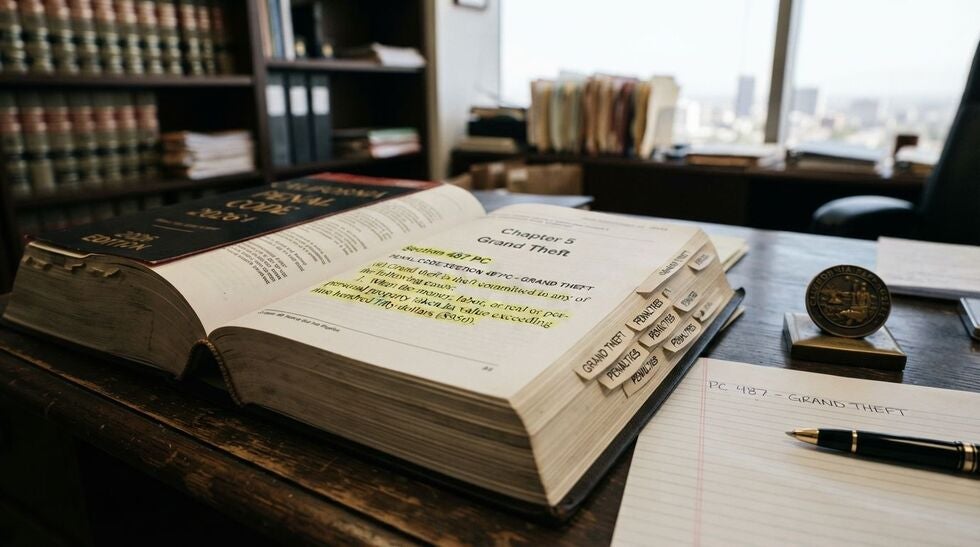
California Penal Code 487 PC defines grand theft as unlawfully taking money, labor, or property worth more than $950, or, regardless of value, taking a firearm, an automobile, or property directly from another person. Grand theft is a wobbler: as a misdemeanor it carries up to 1 year in county jail, and as a felony it carries 16 months, 2, or 3 years. Since Proposition 36 (2024), prosecutors can also combine multiple smaller thefts to reach the $950 threshold.
If you have been arrested or are under investigation for grand theft anywhere in California, contact the criminal defense attorneys at The Bulldog Law for a free, confidential consultation. Many grand theft cases can be reduced to misdemeanors or defeated outright on valuation and intent.
What Counts as Grand Theft Under PC 487?
Theft crosses from petty theft into grand theft in any of these situations:
|
Category |
Rule |
|
Value over $950 (PC 487(a)) |
The default rule, money, labor, or property worth more than $950. At or below $950 the crime is petty theft (PC 490.2) |
|
Farm and sea products (PC 487(b)) |
Crops such as fruits, vegetables, nuts, and avocados worth more than $250; aquacultural products over $250 taken from a commercial fishery |
|
Employee theft (PC 487(b)(3)) |
Theft from an employer totaling $950 or more over any 12-month period, small takings add up |
|
Theft from the person (PC 487(c)) |
Any value. Pickpocketing or taking property carried on someone's body or in their immediate physical possession |
|
Automobiles and firearms (PC 487(d)) |
Grand theft auto and grand theft firearm apply regardless of the item's value, a $100 gun is still grand theft |
For a full overview of how California classifies and prosecutes theft offenses, The Bulldog Law's theft crimes defense page covers the complete range of charges from petty theft through organized retail theft.
The Four Forms of Theft
Grand theft can be committed in four legally distinct ways, and prosecutors must prove the elements of whichever theory they charge:
Theft by larceny, Physically taking and carrying away someone else's property without consent, intending to deprive them of it permanently or for long enough to take a major portion of its value (CALCRIM 1800). Most shoplifting-style cases fall here.
Theft by false pretenses, Deceiving an owner with a knowingly false representation so they hand over ownership of money or property in reliance on the lie.
Theft by trick, Using fraud or deceit to obtain possession (but not ownership) of property the owner never intended to part with permanently.
Theft by embezzlement, Being entrusted with property as an employee, agent, or fiduciary and fraudulently converting it to your own use, even if you intended to return it (see PC 503). The Bulldog Law's embezzlement defense page explains how these cases are built and how they are defended. For additional background, the Bulldog Law blog's piece on embezzlement as the misappropriation of legally obtained funds explains what sets embezzlement apart from other forms of theft.
Across every theory, the two battlegrounds are the same: intent to steal and the value of what was allegedly taken.
Penalties for Grand Theft in California (2026)
|
Conviction |
Punishment |
|
Grand theft (misdemeanor) |
Up to 1 year in county jail and/or fine; summary probation common |
|
Grand theft (felony) |
16 months, 2, or 3 years in county jail under PC 1170(h); felony probation possible |
|
Grand theft firearm (always a felony) |
16 months, 2, or 3 years in state prison; a serious felony and a strike under the Three Strikes Law |
Whether a wobbler is filed as a felony or misdemeanor turns on the value taken, the sophistication of the conduct, and your record. Restitution to the victim is ordered in virtually every case.
New Enhancements After Proposition 36 and AB 1960
Two 2024 laws, Proposition 36 and Assembly Bill 1960, significantly raised the stakes in higher-value and group theft cases:
Excessive-takings enhancement (PC 12022.6, restored effective 2025): Adds 1 year for losses over $50,000, 2 years over $200,000, 3 years over $1 million, and 4 years over $3 million.
Acting with accomplices (PC 12022.65): Committing theft together with two or more other people adds 1, 2, or 3 years, aimed at "smash-and-grab" and organized retail theft.
Repeat petty theft (PC 666.1): A third theft-related offense can now be charged as a felony carrying up to 3 years, even if the new taking was under $950.
Aggregation: How Small Thefts Become Grand Theft
Before Proposition 36, combining separate takings to reach $950 was governed by the judge-made Bailey doctrine and was often hard for prosecutors to use. New Penal Code 487(e) and 490.3 changed that. Prosecutors may now aggregate the value of distinct but related thefts, including thefts against multiple victims and thefts committed in different counties, into a single grand theft count when the acts are motivated by "one intention, one general impulse, and one plan." Evidence of a common plan can include acts that are substantially similar in nature or occur within a 90-day period.
The practical effect: a series of sub-$950 shoplifting incidents that once meant only misdemeanor exposure can now be packaged into a felony grand theft charge. Challenging whether the takings truly share one plan, rather than being separate, impulsive acts, has become one of the most important defense fights in California theft cases.
Legal Defenses to Grand Theft Charges
The value was $950 or less. The threshold is fair market value at the time of the theft, not the retail sticker price. Stores routinely report full retail value for clearance, used, or damaged goods. Auditing receipts, sales data, and appraisals can push a case below $950 and force a reduction to petty theft.
No intent to steal. Theft requires the intent to permanently deprive the owner (or take a major portion of the property's value). Genuine borrowing, misunderstanding, or absent-mindedness is not theft.
Claim of right. A good-faith belief that the property was yours, even a mistaken one, negates the intent to steal.
Consent. Property taken with the owner's permission, or transferred in a legitimate transaction that later went sour, is a civil dispute, not a crime. Many grand theft cases are business or family money disagreements dressed up as criminal charges.
Improper aggregation. When prosecutors stack separate takings to reach $950 or to trigger enhancements, the defense can challenge whether the acts truly arose from one plan and impulse.
False accusation and mistaken identity. Employee-theft and fraud cases often turn on sloppy internal audits, assumptions, and office politics. Independent forensic accounting can expose the gaps. Research has shown that business theft accusations are frequently based on circumstantial conclusions, as explored in The Bulldog Law blog's study on men being more likely to be accused of stealing from businesses, a reminder of how assumptions can drive charges that don't hold up under scrutiny.
Even after conviction, relief may be available: many felony grand theft convictions can be reduced to misdemeanors under PC 17(b), older convictions for takings of $950 or less may qualify for Prop 47 resentencing under PC 1170.18, and probation-based convictions are generally expungeable under PC 1203.4.
Additional Consequences of a Conviction
Immigration: A theft conviction with a sentence of one year or more is an aggravated felony under federal immigration law, and theft is a crime involving moral turpitude, both can trigger deportation for non-citizens. Understanding the full deportation consequences of a criminal conviction before making any decisions in your case is essential if you are not a U.S. citizen.
Professional licensing: Theft is a crime of dishonesty that licensing boards treat harshly, nurses, real estate agents, contractors, accountants, and attorneys all face discipline.
Employment: A theft conviction on a background check is among the most damaging entries for future job prospects.
Firearm rights: A felony conviction, including any grand theft firearm conviction, results in a lifetime firearms ban.
Related California Theft Offenses
-
PC 484 / 488 – Petty theft ($950 or less)
-
PC 459.5 – Shoplifting
-
PC 459 – Burglary
-
PC 211 – Robbery (theft by force or fear)
-
PC 503 – Embezzlement
-
PC 496 – Receiving stolen property
-
PC 490.4 – Organized retail theft
-
Vehicle Code 10851 – Unlawful taking or driving of a vehicle ("joyriding")
Frequently Asked Questions
Is grand theft a felony in California?
It can be. Grand theft is a wobbler that prosecutors may file as a misdemeanor (up to 1 year) or a felony (16 months, 2, or 3 years). Grand theft of a firearm is always a felony, is served in state prison, and counts as a strike.
What is the felony theft amount in California?
More than $950. Theft at or below $950 is petty theft, a misdemeanor, unless the property is a firearm, the theft was from a person, or you have certain disqualifying prior convictions. Under Prop 36, related thefts can now be added together to cross the $950 line.
Can multiple small thefts be combined into grand theft?
Yes. Since Proposition 36 (2024), Penal Code 487(e) and 490.3 let prosecutors aggregate distinct but related thefts, even against different victims or in different counties, into one grand theft count if the acts share one intention, impulse, and plan.
Is stealing a gun always grand theft?
Yes. Firearm theft is grand theft regardless of the gun's value, is always a felony punishable in state prison, and qualifies as a serious felony strike.
Can grand theft charges be reduced or dismissed?
Frequently. Challenging the valuation can drop a case to petty theft; disputes that are really civil disagreements can be resolved without conviction; and many counties offer diversion or civil compromise in appropriate cases. After conviction, PC 17(b) reduction and PC 1203.4 expungement may be available.
What should I do if I'm accused of stealing from my employer?
Do not sit for a company interview or sign any statement or repayment agreement before speaking with a lawyer, loss-prevention interviews are designed to produce confessions that prosecutors later use. Contact a defense attorney immediately, ideally before charges are filed.
Charged With Grand Theft? Contact The Bulldog Law Today
Theft cases are won on the details, the real market value of the property, the paper trail behind the alleged intent, and whether the prosecution's aggregation theory actually holds together under the new laws. With Proposition 36 giving prosecutors sharper tools than they have had in a decade, the difference between a misdemeanor outcome and a felony record is bigger than ever.
The criminal defense team at The Bulldog Law defends clients across California against grand theft, embezzlement, and all theft-related charges. We audit the valuation evidence, expose civil disputes masquerading as crimes, fight improper aggregation, and pursue reductions, diversion, dismissals, and acquittals.
Call The Bulldog Law now for a free, confidential case evaluation. Available 24/7.