
Updated October 2026 | The Bulldog Law | California Theft Crimes Defense
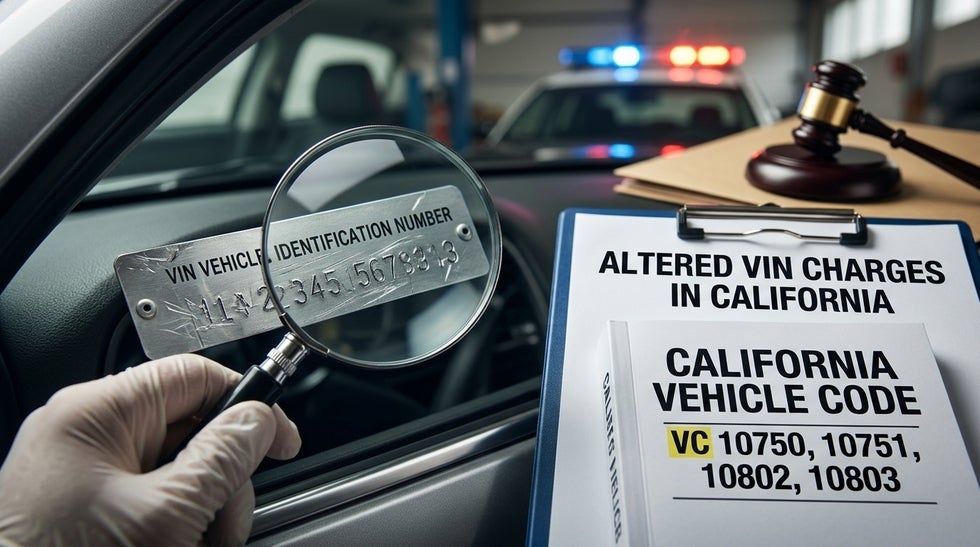
Altering a vehicle identification number is a crime in California, and the seriousness depends on why it was done. Vehicle Code 10750 makes it a misdemeanor to intentionally deface, destroy, or alter a VIN, a motor number, or any other identifying number on a vehicle or a component part, or to stamp a number the manufacturer did not assign. Vehicle Code 10751 makes it a misdemeanor to knowingly possess, sell, or transfer a vehicle or part whose number has been altered or removed, and the vehicle is subject to seizure. Vehicle Code 10802 makes it a wobbler, up to three years, to tamper with a VIN in order to misrepresent or prevent the identification of a vehicle or part for sale or transfer. Vehicle Code 10803 makes it a felony, up to six years and a $60,000 fine, to buy, possess, or transfer vehicles or parts with tampered numbers, knowingly, for sale. Federal law adds up to five years for the tampering and ten for the trafficking. Every one of these statutes requires knowledge, and knowledge is where the cases are defended.
The Bulldog Law's attorneys see VIN cases from three directions: the buyer who purchased a car or a part that turned out to have a ground-off number, the restorer or mechanic who reassembled a vehicle from parts and re-stamped something they should not have, and the client swept into a theft-ring or chop-shop investigation where VIN tampering is one count among many. The statutes treat all three the same on paper and the facts separate them. What follows is each California statute with its penalty, the lawful route for a vehicle without a valid number, how the cases are investigated, the federal statutes, the companion charges, and the defenses. Call (888) 928-1609 or message our team.
The California statutes
|
Statute |
Conduct |
Mental state |
Classification |
Penalty |
|
VC 10750(a) |
Defacing, destroying, or altering a VIN, motor number, or other distinguishing number or mark on a vehicle or component part; placing or stamping an unassigned number |
Intentional |
Misdemeanor |
Up to 6 months county jail, $1,000 fine |
|
VC 10751 |
Buying, selling, offering, receiving, or possessing a vehicle or part with a number knowingly altered, removed, or obliterated |
Knowledge |
Misdemeanor |
Up to 6 months, $1,000; vehicle or part subject to seizure and, if stolen, return to the owner |
|
VC 10802 |
Tampering with, altering, or removing a VIN for the purpose of misrepresenting or preventing identification of a vehicle or part, for sale or transfer |
Knowledge and purpose |
Wobbler |
Up to 1 year jail, or 16 months, 2, or 3 years; fine up to $25,000 |
|
VC 10803(a) |
Buying, disposing of, selling, or transferring more than one vehicle or part with tampered numbers, knowingly, with intent to sell or dispose |
Knowledge and intent |
Felony |
2, 4, or 6 years; fine up to $60,000 |
|
VC 10803(b) |
Possessing more than one vehicle or part with tampered numbers, knowingly, with intent to sell or dispose |
Knowledge and intent |
Felony |
16 months, 2, or 3 years; fine up to $30,000 |
|
VC 10801 |
Owning, operating, or conducting a chop shop |
Knowledge and intent |
Felony |
2, 3, or 4 years; fine up to $50,000 |
Vehicle Code 10750 is the base offense and covers every intentional alteration regardless of motive. It applies to the public VIN plate on the dashboard, the federal certification label on the door jamb, the confidential VINs stamped on the frame and body, the engine and transmission numbers, and the part numbers on major components, and it covers grinding, re-stamping, removing a plate, swapping a plate from another vehicle, and covering a number with a new one. The felony statutes, 10802 and 10803, add a purpose: the tampering was done to misrepresent or hide the identity of the vehicle or part so it could be sold or transferred, or the vehicles or parts were possessed or trafficked with that knowledge and intent. The difference between a six-month misdemeanor and a six-year felony is therefore not what was done to the number but what the prosecution can prove about why, and the number of vehicles or parts involved; 10803 requires more than one.
The lawful route: assigned VINs and the CHP inspection
A vehicle can lawfully receive a new number, but only from the state. A vehicle whose VIN plate was lost, destroyed, damaged, or removed, a specially constructed or homebuilt vehicle, a kit car, certain imported vehicles, and a vehicle rebuilt from salvage with missing identification are issued a California assigned VIN after an inspection by the California Highway Patrol, which verifies the vehicle's origin and the ownership of its major components, and an application to the DMV; the assigned number is affixed by or under the supervision of the CHP, and the vehicle's title reflects it. A vehicle whose public VIN has been removed but whose confidential numbers are intact can be identified and re-plated through the same process. The practical rule for restorers, builders, and mechanics is that any missing, damaged, or mismatched number is a reason to stop and call the CHP, not to fix it in the shop; a client who re-stamped a frame to match a dashboard plate, swapped a VIN plate from a donor car onto a restored body, or drilled out the rivets on a plate to repaint the dash has committed 10750 regardless of any innocent purpose, and whether the prosecution believes the purpose was innocent decides whether the charge stays a misdemeanor. Engine and transmission swaps, body panel replacements, and the use of salvage parts are all lawful so long as each component keeps its own number and the vehicle's identity is not misrepresented.
How VIN cases are investigated
VIN cases begin with a vehicle. A traffic stop, a DMV registration or title application, a CHP inspection, an insurance claim, a smog check, or a sale produces a VIN that does not match the vehicle, does not exist, belongs to a vehicle reported stolen, or shows signs of alteration, and the vehicle is seized and examined by a CHP vehicle theft investigator who checks the confidential numbers, the component numbers, and the manufacturer's records. The investigation then turns to the people: the current owner, the seller, and anyone in the chain of title, each of whom is interviewed about what they knew. A person contacted about a vehicle they own or sold should decline to be interviewed and retain counsel before responding, because the knowledge element is proved almost entirely from what the person says about the purchase, the price, the paperwork, and the condition of the numbers. Where the vehicle is one of several, where parts are found at a shop or a storage unit, or where the investigation involves a task force, the case becomes a chop shop or trafficking investigation with search warrants, surveillance, and the companion charges discussed below. The vehicle itself is evidence and may be held for the duration of the case; a stolen vehicle is returned to its owner or insurer, and an innocent buyer's remedy is against the seller.
Federal law
18 U.S.C. 511 makes it a federal felony, punishable by up to five years, to knowingly remove, obliterate, tamper with, or alter an identification number for a motor vehicle or a motor vehicle part, with exceptions for a scrap processor, a motor vehicle repair, and work done in connection with a lawful restoration or an authorized replacement of a part, and for a person who does so at the direction of a government agency. 18 U.S.C. 2321 makes it a felony punishable by up to ten years to buy, receive, possess, or obtain control of a motor vehicle or part with a tampered identification number, knowing it was tampered with, with intent to sell or dispose of it. 18 U.S.C. 2312 and 2313 cover transporting and receiving stolen vehicles across state lines. Federal charges are filed when vehicles or parts crossed a state line or the border, when the case is part of an export or trafficking ring, or when a federal task force ran the investigation, and the federal sentencing guidelines drive the sentence by the number and value of the vehicles. Our page on federal versus state charges covers how the systems divide a case.
Companion charges
A VIN count rarely travels alone. Where the vehicle was stolen, the prosecution adds receiving stolen property under Penal Code 496 or, where the defendant took it, grand theft auto under Penal Code 487(d) or unlawful taking under Vehicle Code 10851. Where title or registration documents were falsified, forgery under Penal Code 470 and Vehicle Code 4463, which covers forged registration cards, plates, and stickers, are added. Where the vehicle was insured and reported stolen by its own owner, insurance fraud under Penal Code 550 is charged. Where parts were being disassembled and stored, the chop shop statute applies. And where a dealer or a licensed dismantler is involved, the Business and Professions Code and the dismantler licensing statutes add administrative penalties and license revocation. Each companion charge has its own elements, and in many cases our attorneys' work is to separate the client's actual conduct, which may be a single 10750 misdemeanor, from the ring's conduct that the prosecution has charged across every defendant.
Defenses
Knowledge is the defense in most VIN cases. The misdemeanor statutes require intentional alteration or knowing possession, and the felony statutes require knowledge plus a purpose to misrepresent or an intent to sell. A buyer who did not know the number had been altered has committed no crime, and the evidence of knowledge is circumstantial: the price paid against market value, whether the seller was a stranger paid in cash, whether there was a title and whether it matched, whether the alteration was visible to a layperson or detectable only by a trained investigator, and what the buyer did when they learned of it. A restorer or mechanic who altered a number for a reason unrelated to misrepresentation, such as matching a replacement part, has committed the misdemeanor but not the felony, and the purpose element is where the felony is defeated. A person who possessed a single vehicle or part has not violated 10803, which requires more than one. The lawful-restoration and repair exceptions under federal law and the assigned-VIN process under state law are defenses where the client was working within them or in good faith toward them. Searches of shops, storage units, and vehicles are challenged on warrant and consent grounds, and the identification of a number as altered is contested through a defense vehicle examiner where the alteration is disputed. A 10750 or 10751 conviction is a misdemeanor eligible for diversion in many courts and for expungement after probation; a felony 10802 or 10803 conviction is a crime of dishonesty for licensing purposes and, for a non-citizen, likely a crime involving moral turpitude, which our immigration attorneys review before any plea. The negotiated outcome in a case with a real knowledge dispute is frequently a plea to 10751 or to a non-vehicle misdemeanor with the vehicle forfeited, which keeps the client's record free of the felony and the dishonesty finding.
Frequently asked questions
Is it illegal to alter a VIN number?
Yes. Vehicle Code 10750 makes it a crime to intentionally deface, destroy, or alter the vehicle identification number, the motor number, or any other distinguishing number or mark on a vehicle or a component part, or to place or stamp a number other than the one assigned by the manufacturer or the DMV. It is a misdemeanor on its own. Altering a VIN to misrepresent or hide a vehicle's identity so it can be sold or transferred is a felony under Vehicle Code 10802, and federal law makes it a felony as well under 18 U.S.C. 511.
What is the penalty for VIN tampering in California?
Simple alteration under Vehicle Code 10750 is a misdemeanor punishable by up to six months in county jail and a $1,000 fine. Knowingly possessing, selling, or transferring a vehicle or part with an altered or removed VIN under Vehicle Code 10751 is a misdemeanor and the vehicle can be seized. Tampering with a VIN to misrepresent or prevent identification for sale or transfer under Vehicle Code 10802 is a wobbler, up to one year in jail or 16 months, two, or three years, with a fine of up to $25,000. Buying, possessing, or transferring a vehicle or part with a tampered VIN with knowledge, for sale, under Vehicle Code 10803 is a felony carrying two, four, or six years and a fine of up to $60,000, or 16 months, two, or three years and $30,000 for possession for sale.
What happens if you unknowingly buy a car with an altered VIN?
Every VIN offense requires knowledge, so an innocent buyer has not committed a crime. The vehicle, however, is subject to seizure as evidence and may be forfeited or returned to its true owner or insurer if it was stolen, and the buyer is left with a civil claim against the seller. The buyer will be interviewed, and the first task is establishing good faith: the price paid, the paperwork, the seller's identity, and the absence of any sign that the VIN had been disturbed. A buyer who paid far below market value in cash to a stranger with no title faces a harder knowledge argument than one who bought from a dealer with a clean title and a CARFAX report.
Can a VIN be legally changed or replaced?
Only by the DMV or the CHP. A vehicle whose VIN plate was lost, damaged, or removed, a homebuilt or specially constructed vehicle, and certain imported and salvage vehicles receive an assigned California VIN after a CHP inspection and a DMV application, and the assigned number is stamped and plated under official supervision. Swapping an engine, a transmission, or a body panel is lawful, but the component's own number must not be altered, and a vehicle rebuilt from parts of more than one car is where most innocent restorers run into the statute. Anyone who removes or re-stamps a number themselves, for any reason, has violated Vehicle Code 10750.
Is VIN tampering a federal crime?
Yes. 18 U.S.C. 511 makes it a federal felony, punishable by up to five years, to knowingly remove, obliterate, tamper with, or alter an identification number on a motor vehicle or part, with exceptions for repairs and for authorized scrapping and restoration. 18 U.S.C. 2321 makes it a felony punishable by up to ten years to buy, receive, possess, or obtain control of a vehicle or part with a tampered identification number with intent to sell or dispose of it. Federal charges are typical when vehicles or parts crossed state lines or an international border, or when the case is part of a larger theft ring.
What is a chop shop charge?
Vehicle Code 10801 makes it a felony to knowingly and intentionally own, operate, or conduct a chop shop, meaning any place where a person alters, destroys, disassembles, dismantles, reassembles, or stores a stolen vehicle or stolen vehicle parts with the intent to sell or dispose of them, punishable by two, three, or four years and a fine of up to $50,000. VIN tampering charges under Vehicle Code 10802 and 10803 are almost always filed alongside it, and the property, tools, and vehicles on the premises are seized.
Related reading from our attorneys
- Grand theft auto under Penal Code 487(d)
- Receiving stolen property under Penal Code 496
- Unlawful taking or driving of a vehicle under Vehicle Code 10851
Vehicle seized over a VIN? What you knew is the whole case
The Bulldog Law's criminal defense attorneys handle VIN tampering, receiving, grand theft auto, and chop shop cases across California and in the federal courts, from the seizure through the knowledge defense. Visit our theft crimes page, call (888) 928-1609, or reach us online.