
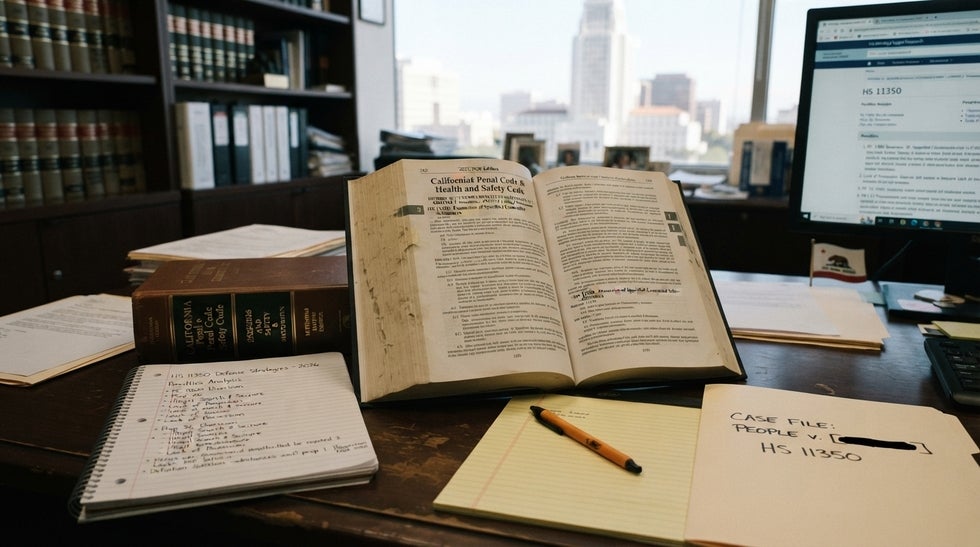
California Health & Safety Code 11350 HS makes it illegal to possess a controlled substance, such as heroin, cocaine, fentanyl, or prescription opioids without a valid prescription, for personal use. Known as simple possession, the offense is usually a misdemeanor punishable by up to 1 year in county jail and a $1,000 fine. Since Proposition 36 took effect in December 2024, people with two or more prior drug convictions can instead be charged with a treatment-mandated felony carrying up to 3 years, or a full dismissal after completing drug treatment.
If you have been arrested for drug possession anywhere in California, contact the criminal defense attorneys at The Bulldog Law for a free, confidential consultation. Many HS 11350 cases can be dismissed entirely through diversion or suppressed evidence.
What Is Health & Safety Code 11350 HS?
HS 11350 is California's simple possession statute. It applies when a person knowingly holds or controls a usable amount of a controlled substance for personal use, not for sale. The drugs covered come from the schedules in Health & Safety Code 11054 and 11055 and include both street drugs and legitimate medications possessed without a prescription.
Substances commonly charged under HS 11350 include:
|
Substance |
Category |
Notes |
|
Heroin |
Schedule I opiate derivative |
One of the most common HS 11350 charges |
|
Cocaine / crack cocaine |
Schedule I / II |
Simple possession only; possession for sale is HS 11351 |
|
Fentanyl |
Opioid |
Subject to enhanced penalties under Prop 36 (2024) |
|
Oxycodone, hydrocodone (Vicodin), codeine |
Prescription opioids |
Illegal only without a valid prescription |
|
GHB, peyote, certain hallucinogens |
Scheduled substances |
Covered by the HS 11054/11055 schedules |
Note: methamphetamine, ecstasy, and most other stimulants are charged under a separate statute, Health & Safety Code 11377, and marijuana is governed by its own laws following Proposition 64.
The Bulldog Law's drug crimes defense page covers the full range of California drug offenses, from simple possession through trafficking, and explains what to expect at each stage of these cases.
What Must the Prosecutor Prove?
Under California jury instruction CALCRIM No. 2304, a conviction for simple possession requires proof beyond a reasonable doubt of five elements:
-
Possession, You exercised control over the substance. Possession can be actual (in your pocket or hand), constructive (in a place you control, like your car, home, or backpack), or joint (shared with another person).
-
Knowledge of presence, You knew the substance was there. Drugs left in a borrowed car by someone else, without your knowledge, are not your crime.
-
Knowledge of its nature, You knew the substance was a controlled substance (though you did not need to know its exact chemical name).
-
Usable amount, The quantity was enough to be used. Trace residue or microscopic amounts generally do not qualify.
-
No valid prescription, For medications, possession is lawful with a valid prescription from a licensed physician, dentist, podiatrist, or veterinarian.
If the prosecution fails on even one element, there can be no conviction. In addition, HS 11350(d) makes it lawful to hold another person's prescription medication at that person's direction, for the sole purpose of delivering it to them or lawfully discarding it.
Penalties for HS 11350 in 2026
Proposition 47 (2014) reduced most simple possession charges to misdemeanors, but Proposition 36 (2024) restored felony exposure for repeat offenders. The current sentencing landscape looks like this:
|
Scenario |
Charge Level |
Penalty |
|
Standard simple possession (most defendants) |
Misdemeanor |
Up to 1 year county jail and/or $1,000 fine; summary probation common |
|
Prior conviction for a "super strike" (e.g., murder, certain sex crimes) or a Penal Code 290 registrable sex offense |
Felony |
16 months, 2, or 3 years county jail (PC 1170(h)) |
|
Possession of a hard drug with 2+ prior drug convictions (HS 11395, Prop 36 of 2024) |
Treatment-mandated felony (wobbler) |
Court-approved treatment with dismissal on completion, or 16 months, 2, or 3 years if treatment is refused or failed |
On a felony grant of probation, the court must also impose a minimum fine of $1,000 for a first offense or $2,000 for a repeat offense (or community service if the defendant cannot pay).
For a deeper look at the circumstances that can convert a simple possession case into a felony, The Bulldog Law blog's guide on when drug possession can be a felony offense in California explains the key factors prosecutors consider.
The 2024 Proposition 36 Update: Treatment-Mandated Felonies
Effective December 18, 2024, Proposition 36, the Homelessness, Drug Addiction, and Theft Reduction Act, created a new crime under Health & Safety Code 11395 that directly affects HS 11350 defendants. Key points:
Who it applies to: Anyone caught possessing a "hard drug", fentanyl, heroin, cocaine, cocaine base, methamphetamine, PCP, or their analogs, who has two or more prior felony or misdemeanor convictions for specified drug offenses (including HS 11350, 11351, 11352, 11377, 11378, and 11379).
No washout period: Prior convictions count no matter how old they are. Decades-old possession convictions can still trigger a felony charge today.
The treatment path: The defendant can choose treatment instead of jail by pleading guilty or no contest, admitting the priors, and agreeing to a court-approved program that may include drug treatment, mental health treatment, and job training. Successful completion results in dismissal of the charge and sealing of the arrest.
The punishment path: Refusing treatment or failing the program exposes the defendant to 16 months, 2, or 3 years in custody, with state prison possible for a second or subsequent HS 11395 conviction.
Excluded drugs: Cannabis, peyote, LSD, mescaline, and psilocybin are not "hard drugs" under HS 11395.
Prop 36 also increased penalties for fentanyl trafficking and for drug offenses committed while armed with a firearm. Because prosecutors now have discretion to file a felony where only a misdemeanor was possible before, early intervention by a defense attorney matters more than ever.
Drug Diversion: Getting HS 11350 Charges Dismissed
California law strongly favors treatment over jail for simple possession, and several programs can end a case without a conviction:
Penal Code 1000 pretrial diversion: Eligible first-time offenders enter a drug education or treatment program (typically 12 to 18 months) without pleading guilty. On successful completion, the charge is dismissed and, for most purposes, the arrest is deemed never to have occurred. HS 11350 is expressly listed as a qualifying offense. The Bulldog Law's page on California pretrial diversion programs explains eligibility and the full range of alternative sentencing options.
Proposition 36 (2000) probation (PC 1210.1): Non-violent drug possession offenders may receive probation with mandatory treatment instead of incarceration.
Drug court: A supervised, court-monitored treatment track that can also lead to dismissal. The Bulldog Law blog has an in-depth look at why the drug court process is so effective and how it compares to the standard criminal track.
Military diversion (PC 1001.80): Available to current and former members of the military suffering from service-related trauma or substance abuse.
Eligibility rules differ by program, for example, PC 1000 is generally unavailable if the current case involves violence, sales, or certain recent prior convictions. A defense attorney can identify the strongest route for your circumstances.
Legal Defenses to HS 11350 Charges
Drug possession cases are highly defensible. The strategies our attorneys use most often include:
Illegal search and seizure. The Fourth Amendment requires police to have a valid warrant, consent, or a recognized exception before searching you, your car, or your home. If officers overstepped, a motion to suppress under Penal Code 1538.5 can exclude the drugs from evidence, which usually ends the case.
The drugs were not yours. Mere proximity is not possession. Prosecutors must prove you exercised control over the substance, which is often difficult in shared cars, apartments, or borrowed bags.
Lack of knowledge. If you did not know the drugs were present, or did not know the substance was a controlled substance, an element of the crime is missing.
Valid prescription. A legitimate prescription for the medication is a complete defense, as is lawfully holding someone else's prescription to deliver or dispose of it under HS 11350(d).
Not a usable amount. Residue in a pipe or trace amounts on a surface generally cannot support a conviction.
Momentary possession. Briefly holding drugs solely to dispose of them can be a defense in limited circumstances.
Unreliable lab work or field tests. The prosecution must prove the substance actually is what they claim. Field tests are notoriously error-prone, and chain-of-custody or lab-analysis failures can be challenged.
Entrapment. If police or an informant induced you to commit a crime you were not otherwise disposed to commit, the charge can be defeated.
Additional Consequences of a Drug Possession Conviction
Immigration: Almost any controlled substance conviction can make a non-citizen deportable or inadmissible under federal law. Non-citizens should never plead guilty to a drug charge without immigration-safe advice, diversion without a plea is often the critical goal. The Bulldog Law's deportation consequences of criminal convictions page explains exactly how drug convictions are treated under federal immigration law.
Professional licenses: Doctors, nurses, pharmacists, teachers, lawyers, and other licensees may face discipline from their licensing boards.
Firearm rights: A felony conviction under HS 11350 results in a lifetime loss of gun rights; a misdemeanor conviction generally does not.
Employment and housing: Background checks can surface drug convictions to employers and landlords.
Driver's license and financial aid: Certain drug convictions can affect driving privileges in specific circumstances and eligibility for some federal student aid.
Can an HS 11350 Conviction Be Expunged?
Yes, in most cases. After successfully completing probation or the jail sentence, a defendant can petition for expungement under Penal Code 1203.4, which releases them from most penalties and disabilities of the conviction. Better still, charges resolved through PC 1000 diversion or the HS 11395 treatment path are dismissed outright, no conviction ever enters the record, and the arrest can be sealed.
Related California Drug Offenses
-
HS 11351 – Possession of a controlled substance for sale (always a felony)
-
HS 11352 – Sale or transportation of a controlled substance (always a felony)
-
HS 11377 – Possession of methamphetamine and similar stimulants
-
HS 11550 – Being under the influence of a controlled substance
-
HS 11364 – Possession of drug paraphernalia
-
HS 11395 – Treatment-mandated felony for repeat possession (Prop 36 of 2024)
-
HS 11370.1 – Possession of a controlled substance while armed with a firearm
Frequently Asked Questions
Is HS 11350 a felony or a misdemeanor?
For most people it is a misdemeanor, punishable by up to one year in county jail. It becomes a felony if the defendant has a prior conviction for a "super strike" offense or a sex crime requiring Penal Code 290 registration, or, since December 2024, if the defendant has two or more prior drug convictions and is charged under HS 11395.
Can a first-time drug possession charge be dismissed?
Very often, yes. Most first-time HS 11350 defendants qualify for Penal Code 1000 pretrial diversion: complete a treatment or education program and the charge is dismissed without a conviction. Suppression motions based on illegal searches are another common route to dismissal.
What is the new Prop 36 treatment-mandated felony?
Proposition 36 (2024) created HS 11395, which lets prosecutors charge possession of a hard drug as a felony when the defendant has two or more prior drug convictions. The defendant can choose court-supervised treatment; completing it means the charge is dismissed and the arrest sealed, while refusing or failing treatment can mean up to three years in custody.
Does HS 11350 cover methamphetamine or marijuana?
No. Methamphetamine and most stimulants are charged under HS 11377, and marijuana is regulated separately under Proposition 64. HS 11350 mainly covers opiates and opioids (heroin, fentanyl, prescription painkillers), cocaine, and certain other scheduled substances.
Will a drug possession conviction affect my immigration status?
It can. Controlled substance convictions are among the most dangerous for non-citizens and can trigger deportation or inadmissibility. Resolving the case through diversion without a guilty plea is often essential, so speak with a defense attorney before entering any plea.
What should I do after a drug possession arrest?
Stay silent, do not consent to any searches, and do not try to explain the drugs to police, statements like "it's only for personal use" are still admissions. Contact a criminal defense attorney as soon as possible so evidence, eligibility for diversion, and search issues can be evaluated early.
Arrested for Drug Possession? Contact The Bulldog Law Today
A drug charge does not have to become a conviction. With Proposition 36 now giving prosecutors the power to file felonies against repeat offenders, the stakes of even a "simple" possession case are higher than they have been in a decade.
The criminal defense team at The Bulldog Law defends clients across California against HS 11350 and all drug-related charges. We attack unlawful searches, fight for diversion and treatment outcomes that keep convictions off your record, and take cases to trial when the evidence does not hold up.
Call The Bulldog Law now for a free, confidential case evaluation. Available 24/7.