
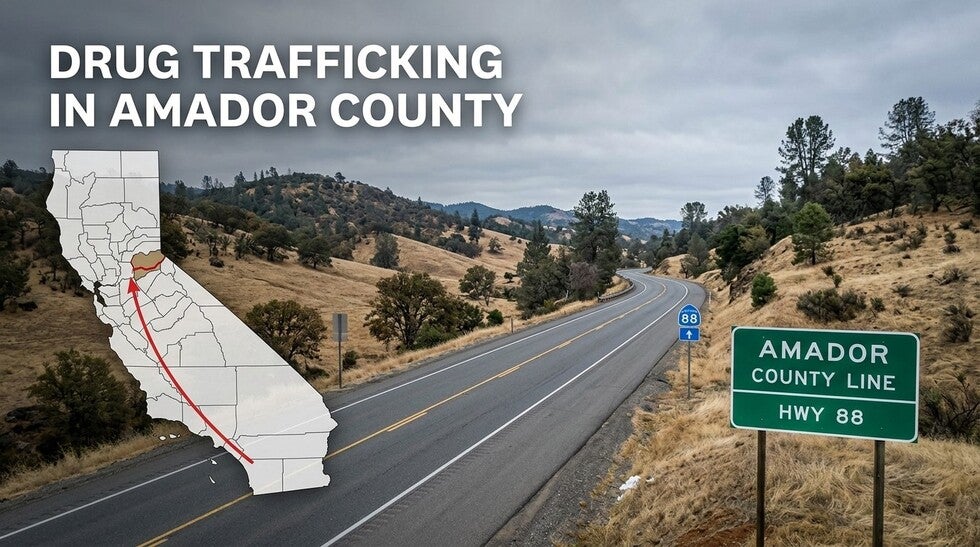
Drug Trafficking in Amador County cases often begin with a vehicle stop on Highway 88, a search in Jackson, a controlled buy, a hotel investigation, a probation search, or a package connected to a larger trafficking route. Under Health and Safety Code § 11352, California prosecutors may charge a person with selling, furnishing, administering, giving away, importing, transporting for sale, offering to do those acts, or attempting to transport or import certain controlled substances.
The word “trafficking” can be misleading because California and federal law do not always use the same terms. A state HS § 11352 case in Amador County may involve narcotics sales or transportation for sale. A federal case under 21 U.S.C. § 841 may involve manufacture, distribution, possession with intent to distribute, or a conspiracy tied to a broader network. The defense must identify which system is actually involved, what substance is alleged, what quantity is at issue, and whether the prosecution can prove intent to sell.
What Drug Trafficking in Amador County means under HS § 11352
Health and Safety Code § 11352 is one of California's main narcotics sales and transportation statutes. It can apply to substances such as heroin, cocaine, certain opiates, and some prescription narcotics. It does not cover every drug. Methamphetamine cases are usually charged under different Health and Safety Code sections, and cannabis cases are handled under California's cannabis statutes, not HS § 11352.
A felony HS § 11352 case may be based on allegations of:
- Selling a controlled substance
- Transporting a controlled substance for sale
- Importing a controlled substance into California
- Furnishing, administering, or giving away a controlled substance
- Offering or attempting to commit one of those acts
In many Amador County cases, the defense focuses on whether the evidence actually proves sales activity. Possession is not the same as possession for sale. Transportation is not enough unless the prosecution can prove transportation for sale. A person carrying drugs for personal use may still face consequences, but that is different from trafficking.
Bulldog Law's broader drug trafficking defense practice focuses on these distinctions because the label attached to the case can drive custody exposure, immigration risk, forfeiture, and federal interest.
Drug Trafficking in Amador County and Highway 88 stops
Highway 88 is a major route through Amador County, connecting the Central Valley, Jackson, Pine Grove, Pioneer, the Sierra Nevada, and routes toward Nevada. Drug cases on this corridor may begin with California Highway Patrol stops, Amador County Sheriff's investigations, Jackson Police Department activity, probation searches, or multiagency operations.
A vehicle stop case often turns on constitutional questions before it ever reaches the drug evidence. Officers need a lawful basis for the stop, detention, search, and any expansion of the traffic investigation. If the stop began as a minor traffic matter, the defense should examine why it became a drug investigation.
Important questions include:
- What exact traffic violation did the officer claim?
- Did dashcam or bodycam footage support that claim?
- Was the detention prolonged beyond the traffic purpose?
- Was consent to search voluntary or coerced?
- Was a K-9 used, and if so, when and why?
- Did officers rely on a probation, parole, or inventory search theory?
- Did the accused make statements before or after Miranda warnings were required?
If the stop or search was unlawful, the defense may file a motion to suppress. A successful suppression motion can remove the drugs, cash, phones, or statements from the case, which may leave the prosecution without enough evidence to proceed.
The federal border between HS § 11352 and 21 U.S.C. § 841
The “federal border” in an Amador County trafficking case is not always a physical border. It is the line between a local California prosecution and a federal controlled-substance case. A state case may stay in Amador County Superior Court. A federal case may move into the Eastern District of California if federal agencies, interstate activity, larger quantities, firearms, money laundering, organized distribution, overdose, or cross-state transportation are alleged.
Federal prosecutors may consider 21 U.S.C. § 841 when they believe a person knowingly or intentionally manufactured, distributed, dispensed, or possessed a controlled substance with intent to distribute. Federal penalties can depend heavily on drug type, quantity, prior convictions, death or serious bodily injury allegations, firearms, and sentencing guidelines.
Defense strategy in a federal drug case is different from a state HS § 11352 case. Bulldog Law's guide on how to beat federal drug trafficking charges explains why federal cases often require challenges to conspiracy allegations, drug weight, search warrants, confidential informants, phone evidence, and sentencing enhancements.
How Amador County cases compare with federal trafficking districts
Amador County is smaller than many California counties, but a local arrest can still connect to a larger federal theory. Investigators may allege that drugs moved from Southern California, the Central Valley, Nevada, or the Bay Area into Sierra communities. The defense should not assume a case is minor simply because the arrest happened in a rural county.
Federal drug trafficking defense varies by district, agency, and route. A case involving Los Angeles federal drug trafficking under 21 U.S.C. § 841 may focus on distribution networks, warehouses, phones, and freeway corridors. A San Diego federal trafficking case may involve border-related investigations. An Imperial County federal drug trafficking matter may involve ports, checkpoints, and importation theories. A Bakersfield federal drug trafficking case may involve Central Valley distribution, transportation, and stash-house allegations.
Amador County cases can share pieces of those patterns, but they must still be defended on their actual evidence. A Highway 88 stop is not proof of a federal conspiracy. Cash, phones, packaging, or travel are not enough unless the government can connect them to knowing drug trafficking beyond a reasonable doubt.
Sales intent, transportation for sale, and weak trafficking inferences
Prosecutors often build HS § 11352 cases from circumstantial evidence. They may argue that quantity, packaging, cash, scales, multiple phones, pay-owe records, text messages, or travel patterns show intent to sell. Those facts can matter, but each one can be challenged.
Defense issues may include:
- Quantity consistent with personal use rather than sale
- Packaging that reflects how drugs were purchased, not how they would be sold
- Cash from work, family, casino winnings, or other lawful sources
- Messages that are vague, old, joking, or unrelated
- Phones shared by multiple people
- No observed hand-to-hand sale
- No fingerprints, DNA, or reliable proof of possession
- Multiple occupants with access to the same vehicle or room
The prosecution may rely on an officer's expert opinion that the drugs were possessed for sale. The defense can challenge that opinion with facts, cross-examination, toxicology, user-pattern evidence, phone review, or a defense expert when appropriate.
Cannabis cases, rescheduling, and what HS § 11352 does not cover
Cannabis creates a separate issue. California has legalized and regulated certain cannabis activity, but unlicensed cultivation, possession for sale, transportation, distribution, or commercial activity can still lead to state charges. Those cases are not typically charged under HS § 11352. They require cannabis-specific analysis.
For comparison, Trinity County cannabis defense under HS § 11358 and HS § 11359 involves cultivation and possession-for-sale issues that differ from HS § 11352 narcotics trafficking.
Federal marijuana law has also been changing, but cautiously. Recent federal rescheduling activity has not created full federal legalization, and recreational cannabis remains legally sensitive under federal law. Cannabis businesses, transporters, investors, and defendants should not assume that California compliance eliminates federal risk. Bulldog Law's analysis of federal marijuana rescheduling and cannabis defense strategy explains why state and federal cannabis law can still diverge.
Immigration, firearms, forfeiture, and collateral consequences
Drug trafficking allegations can create consequences beyond jail or prison. Noncitizens may face serious immigration risks, especially if the case is treated as trafficking, distribution, or possession for sale. A plea that seems manageable in criminal court may create deportability, inadmissibility, or future immigration barriers.
Other collateral consequences may include:
- Asset forfeiture involving cash, vehicles, phones, or accounts
- Firearm restrictions
- Professional licensing issues
- Probation or parole violations
- Child custody and family court concerns
- Employment and background check consequences
- Federal sentencing exposure if the case is adopted federally
These issues must be evaluated before any plea. The charge title, factual basis, drug type, quantity, sentence, and record of conviction can all matter.
Where Drug Trafficking in Amador County cases are handled
State criminal cases in Amador County are handled at the Superior Court of California, County of Amador, located at 500 Argonaut Lane, Jackson, CA 95642. Defendants should rely on the court notice, attorney instructions, and official court calendar for exact hearing details.
A felony HS § 11352 case may involve arraignment, bail or release conditions, discovery, lab testing, search and seizure motions, preliminary hearing, settlement conferences, readiness proceedings, and trial. If the case becomes federal, it will proceed in federal court, usually with different discovery rules, detention hearings, indictment procedures, and sentencing guidelines.
The first court appearances can shape the case. Bail, protective conditions, search issues, phone extraction, lab delays, and informant evidence should be addressed early.
Defenses to Drug Trafficking in Amador County charges
Drug Trafficking in Amador County cases should be defended at the level of proof. The prosecution must prove the correct substance, possession or control, knowledge, intent to sell or transport for sale, and any enhancement or federal theory it alleges.
Potential defenses include:
- Illegal stop, detention, search, or seizure
- No knowledge that drugs were present
- No possession or control over the drugs
- Personal use rather than intent to sell
- Weak or unreliable informant evidence
- Entrapment or improper police pressure
- Misidentified substance or unreliable lab testing
- Unproven drug weight or mixture calculation
- No agreement to join a conspiracy
- Overcharged federal case based on a local arrest
The defense may also seek reduction to a lesser offense, exclusion of evidence, challenge to enhancements, immigration-safe alternatives where possible, or a resolution that avoids the most damaging consequences.
What to do after a drug trafficking arrest in Amador County
After an arrest, do not explain the drugs, travel route, cash, phone messages, or other people involved. Statements made at the roadside or in the jail can become the government's strongest evidence. A person who tries to minimize their role may accidentally admit knowledge, possession, or participation in a larger case.
Important steps include:
- Invoke the right to remain silent and ask for a lawyer.
- Do not consent to searches of vehicles, homes, phones, or storage units.
- Preserve pay records, travel records, prescriptions, and lawful cash-source documents.
- Do not delete messages, apps, photos, or call logs.
- Write down the stated reason for any Highway 88 stop.
- Identify passengers, witnesses, and possible surveillance locations.
- For noncitizens, get immigration-aware defense advice before any plea.
- If federal agents contact you, do not speak without counsel.
Early defense work can determine whether the case stays local, whether evidence is suppressed, whether sales intent is weakened, and whether federal exposure can be avoided or limited.
Drug Trafficking in Amador County lawyers in California
Drug Trafficking in Amador County cases require careful review of HS § 11352, Highway 88 stop evidence, sales-intent allegations, drug lab results, phone data, informant claims, federal adoption risk, and collateral consequences. A trafficking label should never be accepted without testing the evidence.
Bulldog Law defends serious California and federal drug cases with attention to search and seizure issues, trafficking allegations, federal sentencing exposure, immigration risk, forfeiture, and trial strategy. If you or a loved one is facing an Amador County drug trafficking investigation, legal strategy should begin before statements are made, phones are searched, or the state and federal theories become fixed.