
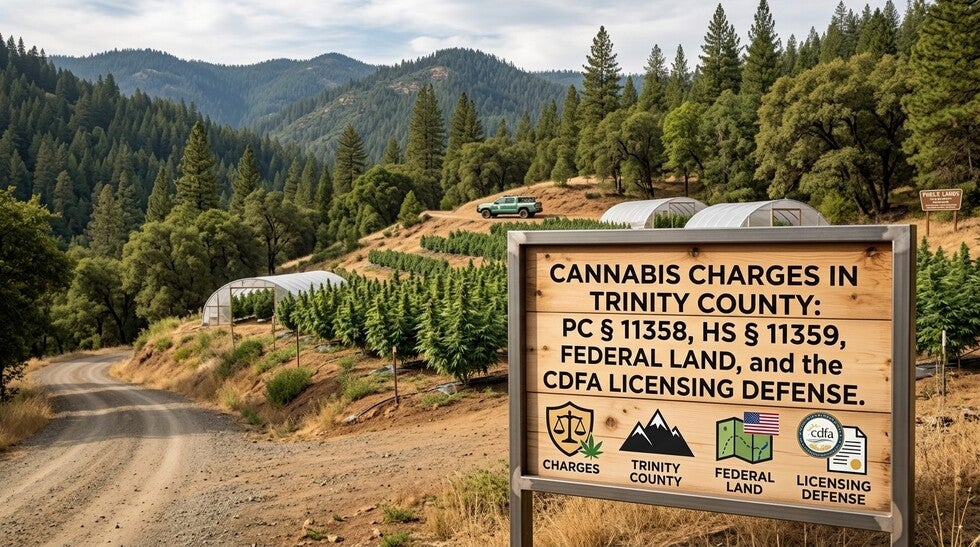
Cannabis Charges in Trinity County require a defense that starts with location, licensing, and jurisdiction. A cannabis case on private land in Trinity County may be handled under California law at the courthouse in Weaverville. A grow on Shasta-Trinity National Forest land may become a federal case in Sacramento. A licensed commercial operation may raise compliance and license-scope issues instead of a simple criminal cultivation theory.
California cannabis law is not the same as federal cannabis law. A person can be licensed or partly compliant under California's commercial cannabis system and still face federal exposure if the alleged conduct occurs on federal land or violates federal drug statutes. That difference can affect penalties, plea strategy, immigration risk, property issues, and the future of a cannabis business.
Cannabis Charges in Trinity County start with jurisdiction
Trinity County cannabis defense begins with a practical question: where exactly did the cultivation, possession, processing, transportation, or alleged sale occur?
The answer can determine whether the case is handled as:
- A California Health and Safety Code case in Trinity County Superior Court.
- A federal drug case involving Shasta-Trinity National Forest or other federal land.
- A regulatory compliance matter involving a licensed cannabis business.
- A combined investigation involving state, local, and federal agencies.
Boundary issues matter. Rural parcels, access roads, leased property, neighboring public land, water sources, and forest boundaries are not always obvious from the ground. GPS coordinates, parcel maps, cultivation diagrams, lease documents, DCC licensing records, county records, and federal land maps can become core evidence.
HS 11358 cultivation charges in Trinity County
Health and Safety Code 11358 addresses unlawful cannabis cultivation. Adults 21 and older may generally cultivate up to six plants for personal use, subject to state and local rules. Cultivation beyond what the law allows, or cultivation outside a valid commercial license, can lead to criminal charges.
For many adults, unlawful cultivation of more than six plants is treated as a misdemeanor, but felony exposure can arise in specific circumstances. Those circumstances can include certain prior convictions, repeated prior cultivation violations, registration-related factors, or environmental violations connected to the cultivation.
In Trinity County, environmental allegations are often central. Prosecutors may focus on water diversion, stream impacts, unpermitted grading, pesticides, fertilizers, waste, trash, fuel, generator use, damage to habitat, or cultivation near sensitive waterways. The defense must separate actual environmental harm from assumptions based on remote location or unlicensed activity.
License defense and the DCC issue
Many people still refer to California cultivation licensing as “CDFA licensing” because cultivation licensing was historically associated with the California Department of Food and Agriculture. Today, commercial cannabis licensing is handled through California's Department of Cannabis Control. That distinction matters because the defense should rely on the correct license records, portals, license type, premises diagram, canopy limits, and compliance history.
A valid commercial cannabis license can be a powerful defense when the charged cultivation occurred within the authorized scope of the license. The analysis should review:
- The exact licensed premises.
- The canopy size and cultivation type.
- The license status on the date of the alleged offense.
- Track-and-trace compliance.
- Local authorization or county restrictions.
- Water, environmental, and land-use compliance.
- Whether the alleged plants were inside or outside the licensed area.
A technical compliance problem is not always the same as criminal cultivation. If the issue involves a boundary mistake, documentation gap, canopy dispute, renewal problem, or mistaken parcel identification, the license record can become the foundation of the defense.
For cannabis operators whose professional future depends on a license, California Business and Professions Code section 481 and substantial relationship license defense can be relevant when a conviction or accusation threatens licensing consequences beyond the criminal courtroom.
HS 11359 possession for sale and sales allegations
Health and Safety Code 11359 addresses possession of cannabis for sale without a valid license. In Trinity County, prosecutors may rely on plant count, processed product, packaging, scales, cash, ledgers, text messages, extraction equipment, distribution materials, or statements from witnesses.
The defense should challenge the jump from possession to intent to sell. In cannabis-growing communities, quantity alone may not tell the whole story. A person may possess cannabis for personal use, shared household use, lawful business activity, gifting within legal limits, processing, storage, or transport within a licensed supply chain.
A cultivation license does not automatically authorize retail sales. Commercial cannabis activity is divided into license categories, and a cultivator may need separate authorization for distribution, manufacturing, retail, or delivery. Still, the existence of a license can provide important context for intent, business records, product tracking, and whether prosecutors are misreading regulated activity as illegal sales.
Federal land and Shasta-Trinity National Forest cases
Federal land changes the case. Cannabis cultivation on Shasta-Trinity National Forest land can be prosecuted under federal drug laws even if California law treats some cannabis activity as legal. California personal-use rules and state commercial cannabis licenses do not automatically protect conduct on federal land.
Federal penalties can be far more serious than state penalties, especially when prosecutors allege large quantities, environmental damage, firearms, conspiracy, organized distribution, or prior convictions. Mandatory minimums may apply depending on the drug quantity and other facts.
Federal rescheduling developments should not be confused with legalization of unauthorized cultivation on federal land. Even as federal cannabis policy evolves, federal marijuana rescheduling and cannabis business defense strategy remains separate from defending an alleged trespass grow or unlicensed cultivation case.
Environmental allegations in Trinity County cannabis cases
Trinity County's terrain makes environmental allegations especially important. Remote cultivation sites may involve streams, springs, drainage channels, steep slopes, erosion risk, generators, fuel storage, fertilizer, pesticides, trash, grading, and road cuts.
An environmental allegation can change the entire case. The defense may need experts to evaluate whether there was actual diversion, whether a watercourse was legally covered, whether alleged pesticides were present, whether runoff reached protected water, and whether damage is being overstated.
Useful defense evidence can include:
- Water board documents.
- Permits and notices.
- Environmental compliance records.
- Site photographs before and after law enforcement entry.
- Maps showing streams, setbacks, and property lines.
- Expert analysis of water use and erosion.
- Records showing lawful remediation or attempted compliance.
Property, land-use, and boundary disputes
Some Trinity County cannabis cases are partly criminal and partly property disputes. A grow may be near a parcel boundary, on land used by multiple people, on leased land, on family property, or near public land. Prosecutors may assume control based on proximity, but proximity is not the same as proof beyond a reasonable doubt.
Land records, easements, gates, access roads, lease terms, utility records, water sources, and who actually controlled the cultivation area can matter. When government action affects rural land, access, valuation, or property rights, eminent domain defense strategy under CCP 1258.210 reflects a broader point that property records and government maps can shape legal outcomes.
Immigration consequences for cannabis charges
Noncitizens should treat any cannabis charge as urgent. A California cannabis conviction may trigger deportability or inadmissibility under federal immigration law. Federal cannabis convictions can create even more severe immigration consequences, particularly when the case is treated as trafficking, manufacturing, or distribution.
The defense should involve immigration analysis before any plea. A resolution that seems favorable in criminal court may still be dangerous for immigration purposes. The state versus federal distinction, the exact statute, the record of conviction, and the language of any plea can all matter.
AI tools, compliance maps, and bad data
Some cannabis businesses use mapping tools, compliance software, AI-generated summaries, automated inventory systems, or third-party consultants to manage licensing, canopy, track-and-trace, water records, and environmental documents. Those tools can help, but they can also produce errors.
A mistaken map, incorrect parcel boundary, wrong canopy calculation, hallucinated legal summary, or bad compliance report can create real legal exposure. If a business relied on technology or consultants, the defense should preserve system records, audit logs, communications, prompts, reports, and correction history.
When automated tools generate inaccurate business records or legal conclusions, business liability for AI hallucinations and defense strategies can be relevant to cannabis compliance disputes where bad data contributed to the accusation.
Trinity County Superior Court and federal court
State cannabis charges in Trinity County are generally handled at Trinity County Superior Court, located at 11 Court Street, Weaverville, CA 96093. That court may handle arraignment, protective conditions, discovery, pretrial conferences, motions, negotiated resolutions, trial, sentencing, and probation issues.
Federal cannabis cases connected to Shasta-Trinity National Forest or other federal jurisdiction are generally handled through the United States District Court for the Eastern District of California, which includes proceedings in Sacramento. Federal cases involve different rules, prosecutors, discovery obligations, sentencing guidelines, and plea consequences.
These courts and agencies are public institutions. Bulldog Law is not affiliated, endorsed, partnered, connected, or associated with Trinity County Superior Court, the United States District Court, the United States Attorney's Office, the Trinity County District Attorney, the Trinity County Sheriff's Office, the Forest Service, the Department of Cannabis Control, or any government agency.
What to do after a cannabis arrest in Trinity County
- Do not make statements about plant count, ownership, cultivation history, sales, or location without a lawyer.
- Identify the exact GPS coordinates, parcel number, lease area, or access road involved.
- Preserve all DCC licenses, local permits, renewal records, track-and-trace records, and premises diagrams.
- Preserve environmental compliance documents, water records, remediation records, and consultant reports.
- Do not consent to searches of other properties, phones, storage areas, vehicles, or business records without legal advice.
- If you are not a U.S. citizen, get immigration analysis before discussing any plea.
- Do not edit, delete, or recreate business records after learning of an investigation.
- Document who had access to the cultivation site and who controlled the property.
Cannabis Charges in Trinity County lawyers in California
Bulldog Law defends clients facing cannabis cultivation, possession for sale, federal land, environmental, licensing, immigration, and business-related cannabis charges in Trinity County and throughout California.
Cannabis Charges in Trinity County require a defense that understands rural land, state cannabis licensing, federal jurisdiction, environmental allegations, Shasta-Trinity National Forest issues, and the difference between regulated cannabis activity and criminal conduct. The first defense question is not just how many plants were found. It is where they were, who controlled them, whether a license applied, and which legal system has authority over the case.