
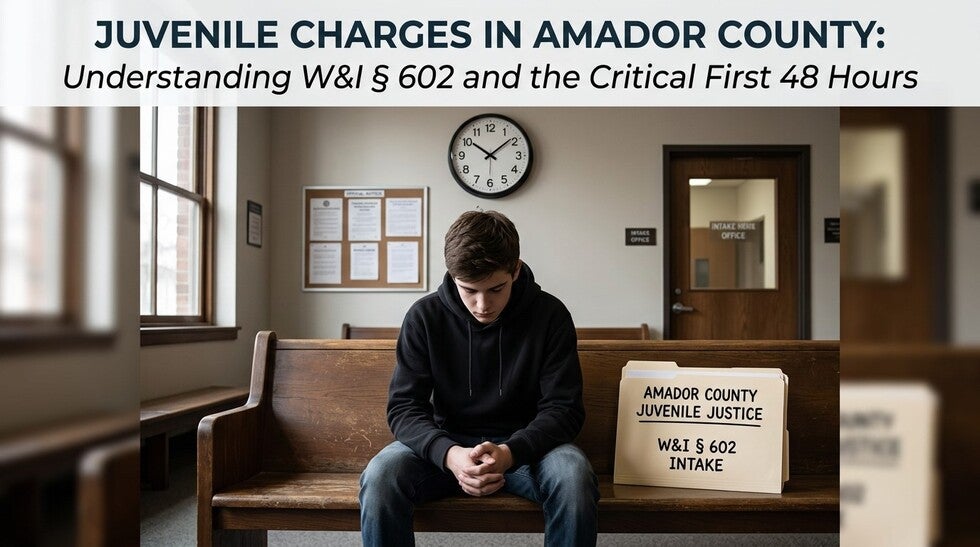
Juvenile Charges in Amador County can move quickly after a school incident, citation, arrest, fight, graffiti allegation, drug accusation, theft report, threat investigation, or traffic-related offense. Under Welfare and Institutions Code § 602, California juvenile court can take jurisdiction over a minor accused of conduct that would be a crime if committed by an adult.
The first 48 hours often shape the case before parents fully understand what is happening. A child may speak to law enforcement, probation, school administrators, classmates, or the alleged victim. A parent may try to explain the incident. A school may begin suspension or expulsion proceedings. Probation may evaluate detention, release, diversion, or whether the district attorney should file a formal petition. Early defense work can affect all of those decisions.
What Juvenile Charges in Amador County mean under W&I § 602
W&I § 602 cases are juvenile delinquency matters, not adult criminal prosecutions. Juvenile court is designed around rehabilitation, supervision, accountability, public safety, and the minor's best interests. That does not mean the case is harmless. A sustained juvenile petition can affect school, probation, restitution, future record sealing, immigration status for noncitizens, and, in serious cases, transfer risk.
California juvenile jurisdiction generally applies to minors ages 12 through 17, with narrow exceptions for younger children accused of certain serious offenses. Families navigating juvenile justice in California should expect different terms than adult court, including petition, detention hearing, jurisdiction, disposition, wardship, informal supervision, and sealing.
Possible outcomes may include:
- No petition filed after probation intake.
- Informal diversion or community-based resolution.
- W&I § 654 informal probation without formal wardship.
- A formal W&I § 602 petition.
- Probation with conditions.
- Counseling, education programs, community service, or restitution.
- Out-of-home placement in more serious cases.
- Transfer litigation in the most serious eligible cases.
The first 48 hours after a juvenile arrest
After a juvenile arrest or citation, the family's priority should be protecting the child's rights and preserving helpful evidence. A minor has the right to remain silent. In California, youth age 17 or younger generally must consult with legal counsel before custodial interrogation and before waiving Miranda rights, subject to limited exceptions. Parents should not assume that an informal explanation will make the problem disappear.
Even when a minor is released to a parent, juvenile citation and release in California can still be followed by probation intake, school discipline, restitution demands, or a later court date.
Important early steps include:
- Ask whether the child is detained, cited, released, or referred to probation.
- Tell the child not to answer questions about the facts without a lawyer.
- Save school records, attendance, grades, awards, work history, and activities.
- Preserve texts, videos, photos, location data, and witness names.
- Find out whether the school has started suspension or expulsion proceedings.
- Do not contact alleged victims or witnesses if there is any warning against contact.
- Do not let the child post about the incident or delete messages.
Probation intake in Amador County
Probation intake can be one of the most important stages in an Amador County juvenile case. Before a formal petition is filed, probation may review the arrest report, the minor's history, school performance, family circumstances, risk factors, and eligibility for informal handling. The district attorney may consider that information when deciding whether to file a W&I § 602 petition.
A strong intake presentation should show that the child is more than the accusation. Helpful materials may include report cards, attendance records, counseling records, work or volunteer history, athletic or school involvement, family supervision plans, community support, and proof that the incident was isolated.
For many first-offense or lower-level cases, the defense goal may be diversion, informal probation, or no formal petition. Those outcomes are not automatic. They require early evidence that the child can be safely redirected without a formal adjudication.
School-based cases at Amador County schools
School-based juvenile cases can create two tracks at once: juvenile court and school discipline. A fight, threat, vape or drug allegation, graffiti incident, theft report, phone video, or weapon accusation may lead to both a law enforcement referral and a school suspension or expulsion process.
The school process can move faster than the juvenile court case. Statements made in a school meeting may later affect the court case, especially if the same incident is being investigated by law enforcement. Parents should ask for written notices, incident reports, suspension documents, and any information about a possible expulsion hearing.
The defense should review:
- Student statements.
- School surveillance video.
- Teacher or administrator reports.
- Discipline notices.
- IEP or 504 plan documents when applicable.
- Prior discipline history.
- Whether the school is seeking transfer, suspension, or expulsion.
Protecting the child's education can be just as important as resolving the court case. A favorable juvenile outcome may lose much of its value if the child is removed from school without a coordinated defense.
Juvenile Charges in Amador County and small-community consequences
Juvenile records are generally confidential, but Amador County's smaller community environment creates practical concerns. Teachers, coaches, neighbors, classmates, employers, and families may hear about an incident even when the court record is not public. That can affect school relationships, sports, part-time jobs, and the child's sense of belonging.
Formal confidentiality is important, but it does not always stop informal community knowledge. Diversion, dismissal, informal probation, and later sealing can help the family respond with a clear record that the case was handled appropriately and that the child is moving forward.
The defense should address both the legal case and the child's real-world future. That means protecting school placement, avoiding unnecessary admissions, reducing public exposure where possible, and pursuing outcomes that preserve long-term opportunities.
Graffiti, vandalism, restitution, and community service
Juvenile vandalism and graffiti allegations can involve schools, bathrooms, parks, signs, buildings, vehicles, businesses, or public property. These cases often involve restitution, cleanup, community service, school discipline, and probation conditions.
A case involving juvenile graffiti charges and mandatory community service should be reviewed for identity, intent, damage amount, actual repair cost, school consequences, and whether restitution is being calculated fairly.
Parents should ask for photographs, invoices, repair estimates, and proof that the alleged damage was caused by their child. Restitution should not include unrelated damage, upgrades, inflated labor, or repairs beyond the actual harm.
Transfer to adult court under W&I § 707
Most juvenile cases remain in juvenile court. In serious eligible cases, however, the prosecution may ask the juvenile court to transfer the minor to adult criminal court under W&I § 707. Transfer is one of the highest-stakes issues in juvenile defense because it can expose the minor to adult penalties and remove many juvenile protections.
Defense strategy in juvenile transfer proceedings under W&I § 707 should focus on rehabilitation potential, maturity, family support, school history, treatment needs, trauma, mental health, role in the incident, and available juvenile programs.
Transfer is not based only on the charge name. The court must consider statutory factors and whether the minor is amenable to rehabilitation within the juvenile system. Evidence from teachers, counselors, family members, coaches, employers, and treatment providers can be critical.
How Amador County compares with other juvenile courts
California juvenile law is statewide, but local practice can vary. Amador County cases may involve smaller probation and court systems, close school-community relationships, rural transportation issues, and local knowledge that differs from larger counties.
Large urban systems such as Los Angeles juvenile defense under W&I § 602 may involve more specialized calendars and larger diversion infrastructure. Coastal and college-community settings can shape Santa Barbara County juvenile cases under W&I § 602 differently. A much larger regional system affects Riverside County juvenile crime defense under W&I § 602, while San Luis Obispo County juvenile cases under W&I § 602 can involve smaller-community dynamics with different local procedures.
Amador County families should focus on the local probation intake, the school response, the child's specific history, and the court's available options rather than assuming another county's result will predict their child's case.
Where Juvenile Charges in Amador County are handled
Juvenile matters in Amador County are handled through the Superior Court of California, County of Amador, located at 500 Argonaut Lane, Jackson, CA 95642. Families should follow the court notice, attorney instructions, and official court communications for hearing dates, courtroom assignments, and appearance requirements.
A juvenile case may involve detention review, arraignment on a petition, jurisdiction hearing, disposition hearing, probation reports, restitution review, school-related evidence, compliance reviews, and later record sealing. Parents should bring release paperwork, probation notices, school discipline documents, court notices, and any positive records to the first attorney meeting.
The courthouse process can feel unfamiliar because juvenile court does not use the same language as adult criminal court. A sustained petition is not called a conviction in the ordinary adult sense, but it can still create serious consequences if not handled carefully.
Record sealing and long-term protection
Record sealing should be considered from the beginning. Many juvenile records can be sealed after successful completion of the case, but eligibility can depend on the offense, outcome, age, compliance, later conduct, and whether the case was transferred to adult court.
Preserving sealing eligibility may affect early strategy. Diversion, informal supervision, dismissal, and careful compliance can all help protect the minor's future. If a formal petition is filed, the defense should still work toward a disposition that supports sealing later.
Long-term concerns may include:
- College applications.
- Scholarships.
- Military enlistment.
- Employment.
- Professional licensing.
- Housing.
- Immigration status for noncitizens.
- Future criminal court consequences if there are later allegations.
The goal is not only to get through the next hearing. The goal is to protect the child's adult future.
What parents should avoid after an arrest
Parents often want to fix the case immediately. That instinct is understandable, but some actions can make the situation worse. A parent should not pressure the child to confess, contact alleged victims, delete messages, argue with school officials, or post about the incident online.
Common mistakes include:
- Letting the child give a statement without legal advice.
- Sending apology messages before understanding the facts.
- Assuming school discipline is separate and harmless.
- Ignoring probation intake because no petition has been filed yet.
- Failing to preserve positive school and community records.
- Discussing the case in family group chats or social media.
- Waiting until the first court date to start building mitigation.
Parents help most by staying calm, protecting the child's rights, preserving evidence, and building a clear record of support, accountability, and rehabilitation.
Juvenile Charges in Amador County lawyers in California
Juvenile Charges in Amador County require fast, careful action. The first 48 hours can affect probation intake, detention, diversion, school discipline, witness statements, restitution, transfer risk, sealing eligibility, and whether a W&I § 602 petition is filed.
Bulldog Law helps families navigate California juvenile defense, probation intake, school-based arrests, diversion, transfer litigation, restitution, record sealing, and courtroom strategy in Jackson. If your child was arrested, cited, or contacted by probation in Amador County, the defense should begin before intake recommendations and school discipline decisions define the case.