
Updated October 2026 | The Bulldog Law | California Criminal Defense
Choosing between a judge-only trial and a twelve-person jury can change a criminal case's outcome, costs, and appeal path, so understanding who decides the facts and how a jury right is waived is essential for every California defendant.
The Constitutional Right to a Jury Trial and How It Can Be Waived in California
In California, Article I, Section 16 of the state Constitution guarantees a jury for every misdemeanor and felony, creating a fundamental protection that cannot be ignored. The right remains unless the defendant, counsel, and prosecutor all agree to a bench trial in open court.
Infractions, such as most traffic tickets, never trigger a jury right; they are always decided by a judge, which simplifies the process but removes the community's voice from the decision.
Constitutional guarantee and statutory system
The Constitution's guarantee applies to all criminal cases, and Penal Code 1042 reinforces that facts must be tried by a jury unless a valid waiver occurs. This statutory tie ensures the jury's role is preserved unless both sides consent.
Federal Rule 23 mirrors this approach, requiring a written waiver, government consent, and court approval before a bench trial can replace a jury trial in federal court.
Requirements for a valid jury waiver
A waiver must be the defendant's personal, knowing, intelligent, and voluntary consent, entered on the record after the judge explains the right. Counsel alone cannot waive the right; the prosecutor must also agree.
Because the waiver must be made in open court, the judge reads the waiver language aloud, and the defendant signs the transcript, creating a clear, documented record of the decision.
Withdrawal of a waiver and procedural safeguards
After a waiver, the defendant may withdraw it only with the court's permission, usually when the change will not cause delay or prejudice. The judge evaluates whether the withdrawal would disrupt the trial schedule.
These safeguards protect the defendant's constitutional right while allowing flexibility when a waiver was entered without proper advisement or under duress.
Bench Trial vs Jury Trial: Core Procedural Differences
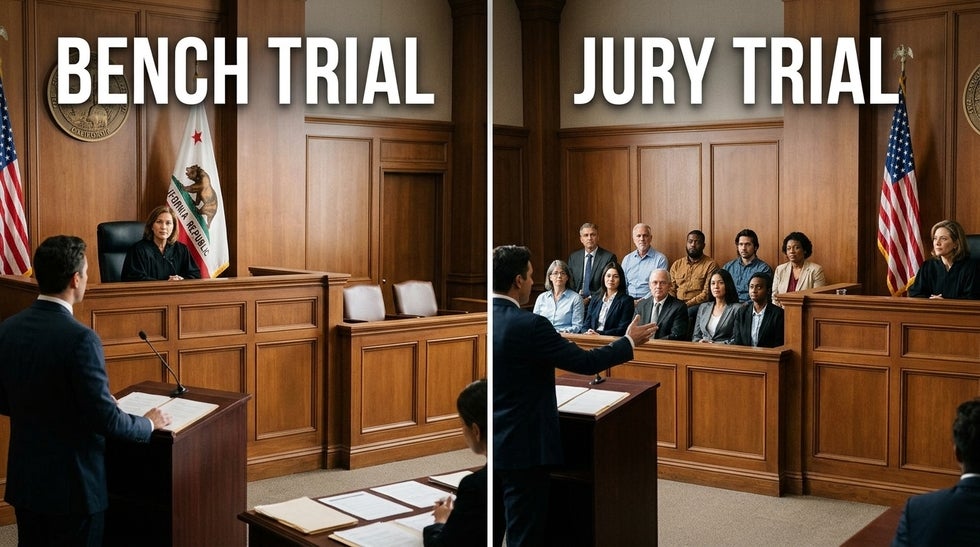
In my practice, I see how the choice between a bench trial and a jury trial reshapes strategy, especially when the evidence is complex or the facts are emotionally charged. Understanding the procedural split helps clients make informed decisions.
Both trial types share the same burden of proof and evidentiary standards, but the fact-finding authority differs: a judge alone versus twelve jurors who must agree unanimously. Readers comparing related California statutes also review our guide on how a California preliminary hearing works.
Who decides the facts: judge versus twelve jurors
During a bench trial, the Judge evaluates credibility, weighs evidence, and renders a verdict based on legal standards. In a jury trial, twelve community members perform that same analysis and must reach a unanimous decision.
The judge's single-person perspective can lead to quicker resolutions, while a jury's diverse viewpoints may provide a broader assessment of the facts.
Uniform burden of proof and evidentiary standards
Both trial formats require the prosecution to meet the burden of proof beyond a reasonable doubt, and the same rules of evidence apply, ensuring fairness regardless of the fact-finder.
Because the standards are identical, the key difference lies in who must be persuaded: a single judge or a unanimous panel of twelve jurors.
Impact of unanimity requirement on outcomes
In a jury trial, any single juror's doubt can prevent a conviction, creating a built-in safeguard against wrongful verdicts. A bench trial requires only the judge's conviction, which may be easier to achieve.
Conversely, unanimity can also produce hung juries, leading to mistrials that sometimes benefit the defense by forcing a new trial.
|
Aspect |
Bench Trial |
Jury Trial |
Typical Penalty Impact |
|---|---|---|---|
|
Fact-finder |
Judge |
12 jurors |
Varies by case |
|
Verdict requirement |
Judge's decision |
Unanimous |
Potentially lower |
|
Speed |
Faster |
Longer |
Reduced costs |
|
Appeal focus |
Legal errors |
Legal & factual |
Different standards |
Strategic Reasons to Choose a Bench Trial in California Criminal Cases
When I evaluate a case, I look for legal or technical issues that a judge can dissect more precisely than a jury, especially when statutory definitions or search-law questions dominate the defense.
Bench trials also shine when the facts are emotionally charged, such as offenses involving children or graphic evidence, where jurors might let sympathy or revulsion influence their decision.
Legal and technical defenses that benefit from a judge's precision
Defenses based on statutory definitions, the legality of a search, or specific-intent elements often succeed better before a judge who applies the law strictly, reducing the chance of a jury's misinterpretation.
For example, a precise argument about whether conduct fits the definition of a crime can lead to an acquittal when the judge focuses solely on the legal elements.
Emotional or prejudicial facts that may sway jurors
Cases involving graphic evidence, child victims, or highly unpopular defendants can trigger strong juror reactions. A judge is trained to set aside emotion and decide based on law and fact alone.
Readers comparing related California statutes also review our guide on Penal Code 288 felony defense in California. When the defense worries that a jury's bias could outweigh the evidence, a bench trial offers a more controlled environment for a fair outcome.
Cost, speed, and appellate preservation considerations
Minor misdemeanors often resolve faster and cheaper in a bench trial, giving clients a quick resolution without the expense of a full jury process. This efficiency can be key for clients with limited resources.
Choosing a bench trial also preserves certain issues for appeal, as judges provide clearer legal rulings that can be reviewed on appeal, especially when the defense plans to challenge a suppression motion under violating a protective order under Penal Code 273.6.
When a Jury Trial Is the Better Choice for Defendants
In my practice, I see defendants who rely on the jury's collective judgment to protect against overzealous prosecutions, especially when the evidence is complex and the stakes are high.
A jury must reach unanimity, meaning all 12 members agree beyond a reasonable doubt, which raises the threshold for conviction compared to a judge's single decision in the case today.
When a case involves California Penal Code 187 murder prosecutions, jurors often weigh mitigating circumstances that a judge might overlook before making a decision in court.
The protective effect of unanimity and community judgment ensures that convictions are not based solely on emotional reactions, as the jury must agree on every point.
Jurors bring diverse life experiences, which can lead to a more nuanced assessment of credibility than a judge who hears similar testimony repeatedly in the court.
Credibility assessments and juror skepticism of law-enforcement testimony can sway a case, especially when police narratives are questioned by a jury that has not heard them before.
Mistrial potential and strategic advantages of a jury deadlock mean that a single juror's doubt can result in a new trial or a plea bargain for the defendant.
Because judges are elected officials, they may be less receptive to routine defenses that have become familiar to them through repeated cases in the practice and in the future.
Special Trial Procedures: Transcript Submissions, Stipulated Records, and Aggravating Factors
In felony cases, parties can opt to submit the case to the judge based on the preliminary hearing transcript, a strategy sometimes called a slow plea when the outcome is.
Readers comparing related California statutes also review our guide on violating a protective order under Penal Code 273.6.
This approach requires the same advisements as a guilty plea, ensuring the defendant understands the consequences before proceeding, as outlined in Article I, Section 16 of the California Constitution right.
When parties agree to a court trial on a stipulated record of facts, they can streamline the process and focus on key evidentiary issues for the defendant.
In multi-count cases, specific issues such as prior conviction allegations can be tried to the judge while the substantive charges go to a jury for the case.
Defendants retain a jury on aggravating factors unless they explicitly waive that right, protecting them from harsher sentences that rely on jury findings in the court and in the future.
California rules of court allow parties to negotiate partial bench trials, ensuring that only the most contentious issues are heard by a judge, as per Penal Code 1042.
The court may also require that the defendant be given the opportunity to present evidence supporting a suppression motion before the judge considers the transcript in the trial process today.
Using these procedures strategically can preserve appellate rights and streamline the resolution of complex criminal cases in California courts today and for the future.
Appealing a Bench Trial Verdict and Post-Trial Motions Under Penal Code 1181
After a bench trial, defendants can appeal on the same grounds as a jury verdict, focusing on legal errors rather than factual disputes in the court and on the future.
Appellate courts defer to the trial judge's findings of fact and credibility, giving the judge's conclusions the same weight as a jury's in the case.
Because judges may not explain their verdict, defense counsel can request a written statement of findings, which clarifies the record for appellate review in the court and for future appeals.
Under Penal Code 1181, a defendant may move for a new trial after a bench trial on the same grounds as after a jury trial, such as insufficient evidence in.
The court will consider whether the new trial is warranted, balancing the defendant's rights against the integrity of the original verdict and the public interest in the case today and and. Readers comparing related California statutes also review our guide on making false statements under 18 U.S.C. 1001.
If the court grants a new trial, it can be a full retrial or a limited one focused on specific disputed issues, preserving appellate options for the defendant in the future today.
Defendants should file the new trial motion promptly, as delays can jeopardize the opportunity to challenge the bench trial verdict before the appellate deadline in the court and for future.
Ultimately, the appellate process after a bench trial mirrors that of a jury trial, but the focus remains on legal correctness and procedural fairness in the court and for future.
How The Bulldog Law Guides California Defendants Through Jury Waivers and Trial Strategy
Our California criminal defense team reviews every piece of evidence, checks for procedural flaws, and safeguards your constitutional right to a fair trial from the first phone call. We tailor a strategy that fits the facts and the law.
We explain how a jury waiver works, weigh the risks of a bench trial, and fight aggressively to protect you. Call (888) 928-1609 for a confidential case review today.
Official statutory text and procedural updates are published directly on Penal Code 1042, which California criminal courts apply across all 58 counties.
Frequently Asked Questions
What factors should a California defendant consider when deciding between a bench trial and a jury trial?
Look at the legal issues, emotional intensity of the facts, and any prior record that might sway jurors. A judge may apply technical law more consistently, while a jury can offer a “reasonable doubt” safety net.
Also weigh speed, cost, and the likelihood of a hung jury. Penal Code 1181 lets you move for a new trial if the bench trial record is insufficient for appeal.
How does the cost of a bench trial compare to a jury trial in California state courts?
Bench trials usually cost less because they require fewer days, no juror fees, and less extensive pre-trial preparation. The reduced schedule also means lower attorney billable hours.
Jury trials add expenses for juror compensation, longer courtroom time, and often more expert witnesses. The difference can be several thousand dollars, depending on case complexity.
Can a plaintiff in California waive the right to a jury trial, and what is the procedure?
Yes. Under California Constitution Article I, §16, both parties must expressly consent in open court. The plaintiff's attorney must state the waiver on the record, and the judge must accept it.
If the defendant objects, the court will deny the waiver and order a jury trial. The waiver cannot be implied; it must be a clear, on-the-record statement.
What are the typical timelines for bench trials versus jury trials in California civil cases?
Bench trials often start within 30-45 days after filing because they need fewer pre-trial motions and no jury selection. They may conclude in one or two days of hearing.
Jury trials require a voir dire process, which adds 2-4 weeks, and the trial itself can last several weeks depending on the number of witnesses and complexity.
How do appellate review standards differ for bench trial verdicts versus jury verdicts in California?
Appellate courts give great deference to a judge's factual findings, just as they do to a jury's. Errors in law or insufficient evidence are reviewed under the same standards.
However, a bench trial record may be richer if the judge provides a written statement of decision, which can aid the appeal. Without that, the appellate court relies on the trial transcript.
What are the strategic advantages of choosing a bench trial for complex commercial litigation in California?
Complex legal issues, such as intricate contract interpretations, are often better handled by a judge familiar with statutory nuances. A judge can focus on the law without being swayed by emotional testimony.
Bench trials also avoid unpredictable juror biases and can lead to quicker resolutions, saving clients time and money while preserving business relationships.
How is Penal Code 1042 applied when a defendant attempts to waive a jury trial?
Penal Code 1042 requires the defendant to make a written waiver of the right to a jury, signed in the presence of the court. The waiver must be voluntary and informed.
If the court finds the waiver was coerced or not fully understood, it will be invalid, and the case proceeds before a jury. The prosecutor must also consent for the waiver to be effective.