
Updated September 2026 | The Bulldog Law | California Criminal Defense
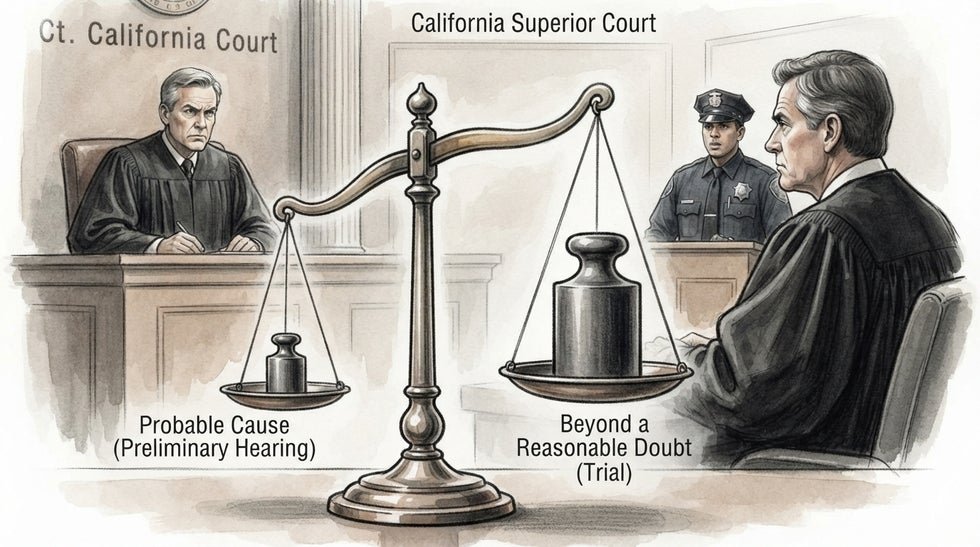
A preliminary hearing is the proceeding in a California felony case where a judge decides whether there is enough evidence to require the defendant to stand trial. The prosecution presents witnesses, usually police officers relaying what others told them, the defense cross-examines and may present evidence, and the judge rules on each charge: hold the defendant to answer, dismiss, or reduce the charge to a misdemeanor. The standard is probable cause, far lower than proof beyond a reasonable doubt, and there is no jury. Under Penal Code 859b the hearing must be held within 10 court days of arraignment for a defendant in custody who doesn't waive time, and within 60 days in any case. Misdemeanors don't get one.
The Bulldog Law's attorneys treat the preliminary hearing as the most valuable hour in a felony case that isn't the trial. It is the first time the prosecution's witnesses testify under oath, the first time the defense gets to ask them questions, and the last time a case can be thrown out before it becomes a matter of picking a jury. Prosecutors know it and, for that reason, offer deals to make it go away. What follows is what happens in the room, what the judge is actually deciding, how cases get dismissed or reduced there, and how our attorneys decide whether to hold the hearing or trade it. If you have one on calendar, call (888) 928-1609 or message our team.
Where it sits in a felony case
A felony case in California begins with a complaint and an arraignment on it. What comes next is the preliminary hearing, which is why the two are confused; the arraignment is where you hear the charges and enter a plea, and the preliminary hearing is where the prosecution has to show it can back them up. If the judge holds the defendant to answer, the prosecutor files an information within 15 days, the defendant is arraigned a second time on that document, and the case moves toward trial. Misdemeanor cases skip all of it and go from arraignment to pretrial conferences to trial. Federal cases use a grand jury instead. And in California, a prosecutor can bypass the preliminary hearing by taking the case to a county grand jury, which happens in a small number of high-profile or multi-defendant matters.
Timing: Penal Code 859b
Penal Code 859b gives a defendant in custody the right to a preliminary hearing within 10 court days of the arraignment, and every defendant the right to one within 60 calendar days, unless the defendant personally waives. A defendant in custody who does not waive time and does not get a hearing within 10 court days is entitled to release on their own recognizance, with narrow exceptions. Most defense attorneys waive the 10-day rule to prepare; our attorneys think harder about it for clients in custody, because the pressure of the deadline is sometimes the best leverage the defense has, and a prosecutor scrambling to find witnesses in 10 days sometimes cannot. The 60-day limit is firmer: a case that blows through it without a personal waiver is dismissed.
What the judge is deciding
The question at a preliminary hearing is whether there is probable cause to believe a felony was committed and that the defendant committed it. Courts describe it as a state of facts that would lead a person of ordinary caution to entertain a strong suspicion of guilt. It is a low bar, deliberately: the hearing is a screen for cases that should never have been filed, not a mini-trial. The judge does not decide credibility disputes the way a jury would and does not weigh whether the defense story is more likely than the prosecution's. Our page on reasonable suspicion versus probable cause explains the standard in the context of police stops; the preliminary hearing applies the same probable cause concept to the case as a whole.
Low as the bar is, cases fall under it. Prosecutors file complaints from police reports, before anyone has tested the witnesses, and they file high, charging the most serious version of the offense that the report could support. The preliminary hearing is where the gap between the report and the evidence shows up, and it is the reason our attorneys read the signs of a weak case into the complaint before the hearing rather than after.
What actually happens in the room
The prosecution's evidence, and the Prop 115 hearsay rule
In most states, the witnesses at a preliminary hearing are the actual witnesses. California is different. Since Proposition 115 in 1990, Penal Code 872(b) lets a qualified law enforcement officer, one with at least five years of experience or specific POST training, testify to what other people told them. So the victim and the eyewitnesses usually never appear; a detective reads from the reports, and the defense cross-examines the detective. Our attorneys cover the mechanics, and the limits, on our page about hearsay at preliminary hearings under Article I, Section 30. The short version: the officer must have the qualifications, may generally relay only one level of hearsay, and can be cross-examined about what they don't know, which is usually a great deal. An officer who can't say whether the witness was intoxicated, or what the lighting was, or why the story changed between the first interview and the second, is a witness whose testimony a judge can discount.
Cross-examination
This is the reason to hold the hearing. Cross-examination at a preliminary hearing is bounded by the probable cause question, and judges will cut off questioning that is purely discovery, but within that boundary the defense gets to ask the prosecution's witness anything relevant to whether the evidence establishes the charge. The answers are under oath and transcribed. A witness who testifies one way at the preliminary hearing and another at trial has handed the defense an impeachment; a witness who admits at the preliminary hearing that they never saw the defendant's face has handed the defense the case. Prosecutors sometimes call the hearing a free deposition for the defense. They are not wrong, which is why they'd rather the defendant waive it.
Defense evidence
Under Penal Code 866, the defense may call witnesses, but the judge can require an offer of proof showing the testimony would establish an affirmative defense, negate an element of the crime, or impeach a prosecution witness. The defense cannot simply put on its case. Used well, though, a single defense witness at a preliminary hearing, an alibi, a person who saw the other party start the fight, a records custodian with the document that contradicts the officer, can end a case. Our attorneys also use the hearing to place a defense theory on the record early, which shapes every negotiation that follows. Witnesses who are reluctant are a separate problem, addressed on our page about what happens when a witness refuses to testify.
The ruling
The judge rules count by count. The three outcomes: held to answer, meaning the case proceeds on that charge; dismissed under Penal Code 871, meaning the evidence was insufficient; or, for a wobbler, reduced to a misdemeanor under Penal Code 17(b) at the judge's discretion, which happens when the facts support the offense but not the felony version of it. Judges also routinely hold a defendant to answer on a lesser charge than the one filed, assault instead of assault with a deadly weapon, receiving stolen property instead of burglary, and can add charges the evidence supports that the prosecutor didn't file. Bail is revisited at the end of the hearing, up or down, and our page on what happens to bail money explains how that affects a family that posted it.
After the hearing
Held to answer. The prosecutor files an information, which may include any charge supported by the evidence at the hearing, within 15 days. The defendant is arraigned on the information, and a new clock starts: under Penal Code 1382, trial must begin within 60 days of that arraignment unless the defendant waives time. The transcript of the preliminary hearing becomes the foundation of trial preparation.
The Penal Code 995 motion. Within 60 days of the arraignment on the information, the defense may move to set it aside on the ground that the defendant was held to answer without reasonable or probable cause, or that the hearing was procedurally defective. A different judge reviews the transcript. A 995 motion is the defense's appeal of the preliminary hearing, and it wins when the magistrate held a defendant to answer on evidence that, read cold, doesn't support the charge.
Dismissed. A dismissal under Penal Code 871 is, in most cases, not the end. Under Penal Code 1387, the prosecution can refile a felony once after a dismissal at the preliminary hearing, and a second dismissal bars the charge. Our page on dismissals with and without prejudice explains the two-dismissal rule and its exceptions. In practice, many prosecutors do not refile after losing a preliminary hearing, because the transcript that produced the dismissal is waiting for them the second time.
The plea. A large share of felony cases resolve at or just before the preliminary hearing, because the prosecutor's offer is often best right before the witnesses have to testify and the defense's leverage is often best right after they do. Our attorneys negotiate on both sides of that line, and our pages on no contest pleas and West pleas explain what an offer at that stage typically looks like. For a non-citizen, the plea decision at this stage is where the immigration consequences get decided, which is why our immigration attorneys are consulted before any felony preliminary hearing, not after.
To waive or not to waive
Defendants are asked at nearly every felony arraignment whether they waive the preliminary hearing, and many do, on advice, without understanding what they gave up. Our attorneys' default is to hold it. The reasons to waive are specific: the prosecution has offered a reduction or a plea that is worth more than the hearing; a witness whose testimony is damaging, and who might not appear at trial, would be preserved on the record if the hearing proceeds, since preliminary hearing testimony of an unavailable witness can be read to the jury; or the case is going to plead regardless and the hearing would only delay the resolution the client wants. Outside those situations, a waiver hands the prosecution a free pass through the one checkpoint that exists before trial, and it forfeits the transcript that would have shaped every decision afterward, including whether to try the case at all. A client who has watched the prosecution's key witness fall apart on cross-examination makes very different decisions about trial than one who has only read the police report, and that is true whether the case ends in a dismissal, a plea, a verdict, or a hung jury.
Frequently asked questions
What is a preliminary hearing in simple terms?
A preliminary hearing is a short court proceeding in a felony case where a judge decides whether the prosecution has enough evidence to make the defendant stand trial. The prosecutor presents evidence, the defense cross-examines, and the judge rules on probable cause. There's no jury and no verdict. If the judge finds probable cause, the defendant is held to answer and the case moves toward trial; if not, the charge is dismissed.
What happens at a preliminary hearing in California?
Usually one or two police officers testify, often relaying what witnesses told them, which California allows at this stage under Proposition 115. The defense attorney cross-examines them, may call a witness or two of their own, and argues that the evidence falls short on one or more charges. The judge then rules count by count: hold to answer, dismiss, or reduce a wobbler to a misdemeanor. Most hearings take less than an hour; serious cases can take days.
Can charges be dropped at a preliminary hearing?
Yes. If the judge finds the evidence insufficient on a count, that count is dismissed under Penal Code 871. It happens more often than people expect, especially on the most serious charge in a complaint, where prosecutors file high and the evidence supports less. A dismissal at the preliminary hearing is usually not final; the prosecution can refile a felony once, but many don't.
Should I waive my preliminary hearing?
Only for a reason. The hearing is the defense's first chance to see the prosecution's witnesses under oath, lock in their testimony, and test the case, and it costs the defendant nothing. Attorneys waive it when the prosecution offers something in exchange, such as a plea to a reduced charge, or when a particular witness's testimony would be more damaging on the record than the hearing is worth. A waiver should be a strategic decision, not a convenience.
How long after arraignment is the preliminary hearing?
Under Penal Code 859b, within 10 court days of the arraignment on the complaint if the defendant is in custody and doesn't waive time, and in any event within 60 calendar days unless the defendant agrees to more. In practice most defendants waive the 10-day rule so the defense can prepare, and the hearing lands a few weeks to a few months out. Out-of-custody defendants routinely waive time; in-custody defendants often shouldn't.
Related reading from our attorneys
- What happens at arraignment in California
- Hearsay at preliminary hearings: Article I, Section 30 and Proposition 115
- Penal Code 738 and preliminary examinations
Preliminary hearing on calendar? It's the hearing we'd rather not waive
The Bulldog Law's defense attorneys try preliminary hearings in felony cases across California, use the transcript to win Penal Code 995 motions and trials, and negotiate from the leverage the hearing creates. If your case is in the window between arraignment and the hearing, the 48-hour rule and the 859b deadlines are already running. Visit our criminal defense page, call (888) 928-1609, or reach us online.