
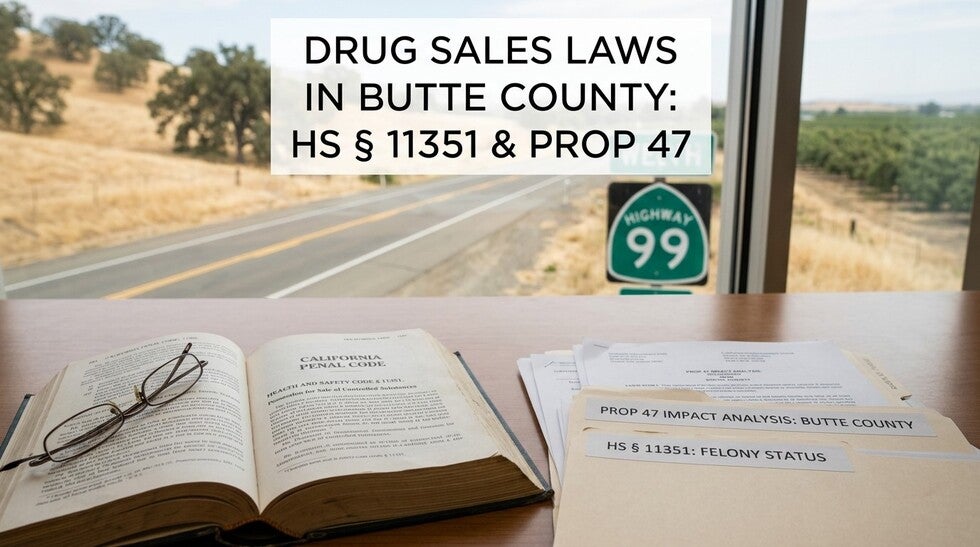
Drug Sales in Butte County are prosecuted aggressively when officers claim that controlled substances were possessed, packaged, transported, or exchanged for sale. Proposition 47 changed many simple possession cases in California, but it did not turn possession for sale under Health and Safety Code § 11351 into a misdemeanor. That distinction matters for drivers stopped on Highway 99 or Highway 70, CSU Chico students, Gridley agricultural workers, healthcare professionals, and anyone whose future depends on avoiding a felony drug sales record.
The defense objective is often clear: challenge the prosecution's upgrade from simple possession to possession for sale. If the evidence supports simple possession instead of sales, the case may move back toward misdemeanor treatment, diversion eligibility, immigration-safer analysis, professional licensing protection, and a very different future.
What Drug Sales in Butte County means under HS § 11351
Health and Safety Code § 11351 covers possession or purchase of certain controlled substances for purposes of sale. It is different from simple possession. The prosecution must prove that the person possessed the substance, knew of its presence, knew of its nature as a controlled substance, had a usable amount, and intended to sell it.
Intent to sell is usually proven through circumstantial evidence. Officers may rely on:
- Quantity of the substance.
- Packaging in separate baggies or bindles.
- Scales, pay-owe sheets, or cash.
- Text messages or social media communications.
- Observed hand-to-hand transactions.
- Expert officer opinions.
- Vehicle stops or surveillance.
- Prior sales allegations or informant statements.
But none of those facts automatically prove sales. A person can possess drugs for personal use, share a residence or vehicle with others, carry cash for lawful reasons, or have messages that are exaggerated, ambiguous, or unrelated. Defense of HS § 11351 drug sales should start by testing every assumption behind the sales label.
Drug Sales in Butte County and what Prop 47 left unchanged
Proposition 47 reduced many simple drug possession offenses to misdemeanors, but it did not reduce possession for sale. That is why prosecutors often fight hard to keep a case under HS § 11351 instead of simple possession. The charge label can determine custody exposure, immigration consequences, licensing risk, diversion eligibility, and long-term record damage.
The impact of Proposition 47 on drug offenses is still important because a successful reduction from possession for sale to simple possession may reopen misdemeanor and diversion arguments. PC 1000 or other drug diversion options may be available in some simple possession cases, but sales and trafficking allegations are generally treated differently.
The defense should ask whether the evidence really proves sales or whether police used quantity, packaging, or location to overstate the case. A person with a substance use disorder should not automatically be treated as a dealer because of an officer's interpretation.
HS § 11352 transportation for sale on Highway 99 and Highway 70
Highway 99 and Highway 70 are major Butte County corridors. Officers may look for drug trafficking indicators during stops near Chico, Gridley, Biggs, Oroville, and routes connecting Sacramento, the North Valley, and the Sierra region. A vehicle stop can quickly become an HS § 11352 transportation-for-sale case if officers find controlled substances and claim the drugs were moving for commercial distribution.
HS § 11352 generally punishes sale, furnishing, administering, giving away, importing, or transportation for sale of covered controlled substances. Standard sentencing exposure can include three, four, or five years. If transportation involves movement between noncontiguous counties, higher exposure may apply.
The first defense is often constitutional. Police need a lawful basis for the stop, detention, search, and seizure. A claimed lane violation, tinted window, speeding allegation, equipment issue, consent search, dog sniff, or prolonged detention should be compared against dashcam, bodycam, dispatch logs, and the officer's report.
Defense questions include:
- Was there a real Vehicle Code violation?
- Did the stop last longer than legally permitted?
- Was consent voluntary or pressured?
- Was the search supported by probable cause?
- Did officers rely on profile evidence instead of specific facts?
- Was the substance linked to the accused or merely found in a shared vehicle?
- Does the evidence prove transportation for sale rather than personal possession?
If the stop or search is unlawful, the defense may seek suppression of the evidence. Without the seized substance, the prosecution may not be able to proceed.
Immigration risks for Gridley agricultural workers
For noncitizens, drug sales allegations are extremely serious. A conviction for possession for sale or transportation for sale can create aggravated felony, controlled substance, inadmissibility, deportability, and future visa consequences depending on the exact conviction, record, and immigration status.
Gridley, Biggs, Chico, and surrounding agricultural areas include workers whose immigration future may depend on avoiding a trafficking-type conviction. H-2A workers, DACA recipients, green card holders, visa holders, and undocumented defendants should not accept a plea without immigration-specific analysis.
The difference between simple possession, possession for sale, transportation for sale, public nuisance, and dismissal can be life changing. Immigration-safe strategy should begin before any plea, admission, or sentencing record is created.
Enloe Medical Center, nurses, and licensing consequences
Healthcare professionals face separate consequences from licensing boards and employers. A drug sales felony can trigger investigation, discipline, suspension, probation, or revocation risk for nurses and other licensed professionals. For Enloe Medical Center employees, students in healthcare tracks, and professionals pursuing California licensure, the criminal case and licensing strategy should be coordinated early.
A licensing board may consider the facts, conviction, rehabilitation, honesty, work history, treatment, and public safety risk. The defense should avoid creating a record that exaggerates sales activity when the evidence supports personal use or a lower-level drug offense.
Important licensing evidence may include:
- Proof of treatment or recovery.
- Negative testing where appropriate.
- Employment history.
- Character references.
- Absence of distribution evidence.
- Reduction from felony sales to a lesser offense.
- Compliance with court orders.
The goal is not only to resolve the criminal case. It is to protect the person's professional future.
Cannabis, rural properties, and federal land issues
Butte County's rural geography can produce cannabis possession for sale, cultivation, transportation, and distribution allegations. State legalization does not mean every cannabis activity is lawful. Licensing, quantity, sales activity, local rules, weapons, environmental damage, and federal land can change the analysis.
When cannabis activity occurs on federal land, including national forest land, federal law may apply regardless of California cannabis rules. Boundary evidence can matter. The defense may need maps, parcel records, GPS data, lease documents, cultivation records, licensing documents, and evidence of who controlled the site.
Cannabis cases should not be treated as automatically minor. State legality, medical use, personal cultivation, commercial licensing, and federal jurisdiction are separate questions.
Drug cases involving schools, minors, and detention facilities
Some Butte County drug cases involve added allegations because of location or alleged recipients. Supplying controlled substances to minors can create civil and criminal exposure. The issue of supplying controlled substances to minors can affect defense strategy when the prosecution claims drugs were shared, furnished, or sold to a younger person.
Drug possession in custody is also different from ordinary possession. A person accused of controlled substances in detention facilities may face charges and discipline tied to jail, prison, transport, or booking settings.
Other statutes may appear in unusual cases. Allegations involving chemical irritants, harmful materials, or noxious releases may require analysis of releasing offensive substances. Drug-related public nuisance resolutions may also arise in some negotiations, and drug-related public nuisance plea agreements should be reviewed carefully before any admission is made.
How Butte County compares with other California drug sales cases
California drug sales law is statewide, but local facts matter. Butte County cases often involve Highway 99 and Highway 70 stops, Chico student housing, rural properties, agricultural communities, healthcare licensing issues, cannabis activity, and vehicle interdiction.
Other counties show different patterns. San Joaquin County drug sales cases may involve Central Valley transportation corridors and warehouse distribution issues. Sutter County drug sales cases may involve neighboring North Valley agricultural communities and cross-county travel.
A Butte County defense should focus on the actual evidence, not assumptions about the route, neighborhood, profession, immigration status, or quantity.
Where Drug Sales in Butte County cases are handled
Butte County felony and misdemeanor criminal cases are generally handled through the Criminal Division at the Butte County Courthouse, located at One Court Street, Oroville, CA 95965. Butte County also operates the North Butte County Courthouse at 1775 Concord Avenue, Chico, CA 95928, which handles other court matters. Defendants should rely on court notices, attorney instructions, and official court communications for the correct location, department, date, and appearance requirements.
A drug sales case may involve arraignment, bail or release conditions, discovery, bodycam footage, dashcam footage, lab testing, search warrant review, phone extraction, informant records, suppression motions, preliminary hearing, negotiations, diversion analysis, immigration review, licensing strategy, and trial.
The early stages matter. If the police report labels a person as a seller, the defense must challenge that label before it controls plea negotiations, licensing consequences, immigration analysis, or sentencing.
Defenses to Drug Sales in Butte County charges
Drug sales defense usually focuses on possession, knowledge, intent to sell, search legality, substance testing, and credibility of police or informants. The defense should not assume that quantity alone proves sales.
Potential defenses include:
- The drugs were for personal use, not sale.
- The accused did not know the substance was present.
- The accused did not control the area where drugs were found.
- The stop, search, or detention was unlawful.
- The substance was not properly tested.
- Packaging or cash was misinterpreted.
- Text messages were taken out of context.
- An informant was unreliable or motivated.
- The officer's expert opinion is unsupported.
- The prosecution overcharged simple possession as sales.
The defense should also consider reduction to simple possession, dismissal after suppression, diversion where legally available, immigration-sensitive alternatives, licensing-sensitive resolutions, and trial when the evidence does not prove sales beyond a reasonable doubt.
What to do after a drug sales arrest in Butte County
After a drug sales arrest, do not explain the quantity, packaging, cash, phone messages, route, passenger relationships, or purpose of travel without legal advice. Statements meant to sound innocent can be used to prove knowledge, possession, transportation, or sales intent.
Important steps include:
- Invoke the right to remain silent.
- Do not consent to additional searches.
- Preserve dashcam, bodycam, phone, and location evidence.
- Write down the officer's stated reason for the stop.
- Identify passengers, witnesses, and who had access to the vehicle or property.
- For noncitizens, get immigration-aware defense before any plea.
- For nurses and licensed professionals, get licensing-aware defense early.
- Do not discuss the case on recorded jail calls.
Fast defense work can preserve video, challenge an unlawful stop, prevent overcharging, and protect immigration, licensing, employment, and education goals.
Drug Sales in Butte County lawyers in California
Drug Sales in Butte County require careful review of HS § 11351, HS § 11352, Prop 47, simple possession reductions, Highway 99 and Highway 70 stops, immigration risk, BRN licensing concerns, cannabis allegations, detention facility charges, and courtroom strategy in Butte County Superior Court.
Bulldog Law defends California drug cases involving possession for sale, transportation for sale, simple possession, suppression motions, vehicle stops, informants, search warrants, phone evidence, cannabis allegations, immigration-sensitive pleas, professional licensing issues, and trial defense. If you or a loved one is facing a drug sales charge in Butte County, legal strategy should begin before statements are made, video is lost, or a felony sales label controls the case.