
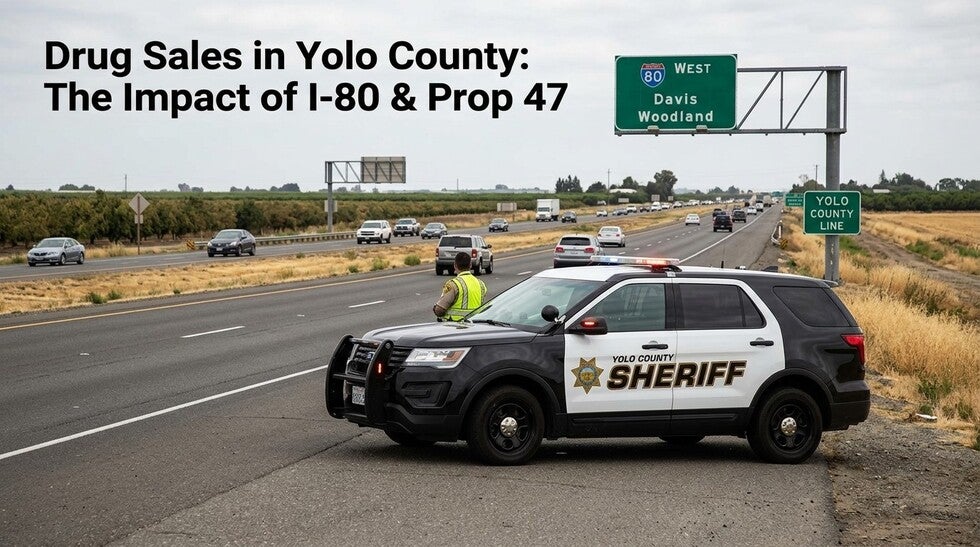
Drug Sales in Yolo County are prosecuted differently from simple possession cases. A person accused of possessing drugs for personal use may face one set of defenses and consequences, while a person accused of possessing drugs for sale under Health and Safety Code § 11351 faces felony exposure, intent-to-sell allegations, search-and-seizure issues, and possible immigration, licensing, and custody consequences.
Yolo County drug sales cases may begin with an I-80 traffic stop, a Davis apartment search, a Woodland residence investigation, a West Sacramento vehicle stop, a controlled buy, a probation search, or an arrest near a school, park, or jail. The central issue is often not whether drugs were present, but whether the prosecution can prove knowing possession and intent to sell.
Drug Sales in Yolo County under HS § 11351
Health and Safety Code § 11351 generally applies when the prosecution claims a person possessed certain controlled substances for sale or purchased them for purposes of sale. It is different from simple possession because the government must prove more than personal possession. It must prove the accused person knew of the substance, knew its nature as a controlled substance, exercised control over it, and intended to sell it.
Intent to sell is usually proven through circumstantial evidence. Prosecutors may point to quantity, packaging, scales, cash, text messages, pay-owe sheets, multiple phones, surveillance, alleged customer traffic, prior sales, or expert officer opinions. None of those facts automatically proves sales intent. The defense may argue that the evidence is consistent with personal use, shared possession, lack of knowledge, addiction, temporary presence, or someone else's conduct.
A conviction under HS § 11351 can carry serious felony consequences. The ordinary sentencing range is often described as two, three, or four years, although enhancements, prior convictions, immigration issues, probation eligibility, and other charges can change the practical exposure. That is why the defense must analyze the exact charge, substance, quantity, record, and facts before discussing likely outcomes.
What Prop 47 changed and what it left unchanged
Proposition 47 changed many low-level California drug possession cases by reducing certain simple possession offenses from felonies to misdemeanors for many defendants. But Prop 47 did not generally convert possession for sale under HS § 11351 into a misdemeanor. That distinction is one of the most important points in a Yolo County drug case.
If the facts support simple possession rather than possession for sale, the defense may push back against the felony sales theory. The difference can affect custody exposure, probation, immigration consequences, employment, licensing, and future criminal history. A comparison with HS § 11350 simple drug possession cases helps show why the prosecution's intent-to-sell theory must be tested instead of accepted.
Prop 47 can still matter indirectly. It may affect how prior simple possession convictions are treated, how a defendant's record is evaluated, or whether the defense can argue that the current case is overcharged. But if prosecutors can prove possession for sale, the case remains much more serious than simple possession.
I-80 traffic stops and search challenges
Many Yolo County drug sales cases begin on I-80, Highway 113, I-5, or local roads connecting Davis, Woodland, West Sacramento, Winters, and Sacramento. A traffic stop may start with speeding, lane position, expired registration, tinted windows, equipment issues, or a claimed moving violation. What happens next often determines the strength of the case.
The defense should examine whether the officer had a lawful basis for the stop, whether the detention was unlawfully prolonged, whether the search was supported by consent, probable cause, a warrant, probation or parole status, or another recognized exception. If the stop, detention, or search violated constitutional protections, the defense may seek suppression of the drug evidence.
Vehicle cases also raise possession issues. Drugs found in a trunk, backpack, hidden compartment, passenger area, or another person's bag do not automatically belong to every occupant. The prosecution must prove the accused person had the required knowledge and control. In multi-passenger vehicles, rental cars, borrowed cars, and rideshare situations, that proof may be contested.
Possession for sale versus transportation or trafficking
HS § 11351 focuses on possession for sale or purchase for sale. Other statutes may apply when prosecutors allege actual sales, furnishing, transportation for sale, importation, or organized distribution. The exact statute matters because the elements and penalties may differ.
In an I-80 case, prosecutors may argue that the freeway route, quantity, packaging, cash, and destination show distribution rather than personal use. The defense should test that theory against actual evidence. A person may be traveling with drugs without being a seller, and quantity alone does not always prove intent to sell.
Large quantities, interstate facts, wiretap evidence, federal task force involvement, firearms, fentanyl allegations, or suspected organized distribution can also increase the risk of federal prosecution. When a case begins to look like federal distribution or possession with intent to distribute, federal drug trafficking defense under 21 U.S.C. § 841 may become part of the strategy.
School, campus, and protected-location allegations
Yolo County drug cases may involve locations near schools, colleges, parks, student housing, or youth-centered areas. Davis, Woodland, West Sacramento, and other communities include dense areas where a drug allegation may be close to a school or campus even if the accused person was not targeting students.
California law can impose additional consequences for certain drug activity connected to school zones or minors. The exact statute, distance, timing, age of the people involved, and type of conduct matter. Prosecutors may overstate a location-based allegation if they do not prove the required facts.
When police claim drug sales occurred near a protected area, the defense should examine maps, measurements, school schedules, witness statements, surveillance, and whether the alleged conduct actually falls within the enhancement language. A careful review of California school drug enforcement laws can help identify whether a location-based allegation is legally supported.
Jail, booking, and custody-related drug allegations
A drug sales arrest can lead to additional charges if drugs are allegedly found during booking, transport, jail intake, or custody. A person arrested after a vehicle stop may face one case for the alleged drugs in the car and a separate custodial contraband allegation if officers claim more substances were discovered at the jail.
Custody-related drug allegations require careful review. The defense may examine whether the accused person knew the substance was present, whether officers gave clear warnings, whether the search was properly documented, whether the alleged substance was tested, and whether the facts show possession inside a custodial setting.
Because a custody contraband allegation can create separate felony exposure, PC § 4573.8 drug contraband possession defenses may become important when a Yolo County drug arrest continues into the booking process.
First-time defendants, diversion, and negotiated outcomes
Not every Yolo County drug sales case has the same outcome. The defense may pursue dismissal, suppression, reduction to simple possession, reduction of enhancements, probation, treatment-based mitigation, or trial. The available options depend on the evidence, criminal history, substance, quantity, alleged sales indicators, immigration status, and public safety concerns.
Diversion and treatment options are usually more limited in sales cases than in simple possession cases. Still, in the right case, negotiation may focus on whether the facts truly prove intent to sell or whether treatment, probation, or a lesser offense is more appropriate. First-time defendants should not assume they are automatically ineligible for every alternative, but they also should not assume a felony sales charge will be treated like simple possession.
When the facts support treatment-based advocacy, California second-chance drug offender programs may help frame the discussion around rehabilitation, accountability, and alternatives to the harshest consequences.
Common defenses to HS § 11351 charges
Common defenses include lack of possession, lack of knowledge, lack of intent to sell, illegal search or seizure, unreliable informant evidence, mistaken identity, weak chain of custody, improper lab testing, and overreliance on officer opinion. In some cases, the defense may also challenge whether the substance and quantity were accurately tested and weighed.
Intent is often the most contested issue. A prosecutor may argue that separate bags prove sales. The defense may show that packaging reflected personal storage, shared use, addiction, or someone else's conduct. A prosecutor may argue that cash proves sales. The defense may show legitimate income, rent money, work proceeds, or unrelated cash possession.
Digital evidence also requires scrutiny. Text messages, payment apps, phone contacts, and social media messages may be ambiguous. Slang, jokes, old messages, and unrelated conversations can be misread. The defense should demand complete context rather than isolated screenshots.
Collateral consequences of a drug sales conviction
A felony drug sales conviction can affect more than the sentence. It may create immigration risks, professional licensing issues, housing problems, financial aid concerns, employment barriers, probation search conditions, firearm restrictions, and future sentencing exposure. Noncitizens should receive immigration-informed criminal defense before entering any plea.
Students, agricultural workers, commercial drivers, public employees, healthcare workers, and licensed professionals may have specific concerns. The defense strategy should account for those consequences from the beginning, not after a plea has already been entered.
Probation terms may also be intrusive. They can include search conditions, drug testing, treatment, stay-away orders, travel restrictions, electronic device searches, and limits on contact with alleged co-participants. Negotiating those terms can matter even when custody is avoided.
Drug Sales in Yolo County court process
State-filed Yolo County drug sales cases generally proceed in Yolo County Superior Court in Woodland. The process may include arraignment, bail or release conditions, discovery, lab testing, motion practice, negotiations, preliminary hearing, trial readiness, and trial.
Early defense work can change the case. Counsel should request police reports, body camera footage, dispatch records, search warrant materials, lab results, informant records where available, surveillance, phone evidence, and any evidence used to claim intent to sell. If the search was unlawful, a suppression motion may be one of the most important tools in the case.
The accused person should not discuss the case with officers, alleged buyers, co-defendants, informants, jail callers, or social media contacts. Statements made after arrest can become evidence, even when the person is only trying to explain or minimize what happened.
Drug Sales in Yolo County lawyers in California
Drug Sales in Yolo County require a defense strategy that separates simple possession from possession for sale, tests the legality of the search, challenges unsupported intent-to-sell theories, and accounts for the consequences of a felony drug conviction.
Bulldog Law helps clients facing California drug sales allegations, HS § 11351 charges, I-80 drug stop cases, school-zone allegations, custody contraband issues, and related state or federal exposure. The firm does not promise outcomes, but it can evaluate the evidence, challenge unlawful searches, negotiate where appropriate, and pursue a defense strategy built around the facts of the case.