
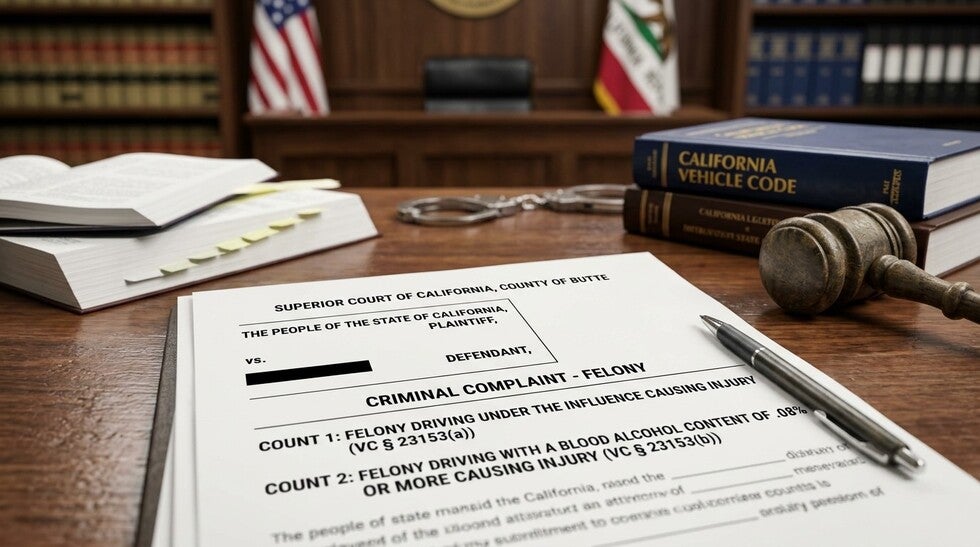
Felony DUI in Butte County usually turns on one issue that many drivers do not understand at the scene: injury. A DUI arrest under Vehicle Code section 23152 can become a VC § 23153 DUI causing injury case when prosecutors claim the driver was under the influence, committed an unlawful act or neglected a legal duty while driving, and proximately caused bodily injury to someone other than the driver.
The injury does not have to be catastrophic for prosecutors to file the case seriously. A Highway 99 rear-end collision, Highway 70 sideswipe, Chico intersection crash, Oroville roadway accident, or Paradise-area injury collision can create felony exposure if medical records, witness statements, officer opinions, and crash reconstruction support the charging theory. The defense must challenge both sides of the case: the DUI evidence and the injury-causation evidence.
Felony DUI in Butte County under VC § 23153
VC § 23153 is different from a standard misdemeanor DUI because it requires bodily injury to another person and a driving act or omission that caused that injury. The prosecution usually must prove more than alcohol or drugs in the system. It must connect impairment, unlawful driving or negligence, causation, and injury.
Common prosecution theories include speeding, unsafe turning, following too closely, drifting from a lane, running a red light, unsafe passing, distracted driving, or failing to adjust for weather and road conditions. In Butte County, those facts may involve Highway 99, Highway 70, Skyway, rural agricultural roads, downtown Chico traffic, or roads near Lake Oroville and Paradise.
A broad overview of California DUI defense strategies is useful because felony DUI cases still require careful review of the stop, investigation, field sobriety testing, chemical testing, officer observations, and constitutional issues.
Felony DUI in Butte County and the injury element
The injury element is often the difference between a misdemeanor DUI and a felony-level case. Medical documentation may include emergency room notes, ambulance records, pain complaints, whiplash allegations, bruising, fractures, concussion symptoms, lacerations, or follow-up treatment.
The defense should not accept the injury allegation without review. A person can be hurt in an accident, but the legal questions are more specific: Was there bodily injury? Was it caused by the accused driver's unlawful act or neglect of duty? Was the claimed injury preexisting? Were symptoms subjective or objectively documented? Did another driver, roadway hazard, weather event, or medical condition cause or contribute to the crash?
Defense review may include:
- collision reports, diagrams, measurements, and photographs;
- body-camera and dashcam footage;
- medical records and ambulance reports;
- vehicle damage analysis;
- event data recorder information;
- weather, lighting, visibility, and roadway conditions;
- witness statements and 911 calls;
- toxicology records and testing documentation.
Felony DUI in Butte County, GBI, and multiple victims
VC § 23153 injury is not the same as great bodily injury. A base injury DUI can be charged based on bodily injury to another person. A great bodily injury enhancement requires a higher showing, generally significant or substantial physical injury. Broken bones, serious head injuries, significant lacerations, prolonged impairment, or major medical treatment may create a different risk than temporary pain or minor bruising.
If prosecutors allege great bodily injury, the sentencing exposure and collateral consequences can increase substantially. Multiple injured victims can also create additional enhancement issues. The defense should review each alleged victim separately rather than treating the accident as one undifferentiated injury event.
In some cases, the best defense result is not only beating the DUI allegation. It may be reducing the case from VC § 23153 to VC § 23152, avoiding a GBI enhancement, narrowing the number of alleged victims, or negotiating a disposition that avoids the most damaging felony consequences.
Alcohol, drugs, and chemical testing defenses
A felony DUI case can involve alcohol, drugs, prescription medication, cannabis, or a combination. Blood and breath testing must be reviewed carefully. The defense may examine probable cause, implied-consent advisements, warrant issues, timing, chain of custody, contamination, lab procedures, calibration, rising blood alcohol, retrograde extrapolation, and whether the test result actually proves impairment at the time of driving.
Blood cases require special attention because refusal issues and testing rules have changed over time. Bulldog Law's article on 2025 DUI blood test refusal changes is relevant when the government relies on a refusal allegation, warrant-backed blood draw, or chemical-test consequence.
Drug DUI cases can be even more complicated. A positive drug test does not always prove impairment at the time of driving. Prescription use, timing, tolerance, inactive metabolites, officer training, and medical explanations can matter. For commercial drivers or workers using regulated vehicles, commercial drug DUI allegations under VC § 23152 may create employment and licensing consequences beyond the criminal case.
DMV, license suspension, and DUI programs
The DMV case is separate from the criminal case. After many DUI arrests, the driver has only 10 days to request a DMV administrative hearing. Missing that deadline can allow an administrative suspension to move forward even while the criminal case is still pending.
Felony DUI can affect license status, ignition interlock requirements, insurance, DUI program length, restricted license eligibility, and future driving privileges. The exact consequences depend on priors, injury, refusal allegations, court sentence, DMV action, and whether the driver has a commercial license.
Bulldog Law's guide to DUI program requirements for license restoration is important because court-ordered programs and DMV reinstatement rules often become the practical path back to lawful driving.
Prior DUIs and what a felony changes
A felony DUI conviction can change the future of every later DUI case. California tracks prior DUI convictions over a lookback period, and prior convictions can increase punishment, program length, license consequences, and charging severity.
A person with multiple priors faces a very different risk than a first-time offender. Bulldog Law's article on California DUI recidivism tracking helps explain why prior convictions, dates, and court records must be reviewed immediately.
For drivers accused of a fourth DUI within the statutory lookback period, fourth DUI charges under VC § 23550 can create felony exposure even without the same injury theory as VC § 23153. If a driver has a prior felony DUI, later DUI cases may also be treated more seriously.
Wet reckless and negotiation issues
Not every DUI case resolves as charged. Depending on the evidence, prior history, injury proof, BAC or drug evidence, causation issues, and prosecutor position, the defense may seek reduction, dismissal of enhancements, misdemeanor treatment, or a negotiated plea.
A wet reckless is a common term in DUI negotiations, but it is not available in every case and may not solve every problem. In an injury case, prosecutors may resist reducing the charge if medical records, witness statements, or victim input support felony treatment. Still, a careful defense may expose weaknesses that make negotiation possible.
Bulldog Law's explanation of a wet reckless plea bargain is relevant when the defense is evaluating whether a reduced disposition would meaningfully protect licensing, insurance, employment, and future DUI exposure.
Cost, insurance, employment, and professional consequences
A felony DUI can cost far more than fines. There may be towing, storage, bail, alcohol education, ignition interlock, increased insurance, restitution, civil claims, medical liens, lost wages, licensing issues, immigration consequences, and loss of professional opportunities.
For nurses, teachers, contractors, commercial drivers, CSU Chico students, public employees, healthcare workers, and non-citizens, the felony label can be as damaging as the sentence. A misdemeanor DUI may still be serious, but a felony injury DUI can trigger more severe disclosure duties and background-check consequences.
Bulldog Law's article on how much a DUI can cost in California helps show why defense planning should include financial and administrative consequences, not just jail exposure.
Butte County DUI court process
Felony DUI cases in Butte County are handled in the Superior Court of California, County of Butte. The Butte County Courthouse is located at One Court Street, Oroville, CA 95965-3303. The North Butte County Courthouse is located at 1775 Concord Avenue, Chico, CA 95928. These are public court facilities. Bulldog Law has no affiliation, endorsement, partnership, special access, or special relationship with the court.
A felony DUI case may involve arraignment, bail or release conditions, DMV deadlines, protective orders, discovery, medical-record subpoenas, restitution claims, preliminary hearing, expert review, negotiations, trial, sentencing, and probation conditions. Injury cases may also create civil lawsuits and insurance disputes that should be coordinated carefully with the criminal defense.
Drivers in nearby counties face the same statewide DUI statutes, but local facts and court practices vary. Trinity County DUI defense may involve rural stops and mountain roads. Madera County DUI cases may involve Central Valley highways and agricultural traffic. San Luis Obispo County DUI defense may involve university settings, coastal roads, and different local enforcement patterns.
What to do after a felony DUI arrest
The first days matter. Evidence can disappear quickly, and early statements can damage both the criminal case and the DMV case. A driver should avoid discussing fault, drinking, drug use, injury, insurance, or apologies with police, insurance adjusters, alleged victims, or civil attorneys without legal advice.
Important steps include:
- request the DMV hearing within the required deadline;
- preserve the full timeline of driving, drinking, medication, and sleep;
- write down weather, traffic, road, and visibility conditions for counsel;
- save dashcam, phone, GPS, rideshare, receipt, and text evidence;
- photograph vehicle damage and the roadway when safe and lawful;
- identify witnesses before memories fade;
- do not contact injured parties directly;
- tell counsel about CDL, licensing, immigration, military, or healthcare employment issues.
Felony DUI in Butte County lawyers in California
Bulldog Law helps clients facing Felony DUI in Butte County, including VC § 23153 injury DUI, Highway 99 and Highway 70 crashes, Chico and Oroville court proceedings, Paradise-area collisions, chemical-test challenges, refusal allegations, soft tissue injury disputes, GBI enhancements, DMV hearings, prior DUI issues, CDL risks, and professional licensing concerns.
No lawyer can promise dismissal, charge reduction, license restoration, or a specific sentence. What Bulldog Law can do is review the stop, test results, medical records, crash evidence, prior convictions, DMV deadlines, and collateral consequences to build a defense focused on what prosecutors must prove and what a felony would change.