
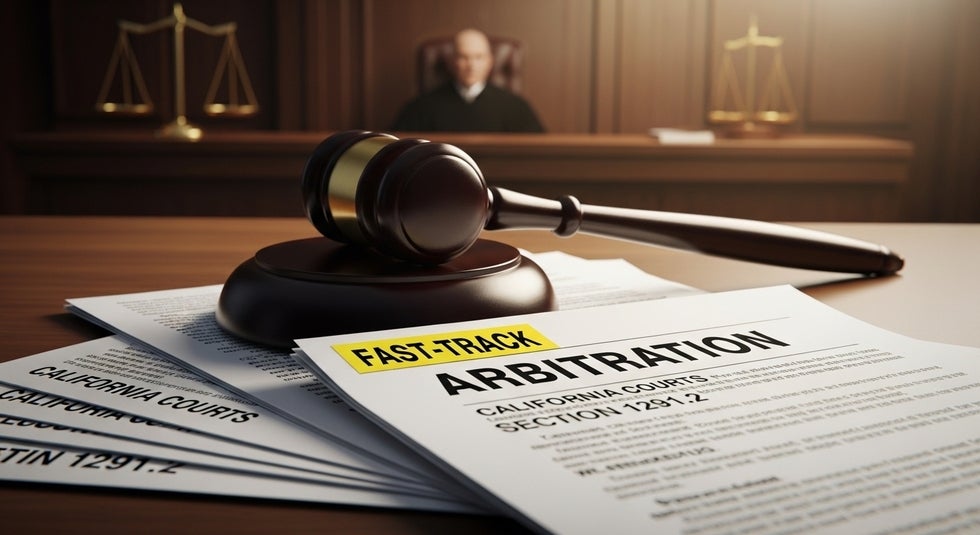
The Courtroom Lane That Moves Faster Than You Expect
Most people going through civil litigation develop a sense of how long things take. Motions get filed, hearing dates get set weeks out, continuances get granted, and the entire process tends to stretch over months or even years. That rhythm can create a false sense of security when the proceeding you are facing happens to fall under California's arbitration statutes.
California Code of Civil Procedure Section 1291.2 breaks that rhythm entirely. Under this provision, courts are required to give arbitration proceedings priority over virtually all other civil matters when it comes to scheduling and hearing those cases. This is not a soft preference or a judicial courtesy.
It is a legal mandate, and if you are on the defense side of an arbitration petition, it means your timeline is almost certainly shorter than you think.
Understanding why this preference exists, what it means practically, and how it shapes your defense strategy is not a background detail. It is one of the most important things you can absorb before your next court date.
What Section 1291.2 Actually Requires
The statute is direct about what it demands of courts. In every proceeding brought under California's arbitration title, courts must give those matters preference over other civil actions and proceedings when setting hearing dates and conducting the hearings themselves. The goal stated explicitly in the law is that all such proceedings shall be "quickly heard and determined."
There are two narrow exceptions carved into the statute. The first applies to older matters of the same character, meaning arbitration proceedings that were filed before yours will still come first in the priority queue. The second applies to matters that receive special precedence under other laws, such as certain juvenile matters, elder abuse cases, or other categories the legislature has designated for priority scheduling. Outside of those two exceptions, your arbitration case moves to the front of the civil docket.
What this means from a practical standpoint is that a court handling an arbitration petition will move it along with a sense of urgency that does not apply to ordinary civil disputes. Judges and clerks are aware of this statutory obligation, and it directly influences how quickly hearing dates get set, how little tolerance there is for delays, and how firmly deadlines get enforced.
The Defense Disadvantage Hidden Inside a Scheduling Rule
On the surface, a rule about court scheduling might not seem like something that creates a defense challenge. In reality, it creates one of the most significant disadvantages a responding party can face, and it operates quietly because it looks administrative rather than substantive.
When courts prioritize arbitration proceedings, the compressed calendar that results puts pressure squarely on the party who did not choose to initiate the process. The petitioner knew the proceeding was coming. They prepared their papers, lined up their evidence, and filed when they were ready. The responding party, by contrast, is reacting. They receive notice, they assess the situation, they retain counsel, and they begin building a defense, all while the court is moving the case toward resolution at a pace that the statute explicitly requires.
That imbalance is not accidental. California made a policy choice to resolve arbitration disputes quickly because delay undermines the efficiency that makes arbitration attractive as an alternative to full litigation. But the downstream effect of that policy choice falls harder on the defense than on the petitioner. Knowing this going in is what separates a prepared defense from a reactive one.
The attorneys at The Bulldog Law have written about how compressed arbitration timelines affect the responding party's ability to mount a thorough defense, and the insights there are directly applicable to any proceeding where Section 1291.2 is in play.
What "Quickly Heard and Determined" Looks Like in Practice
The phrase at the end of Section 1291.2 states the legislature's intent without ambiguity. Courts are not just supposed to set these cases quickly. They are supposed to resolve them quickly. That dual obligation shapes everything from initial scheduling to the pace of any briefing schedule the court sets for opposition papers.
In practice, this means courts may set hearing dates on arbitration petitions within weeks rather than months. It means continuances are harder to obtain and less likely to be granted generously. It means that if you miss a filing deadline for your opposition, the court may proceed without your written submissions rather than accommodate a late filing. And it means that any procedural challenge you intend to raise, whether about service, notice, the scope of the arbitration agreement, or the validity of an award, needs to be raised in writing and on time, because the calendar is moving whether you are ready or not.
This is not a system that forgives slow starts. If you have been served with an arbitration petition in California and you are waiting to see how things develop before engaging an attorney, the priority scheduling mandate in Section 1291.2 is a direct argument for acting today rather than tomorrow.
How to Turn the Speed of the Process Into a Defense Asset
The instinct when facing a fast-moving proceeding is to feel overwhelmed by the pace. But there is a way to reframe Section 1291.2 that actually works in the defense's favor, provided you respond with equivalent urgency.
When courts prioritize arbitration matters, they are also signaling that these proceedings deserve full and serious attention from everyone in the room. A judge who sets an arbitration hearing quickly is also a judge who expects the responding party to be prepared, focused, and ready to make substantive arguments. The compressed timeline does not reduce the quality of the hearing. It raises the standard for preparation on both sides.
What this means for your defense is that early, thorough preparation is not just advisable. It is the only viable approach. Identifying the key issues, assembling your supporting evidence, locating relevant provisions of your arbitration agreement, and working with counsel to build a written opposition that is complete and persuasive before the deadline is the one path that allows you to meet the court's pace without sacrificing the substance of your defense.
Interestingly, the priority scheduling requirement can occasionally be used offensively from the defense position as well. If you have a cross-petition or a related matter that falls under the arbitration statutes, the same preference that applies to the petitioner's filing applies equally to yours. Filing strategically can bring your own arbitration-related claims to the court's attention on the same priority track, consolidating the dispute and potentially shifting the balance of the proceeding. For guidance on cross-petitions and related strategic options, the resources at The Bulldog Law blog address these considerations in more detail.
Continuances, Delays, and the Court's Patience
One of the most immediate questions a defense attorney faces in an arbitration proceeding governed by Section 1291.2 is whether to seek a continuance of the hearing date. Sometimes additional time is genuinely necessary. Key documents may need to be located, witnesses may need to be reached, or the complexity of the legal issues may demand more preparation than the initial notice period allows.
Courts are not categorically opposed to granting continuances in arbitration proceedings, but the bar is meaningfully higher than it is in ordinary civil matters. The statutory command to hear and determine these cases quickly creates a judicial presumption in favor of keeping the proceeding on track. To overcome that presumption and obtain a continuance, you typically need to demonstrate good cause that goes beyond general unreadiness.
This means that if you are going to request more time, the request needs to be specific, supported, and made as early as possible. A vague representation that your attorney needs more time to prepare will not carry the same weight as a detailed showing of what additional preparation is required, why it could not have been completed sooner, and how a brief extension would not prejudice the petitioning party.
Presenting that kind of showing convincingly requires precisely the type of experienced legal advocacy that makes a meaningful difference in proceedings where the court's calendar tolerance is limited.
The Bottom Line on Speed as a Legal Strategy
Section 1291.2 is a scheduling provision that carries strategic consequences reaching well beyond the docket. It reflects California's commitment to efficient arbitration dispute resolution, but it loads the burden of that efficiency primarily onto the party who did not choose the timing of the proceeding.
If you are responding to an arbitration petition in California, the mandatory preference that courts must give these cases is already working against your default timeline. The only answer is to compress your own preparation to match the court's pace, raise your procedural and substantive defenses early and in writing, and engage counsel who understands how arbitration proceedings move and how to defend them effectively within the timeline the statute creates.
For more resources on arbitration defense strategies, procedural objections, and how California courts handle priority-scheduled proceedings, contact us our Criminal Defense Attorneys For a free consultation.