
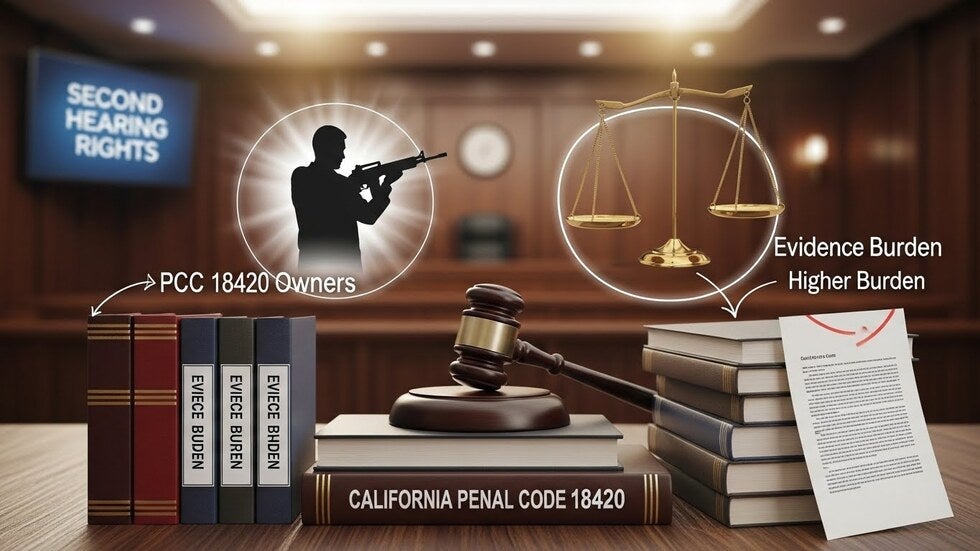
Your Second Chance to Recover Your Firearms
Losing your initial firearm return hearing under California Penal Code Section 18410 isn't the end of the road. Many gun owners don't realize that California law provides a powerful second opportunity to recover seized weapons, and this second chance comes with significantly better odds of success.
Penal Code Section 18420 grants you the right to petition for a second hearing within 12 months of losing your first hearing. More importantly, this statute raises the burden of proof law enforcement must meet to keep your firearms. Instead of preponderance of evidence used at the first hearing, police now must prove endangerment by clear and convincing evidence, which is a substantially higher standard.
This increased burden reflects California's recognition that extended separation from your property requires increasingly strong justification. As time passes and circumstances change, the reasons for initially denying return may become less compelling. Understanding how to leverage this second hearing opportunity and the heightened evidentiary standard can turn an initial defeat into ultimate victory.
The 12 Month Window to File Your Second Hearing Petition
California Penal Code Section 18420 establishes a specific timeframe for requesting your second hearing. You have up to 12 months from the date of your initial hearing to file a petition asking the court to reconsider the firearm return issue.
This 12 month period serves important purposes. It gives you time to demonstrate changed circumstances, complete programs or counseling, establish a track record of compliance with court orders, and allow emotions and tensions from the original incident to cool.
However, this window isn't indefinite. If you don't petition within 12 months, or if you lose your second hearing, your firearms may be disposed of permanently according to California Penal Code Sections 18000 and 18005. The stakes at the second hearing are therefore even higher than at the first.
Deciding When to File During the 12 Month Period
You don't have to wait the full 12 months before filing your second hearing petition. Depending on your circumstances, filing earlier or later may be strategically advantageous.
Filing earlier makes sense when you've quickly established significant positive changes. If you completed an intensive treatment program in three months, reconciled with the alleged victim, and maintained perfect compliance with all court orders, waiting another nine months gains nothing. Strike while your evidence of change is fresh and compelling.
Filing later makes sense when you need more time to build your case. Perhaps you're enrolled in a six month counseling program and want completion documentation. Maybe you need more time to establish a sustained pattern of stability and responsible behavior. The longer your track record of positive conduct, the stronger your argument that return poses no danger.
Avoid waiting until the very end of the 12 month period unless necessary. Give yourself buffer time in case filing problems arise. Missing the deadline by even one day means permanently losing your firearms without any further opportunity for return.
What Your Second Hearing Petition Should Include
Your petition for a second hearing needs to explain why circumstances have changed since the first hearing and why the court should reconsider its previous decision. Generic petitions that simply ask for another hearing without providing substantive reasons won't be persuasive.
Detail specific changes in your life since the initial hearing. Completed programs, therapy attendance, employment stability, housing security, relationship status changes, and compliance with court orders all matter. Quantify everything possible with dates, hours, certificates, and other concrete evidence.
Address the original concerns that led to denial of return. If the court was worried about anger management issues, show completion of anger management programs and testimony from counselors about your progress. If substance abuse was a concern, provide proof of sobriety and ongoing treatment. Don't ignore the problems. Demonstrate you've fixed them.
Include declarations or letters from relevant witnesses. Therapists, counselors, employers, clergy, family members, and even alleged victims if they support return can provide powerful testimony about your transformation during the past months.
Understanding Clear and Convincing Evidence: Your Biggest Advantage
The most important difference between first and second hearings is the burden of proof. At your initial hearing under Section 18410, law enforcement needed only preponderance of evidence to keep your firearms. At the second hearing under Section 18420, they must meet the much higher clear and convincing evidence standard.
This distinction isn't subtle legal hair splitting. It's a game changing difference that significantly improves your chances of prevailing.
What Clear and Convincing Evidence Actually Means
Clear and convincing evidence falls between preponderance of evidence and beyond reasonable doubt. While preponderance means "more likely than not" or just over 50 percent probability, clear and convincing requires a substantially higher degree of certainty.
Courts often describe this standard as evidence that produces a firm belief or conviction about the truth of the allegations. It's not enough that endangerment is slightly more likely than not. Law enforcement must prove that return would result in endangerment with a high degree of probability based on credible, reliable evidence.
From a defense perspective, this heightened standard means you can prevail even when evidence leans somewhat toward endangerment. Unless police present strong, credible, recent evidence that clearly demonstrates danger, you should win.
Why the Higher Standard Favors Gun Owners
California's decision to require clear and convincing evidence at second hearings reflects important policy considerations. The longer firearms remain seized without concrete problems, the weaker the endangerment justification becomes.
If you've gone six, nine, or twelve months since the initial hearing without incident, this track record speaks volumes. You've had ample opportunity to cause problems but haven't. Law enforcement's original concerns haven't materialized into actual danger. Under these circumstances, continued retention becomes harder to justify.
The clear and convincing standard forces courts to seriously question whether speculative concerns from months ago justify ongoing deprivation of property rights. Absent recent, concrete evidence of danger, meeting this elevated burden becomes very difficult for law enforcement.
Exploiting Weaknesses in Their Evidence
The higher evidentiary burden creates opportunities to attack law enforcement's case that didn't exist at the first hearing. Evidence that barely satisfied preponderance of evidence standards clearly falls short of clear and convincing proof.
Challenge stale evidence. If police rely entirely on the original incident without presenting anything recent, argue this outdated information cannot possibly meet the clear and convincing standard. The longer ago the incident occurred, the less weight it should carry.
Highlight positive developments. Each month of compliance, program completion, and incident free living directly undermines endangerment claims. While police must prove danger clearly and convincingly, you can point to objective facts showing safety and responsibility.
Demand specificity. Vague concerns or general worries about what might happen don't satisfy clear and convincing standards. Police need concrete, specific evidence of actual danger. Press them on cross examination to articulate exactly what makes them believe return would endanger someone right now, not months ago.
Building a Compelling Case for Your Second Hearing
Success at your second hearing requires more than just pointing out that law enforcement faces a higher burden. You need to affirmatively demonstrate changed circumstances and present compelling evidence supporting return.
Evidence That Wins Second Hearings
Program completion certificates carry significant weight. Whether anger management, domestic violence intervention, substance abuse treatment, or mental health counseling, completion documentation shows you've addressed problems that contributed to the original incident.
Sustained compliance records are powerful. If you've followed every condition of restraining orders, attended all court dates, maintained required check ins with probation or other agencies, and created zero new incidents, this track record speaks to your current reliability and safety.
Employment and housing stability demonstrate responsible adult functioning. Maintaining steady employment and secure housing for months shows you're focused on positive goals rather than creating problems.
Changed relationships with alleged victims matter enormously. If you've reconciled and the victim wants your firearms returned, their testimony at the second hearing can be decisive. Even if you haven't reconciled, evidence that you've completely respected boundaries and had zero inappropriate contact supports your case.
Professional opinions from therapists or counselors provide expert assessment of your current mental state, anger management capabilities, and dangerousness or lack thereof. These opinions carry weight because they're based on months of professional interaction rather than a single incident.
Addressing What Went Wrong at the First Hearing
Your second hearing shouldn't simply repeat your first hearing arguments. Analyze carefully what went wrong initially and address those specific issues.
If the court found certain evidence persuasive against you, neutralize that evidence. Perhaps witness testimony about your anger seemed credible at the first hearing. Counter it at the second hearing with testimony from your anger management counselor explaining how you've developed different coping mechanisms.
If you presented poorly at the first hearing, either through inadequate preparation or emotional testimony that seemed defensive, improve your presentation. Calm, factual testimony supported by documentary evidence works better than emotional appeals.
If you lacked certain types of evidence at the first hearing, make sure you have it for the second. Courts often signal what they'd like to see. Pay attention to judicial comments during the first hearing about what evidence might change the outcome.
The Attorney's Fees Provision Remains Available
Just like at the initial hearing, Penal Code Section 18420 requires courts to award reasonable attorney's fees to the prevailing party at second hearings. This means if you win and recover your firearms, law enforcement must reimburse your legal costs.
The attorney's fees provision makes hiring experienced counsel more affordable for second hearings. Many gun owners hesitate to invest in legal representation for a second hearing after already paying for the first. But knowing you can recover fees if you prevail changes this calculation significantly.
Discuss fee arrangements with your criminal defense attorney upfront. Some lawyers will take second hearing cases with creative fee structures that account for potential recovery from the government if you win. Others may reduce their rates knowing that prevailing clients can seek reimbursement.
Keep detailed time records throughout the second hearing process. Your attorney should document all work performed because these records form the basis for the fee award. The more organized and detailed your fee documentation, the easier recovering those fees becomes after victory.
What Happens If You Don't Petition or Lose the Second Hearing
Understanding the consequences of inaction or defeat at the second hearing underscores the importance of taking this opportunity seriously. Penal Code Section 18420 explicitly states that if you don't petition within 12 months or if you're unsuccessful at the second hearing, your firearms may be disposed of according to Sections 18000 and 18005.
Disposal means permanent loss. Law enforcement can auction your firearms, destroy them, or retain them for official use. You have no further legal rights to recover them. The property is gone forever.
This finality makes the second hearing your last realistic chance to recover your weapons. While you might theoretically have other legal remedies like civil rights lawsuits, these are expensive, difficult, and rarely successful. The second hearing under Section 18420 is the final practical opportunity the law provides.
Making the Most of Your Last Chance
Treat the second hearing with appropriate seriousness. This isn't just another court date. It's your final opportunity to recover valuable property and vindicate your Second Amendment rights.
Invest in quality legal representation. The higher evidentiary standard works in your favor, but only if you have skilled counsel who knows how to exploit it. An experienced criminal defense attorney who understands firearm forfeiture hearings is essential.
Gather every piece of helpful evidence available. Leave nothing to chance. If there's a witness who might help, call them. If there's a document that supports your case, obtain it. If there's a program you could complete before the hearing, complete it.
Prepare thoroughly for testimony. Whether you testify or not depends on strategic considerations, but if you do testify, prepare extensively. Practice answering difficult questions. Understand how to present yourself credibly and calmly. Remember that demeanor matters as much as content.
Strategic Considerations for Timing Your Second Hearing
The 12 month window for filing creates strategic choices about optimal timing. Different situations call for different approaches.
When to File Early
File your second hearing petition relatively early in the 12 month period when you have strong evidence of rapid, substantial change. Completing intensive programs quickly, achieving significant therapeutic progress in a few months, or obtaining victim support for return all justify earlier filing.
Early filing also makes sense when you need your firearms for legitimate purposes like employment in security or law enforcement, personal protection in dangerous circumstances, or other time sensitive reasons. Waiting months when you have strong grounds for return serves no purpose.
When to Wait
Delay filing toward the latter part of the 12 month period when you need more time to build your case. Extended periods of compliance, stability, and incident free living strengthen your argument that return poses no danger. Sometimes patience produces better evidence than rushing.
Waiting also makes sense when ongoing treatment or programs haven't finished yet. Showing partial completion carries less weight than demonstrating full completion with graduation certificates and positive evaluations.
Conclusion: Use Your Second Chance Wisely
California Penal Code Section 18420 provides a valuable second opportunity to recover firearms after losing an initial return hearing. The heightened clear and convincing evidence standard significantly improves your odds of success, but only if you use this chance strategically.
Don't waste the 12 month window. Use this time to address the concerns that led to initial denial, build a compelling record of changed circumstances, and gather strong evidence supporting return. Work with an experienced criminal defense attorney who understands how to leverage the higher burden of proof law enforcement faces at second hearings.
Remember that this is your last realistic chance to recover your property. After the second hearing, whether you don't file at all or lose on the merits, your firearms will be permanently disposed of. Treat this opportunity with the seriousness it deserves.
If you lost your initial firearm return hearing, do not assume the process is over. California law allows for a second hearing under Penal Code Section 18420, and a well-prepared petition supported by sound legal strategy can make a decisive difference. Your property rights and Second Amendment freedoms deserve vigorous defense until every available legal option has been fully pursued.
For experienced guidance on second firearm return hearings, Penal Code Section 18420 petitions, and firearms rights defense, visit thebulldog.law or call (888) 928-1609 for a confidential consultation.