
What courts must consider before approving community placement and how victims receive notification of potential release
Transitioning from institutional psychiatric treatment to community-based supervision represents a critical milestone for individuals found not guilty by reason of insanity in California. However, this transition cannot occur simply because treatment providers believe a defendant has made progress.
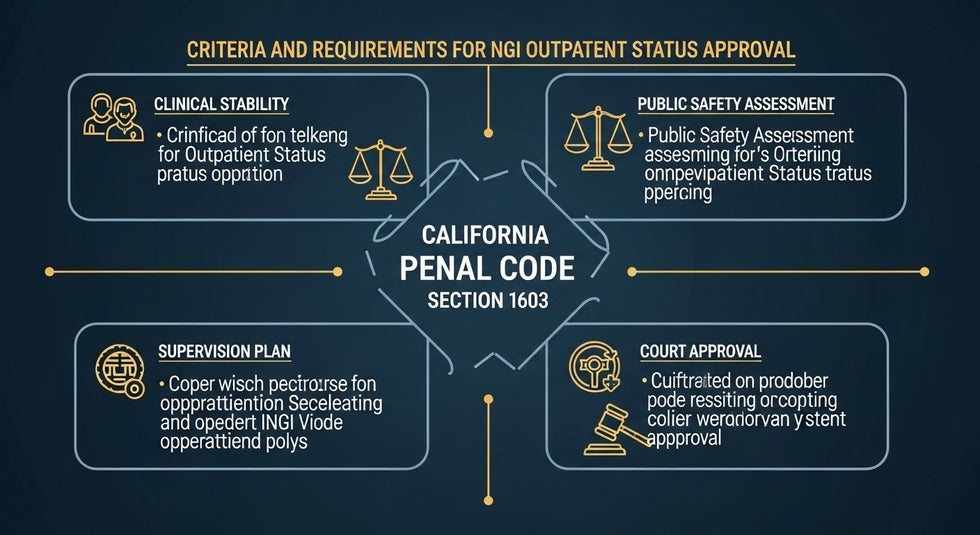
California Penal Code Section 1603 establishes specific criteria that courts must consider and procedural requirements that must be satisfied before approving outpatient status for NGI commitments.
These statutory requirements balance multiple competing interests: providing appropriate treatment settings for mentally ill defendants, protecting public safety, respecting victims' rights to information and input, and ensuring thorough evaluation before community placement occurs. Understanding these requirements helps defendants and their families navigate the outpatient approval process while recognizing the legitimate concerns that courts must address.
Treatment Facility Director's Professional Recommendation
The first criterion courts must consider involves the professional opinion of the director of the state hospital or treatment facility where the defendant is currently committed. This requirement ensures that the individuals who have directly supervised the defendant's treatment and observed their progress over extended periods provide input about community placement suitability.
The facility director must advise both the committing court and the prosecutor that the defendant would no longer present a danger to the health and safety of others, including themselves, while under supervision and treatment in the community. This safety assessment forms the cornerstone of the outpatient evaluation.
Treatment facility directors base these safety assessments on extensive observation, clinical evaluations, psychological testing, review of institutional behavior, and professional judgment developed through years of experience working with mentally ill offenders. These assessments carry significant weight because directors have detailed knowledge of the defendant's mental health status, treatment response, and behavioral patterns.
The director must also advise that the defendant will benefit from outpatient status. This requirement recognizes that community placement should serve therapeutic purposes, not simply reduce costs or free institutional bed space. Defendants who have plateaued in their progress or reached a point where community integration would enhance recovery are appropriate candidates for outpatient consideration.
Defense counsel should work closely with treatment teams well before formal outpatient recommendations to ensure that facility directors have complete information about their clients' progress, family support systems, and community treatment resources. Building strong cases for outpatient placement requires months of preparation demonstrating consistent stability and treatment engagement.
Community Program Director or Independent Panel Evaluation
The second criterion requires input from either the community program director, their designee, or an independent evaluation panel established under Welfare and Institutions Code Section 4360.5. This requirement ensures that professionals who would actually supervise outpatient treatment assess whether community placement is appropriate.
The community program director or panel must advise the court that the defendant will benefit from outpatient status. This duplicates the benefit assessment required from the treatment facility director but comes from a different perspective. While facility directors know the defendant's institutional behavior, community program directors understand local treatment resources and supervision capabilities.
Additionally, the community program director or panel must identify an appropriate program of supervision and treatment. This goes beyond simply concluding that outpatient placement might work in theory. Evaluators must specify actual treatment programs, supervision structures, and community resources that would serve the defendant's needs.
Identifying appropriate supervision and treatment programs requires detailed knowledge of what services exist in the community, which providers can work effectively with mentally ill offenders, what intensity of supervision the defendant requires, and how various community resources can be coordinated to create comprehensive support systems.
The dual evaluation requirement means courts receive professional opinions from both institutional treatment providers who know the defendant well and community professionals who understand local resources and supervision realities. This combination provides courts with balanced information for making informed decisions about outpatient placement.
Victim Notification Requirements and Rights
California law recognizes that victims of crimes committed by mentally ill defendants have legitimate interests in knowing about potential release to the community. Penal Code Section 1603 establishes specific notification requirements designed to ensure victims receive timely information about outpatient placement proceedings.
Before any defendant may be released to outpatient status, the prosecutor must provide notice of the hearing date and pending release to the victim or next of kin of the victim. This notification requirement only applies when the victim or next of kin has filed a request for notice with the court.
The statute places responsibility on victims to keep courts informed of current mailing addresses. This requirement balances victims' notification rights with practical realities of maintaining contact information over potentially lengthy commitment periods. Courts cannot notify victims at unknown addresses, so victims must actively maintain current contact information if they wish to receive notices.
Victim notification serves multiple purposes. It allows victims to attend court hearings where outpatient placement will be considered. It provides opportunities for victims to express their views about whether community placement is appropriate. It ensures victims are not surprised to encounter defendants unexpectedly in community settings.
However, victim notification rights do not give victims veto power over outpatient placement decisions. Courts must consider victim input as one factor among many when deciding whether to approve community supervision. Professional assessments of the defendant's mental health status, treatment progress, and dangerousness typically carry more weight than victim opposition based primarily on understandable anger about past offenses.
Defense attorneys should approach victim concerns respectfully while advocating effectively for their clients. Proposing conditions like no contact orders, geographic restrictions keeping defendants away from victims' neighborhoods, or other safeguards can sometimes address victim concerns while still permitting outpatient placement.
Day Release Program Notifications
Beyond notifications about potential outpatient placement, the statute requires treatment facility directors to notify victims who have filed requests about any programs allowing defendants day release unattended by facility staff. This notification requirement applies to various step-down programs that institutions use to gradually transition defendants toward community living.
Day release programs might include allowing defendants to attend community treatment appointments alone, permitting unsupervised visits with family members, authorizing shopping trips or recreational activities in the community, or other gradual reintegration activities that occur before full outpatient placement.
These programs represent important steps in the treatment process. They allow clinical teams to assess how defendants function with increasing independence, identify problems that might arise in less structured settings, and build confidence in community functioning before recommending full outpatient status.
Victim notification about day release programs ensures that victims are not caught off guard by unexpected encounters with defendants in community settings. It also provides victims opportunities to express concerns if they believe day release presents safety risks.
Defense counsel should ensure that treatment facility directors maintain updated victim contact information and provide required notifications. Failures to notify victims properly can derail outpatient placement proceedings and create unnecessary complications even when defendants have made excellent treatment progress.
The Thirty Day Evaluation Timeline
The statute establishes a specific timeline for community program directors, their designees, or independent evaluation panels to complete required evaluations and treatment plans. These evaluations and plans must be submitted to the court within 30 calendar days after the court notifies evaluators to proceed.
This 30 day timeline ensures prompt evaluation while providing sufficient time for thorough assessment. Community program directors need time to review institutional records, interview defendants, consult with treatment providers, identify appropriate community resources, and develop detailed supervision plans.
The evaluation submitted to courts must include the treatment plan specified in the statute. This plan should detail specific treatment services the defendant will receive, supervision structures that will monitor compliance and safety, living arrangements in the community, medication management procedures, and responses to potential problems.
Comprehensive treatment plans significantly increase the likelihood of court approval for outpatient placement. Courts need confidence that detailed planning has occurred to address foreseeable issues. Vague or incomplete plans suggest inadequate preparation and may lead courts to deny outpatient requests even for defendants who have made substantial progress.
Defense attorneys can assist in developing strong treatment plans by identifying community resources, facilitating connections between defendants and potential treatment providers, arranging appropriate housing options, and ensuring that plans address specific concerns courts typically raise.
Review of Criminal Offense and Prior History
The statute specifically requires that evaluations and recommendations include review and consideration of complete, available information regarding the circumstances of the criminal offense and the defendant's prior criminal history. This requirement ensures that evaluators have full context about the defendant's background when assessing community placement suitability.
Understanding the circumstances of the commitment offense helps evaluators assess what factors contributed to the criminal conduct, how the defendant's mental illness influenced their behavior, whether similar circumstances might arise in community settings, and what safeguards might prevent similar incidents.
Prior criminal history provides important context about patterns of behavior, substance abuse issues, violence history, treatment compliance in the past, and other factors relevant to risk assessment. Defendants with extensive violent histories typically face greater scrutiny than those whose commitment offenses represented isolated incidents during acute psychiatric crises.
However, criminal history alone should not automatically disqualify defendants from outpatient consideration. Many individuals with serious criminal backgrounds achieve stability through effective treatment and can safely transition to community supervision with appropriate support structures.
Defense counsel should ensure that evaluators understand the full context of criminal history, not just raw arrest data. This includes providing information about charges that were dismissed, conduct that occurred during untreated mental illness, the role of substance abuse, and evidence showing how treatment has addressed underlying issues.
Court Hearing and Specific Approval Requirements
Even after receiving positive recommendations from treatment facility directors and community program directors, courts must conduct hearings and specifically approve outpatient placement. This judicial review ensures that community placement decisions receive careful consideration rather than automatic approval based solely on professional recommendations.
Court hearings on outpatient placement provide opportunities for prosecutors to present opposition, victims to express concerns, defense counsel to advocate for community placement, and expert witnesses to testify about the defendant's progress and suitability for outpatient supervision.
The statute requires courts to "specifically approve" the recommendation and plan for outpatient status. This language indicates that courts must make individualized determinations based on the particular facts of each case rather than applying rubber stamp approval to professional recommendations.
Courts typically consider multiple factors during these hearings beyond the statutory criteria. These include the severity of the commitment offense, the length of time since commitment, the defendant's institutional behavior, the comprehensiveness of the proposed supervision plan, the quality of community support systems, and the availability of appropriate treatment resources.
Defense attorneys should prepare thoroughly for outpatient hearings by gathering supporting documentation, identifying witnesses who can testify about the defendant's progress, anticipating prosecutorial objections, and developing responses to likely concerns. Effective advocacy during these hearings can make the difference between approval and denial of outpatient placement.
Building Strong Cases for Outpatient Approval
Successfully obtaining court approval for outpatient status requires more than simply meeting minimum statutory criteria. Defendants and their attorneys should focus on building compelling cases that address all potential concerns comprehensively.
Sustained treatment progress over extended periods provides the strongest foundation for outpatient applications. Courts want to see consistent stability rather than recent improvement that might not be sustained. Documentation showing months or years of treatment compliance, medication adherence, symptom management, and appropriate behavior creates confidence in community placement.
Understanding of mental illness and personal responsibility demonstrates that defendants recognize their psychiatric conditions, understand how symptoms affected their past behavior, and have developed tools to manage mental health issues. This insight reduces risk of treatment noncompliance or crisis situations.
Comprehensive support systems including family involvement, housing stability, employment or educational opportunities, and connections to community mental health providers show that defendants will have resources to maintain stability. Strong support systems provide safety nets when challenges arise.
Detailed supervision plans that specify exactly how treatment will be delivered, who will provide supervision, how compliance will be monitored, and how problems will be addressed quickly give courts confidence that adequate oversight will exist in community settings.
When Courts Deny Outpatient Placement
Not all outpatient applications receive court approval, even when defendants have made significant progress. Understanding common reasons for denial helps defendants and attorneys address concerns in future applications.
Courts may deny outpatient placement when insufficient time has passed since commitment, when institutional behavioral problems suggest instability, when supervision plans lack adequate detail or fail to address specific concerns, when victims present compelling safety concerns, or when defendants have not achieved sufficient insight into their mental illness.
Denials do not necessarily mean defendants can never achieve outpatient status. Instead, they indicate that courts need additional evidence of stability, more comprehensive planning, or longer periods of sustained progress before approving community placement.
Defense counsel should request specific feedback from courts when outpatient applications are denied. Understanding exactly what concerns led to denial allows attorneys and defendants to address those issues and strengthen future applications.
Experienced Legal Representation for Outpatient Status Proceedings
Obtaining court approval for outpatient placement after NGI commitment requires skilled legal representation and thorough preparation. At Bulldog Law, we represent clients throughout the outpatient application process, working to achieve appropriate community placements while protecting client rights.
We collaborate with treatment providers to develop comprehensive supervision plans, gather evidence of our clients' progress and stability, prepare persuasive presentations for court hearings, and address prosecutor and victim concerns effectively. Our experience with NGI proceedings allows us to anticipate obstacles and develop strategies to overcome them.
If you or a family member has been found not guilty by reason of insanity and wishes to pursue outpatient placement, contact our office for a confidential consultation. We provide aggressive, knowledgeable representation focused on achieving the best possible outcomes while ensuring fair treatment throughout the commitment process.