
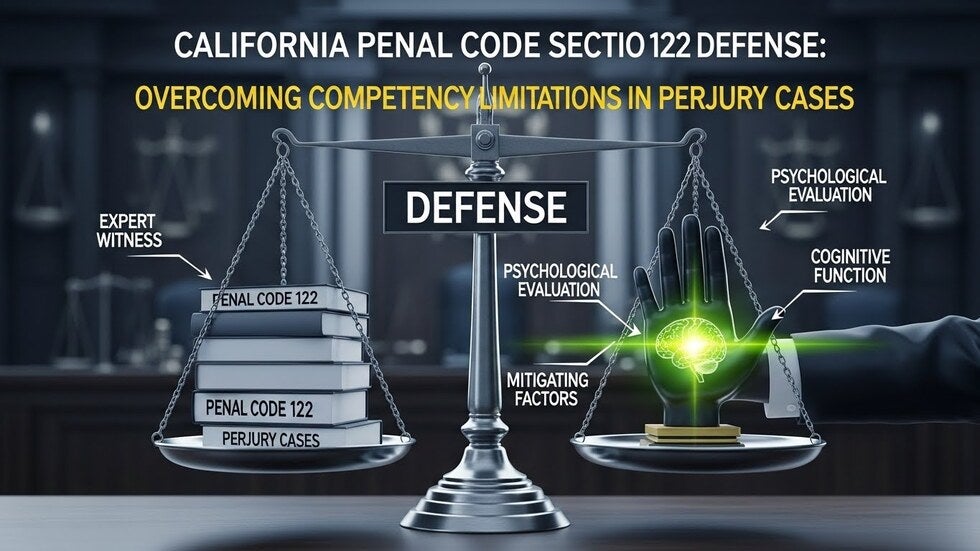
California Penal Code Section 122 represents one of the harshest provisions in perjury law, eliminating what many defendants assume would be a natural defense to false statement charges.
This statute declares that incompetence to give testimony doesn't constitute a defense to perjury prosecutions, creating significant challenges for defendants who believed their statements were legally meaningless.
Understanding both this limitation and alternative defense strategies becomes crucial when facing perjury allegations despite competency concerns.
Understanding the Harsh Reality of California Penal Code Section 122
California Penal Code Section 122 eliminates competency as a defense to perjury charges, establishing that defendants can face criminal liability for false statements even when they lacked legal authority to provide testimony, depositions, or certificates. This provision reflects the legislature's determination to prevent individuals from escaping perjury consequences through technical competency arguments.
The statute's language is deliberately broad and unforgiving, stating that it's "sufficient that the accused did give such testimony or make such deposition or certificate" regardless of their competence to do so. This approach prioritizes the integrity of legal proceedings over individual defendants' technical legal standing.
From a defense perspective, Section 122 creates immediate challenges by foreclosing what might seem like obvious arguments about defendants' authority or qualification to provide sworn statements. Many defendants facing perjury charges naturally assume that their lack of competency would shield them from criminal liability.
However, the statute's elimination of competency defenses doesn't end all defense possibilities. While defendants cannot argue they lacked competence to testify, other fundamental perjury elements remain available for challenge, including intent, materiality, and the truth or falsity of statements.
Understanding Section 122's limitations helps defense attorneys focus their efforts on viable defense theories rather than pursuing futile competency arguments that California law explicitly rejects.
The Legislative Intent Behind Section 122
The legislature's decision to eliminate competency defenses through Section 122 reflects concerns about maintaining the integrity of legal proceedings and preventing manipulation of competency rules to avoid perjury liability. Without this provision, defendants might escape consequences for deliberately false statements by claiming they lacked standing or authority to testify.
This legislative approach recognizes that allowing competency defenses could create perverse incentives for individuals to provide false testimony while claiming they had no right to testify in the first place. Such a system would undermine the truth-seeking function of legal proceedings and create loopholes for deliberate deception.
The statute also reflects practical recognition that many legal proceedings involve testimony from individuals whose competency might be technically questionable but whose statements significantly impact case outcomes. Allowing competency defenses in these situations could create chaos in legal proceedings.
However, the legislature's broad approach through Section 122 can create harsh results for defendants who genuinely believed their statements were legally meaningless or who were encouraged to testify despite competency concerns.
Defense attorneys must work within this legislative framework while identifying other viable defense theories that address the fundamental elements of perjury charges.
Alternative Defense Strategies When Competency Is Unavailable
While Section 122 eliminates competency defenses, experienced defense attorneys can pursue numerous alternative strategies that address other essential elements of perjury prosecutions. The statute doesn't eliminate all defenses; it merely forecloses one specific argument.
Intent represents perhaps the most crucial alternative defense avenue. Prosecutors must prove that defendants knowingly made false statements with intent to deceive. When defendants genuinely believed their statements were truthful or acted without intent to mislead, these circumstances can support complete acquittal even when competency defenses are unavailable.
The materiality element provides another fundamental defense opportunity. Prosecutors must establish that false statements were material to the proceedings in which they were made. When alleged false testimony didn't affect case outcomes or involved trivial matters, materiality challenges can result in dismissal regardless of competency issues.
Challenging the truth or falsity of statements remains available despite Section 122's limitations. When defendants can demonstrate that their statements were actually truthful or that prosecutors cannot prove falsity beyond a reasonable doubt, these factual defenses can succeed without relying on competency arguments.
Constitutional defenses may also apply in appropriate cases, particularly involving due process violations, inadequate notice of perjury exposure, or other fundamental rights concerns that operate independently of competency issues.
The Intersection of Section 122 with Mental Health Defenses
While Section 122 eliminates competency to testify as a defense, it doesn't necessarily preclude all mental health-related defenses in perjury cases. The distinction between competence to testify and mental capacity to form criminal intent creates potential defense opportunities that operate independently of Section 122's limitations.
Mental health conditions that affected defendants' ability to understand the nature of their statements or form intent to deceive may support defenses that don't rely on testimonial competency. These defenses focus on defendants' mental state at the time of alleged false statements rather than their legal authority to testify.
However, pursuing mental health defenses in perjury cases requires careful strategic consideration. Such defenses may involve complex psychiatric evaluations, expert testimony, and potential competency proceedings that can complicate case resolution and create additional risks for defendants.
The relationship between Section 122 and insanity defenses remains complex and fact-specific. While the statute eliminates testimonial competency defenses, it doesn't necessarily preclude arguments about defendants' mental capacity to form the specific intent required for perjury convictions.
Defense attorneys must carefully analyze whether mental health issues affected defendants' intent to deceive rather than merely their competence to provide testimony.
Procedural Implications of Section 122
Section 122's elimination of competency defenses creates important procedural implications for perjury prosecutions. Defense attorneys cannot pursue pretrial motions based solely on clients' incompetence to testify, requiring alternative approaches to case resolution.
The statute's broad language affects discovery strategies in perjury cases. While defendants cannot pursue competency-based defenses, they may still need competency-related evidence to support alternative defense theories about intent, understanding, or other mental state issues.
Plea negotiation strategies must account for Section 122's limitations while identifying other factors that might influence prosecutorial charging decisions or sentencing recommendations. The inability to pursue competency defenses may require greater emphasis on mitigation evidence and alternative resolution approaches.
Trial strategy in Section 122 cases must focus on viable defense theories while avoiding futile competency arguments that could undermine credibility with judges and juries. Effective advocacy requires clear focus on elements prosecutors can actually be challenged on.
Expert Testimony and Section 122 Limitations
The elimination of competency defenses through Section 122 affects how expert witnesses can contribute to perjury defense cases. While experts cannot testify about defendants' competence to provide testimony, they may still offer valuable insights about other defense-relevant issues.
Mental health experts might testify about defendants' capacity to form intent to deceive, understand the nature of their statements, or appreciate the legal significance of their testimony. These expert opinions can support intent-based defenses without running afoul of Section 122's competency prohibition.
Legal experts occasionally contribute to perjury defenses by explaining complex procedural requirements, the nature of different types of proceedings, or other technical issues that might affect materiality or other elements of prosecution cases.
However, defense attorneys must carefully structure expert testimony to avoid implicit competency arguments that Section 122 prohibits while still providing valuable information to support viable defense theories.
Strategic Considerations for Defendants
Understanding Section 122's limitations helps defendants and their attorneys develop realistic expectations about available defense options in perjury cases. While the statute eliminates certain arguments, it doesn't preclude effective defense representation or favorable case outcomes.
Early case evaluation becomes particularly important when Section 122 issues arise. Defense attorneys must quickly identify viable defense theories while avoiding time and resources on competency arguments that California law prohibits.
The relationship between Section 122 and parallel civil proceedings can create additional strategic considerations. Defendants may face both criminal perjury charges and civil consequences related to the same alleged false statements, requiring coordinated defense approaches.
Client counseling in Section 122 cases must address both the elimination of competency defenses and the availability of alternative strategies that can still result in favorable outcomes.
Protecting Your Rights Despite Section 122's Limitations
While California Penal Code Section 122 eliminates competency defenses in perjury cases, it doesn't eliminate all defense possibilities or guarantee prosecutorial success. Experienced criminal defense attorneys can develop effective strategies that work within the statute's limitations while aggressively challenging other elements of perjury charges.
The key to successful defense in Section 122 cases lies in understanding which arguments remain viable and focusing legal efforts on theories that can actually succeed under California law. Intent, materiality, and factual challenges all remain available despite competency limitations.
Defendants facing perjury charges should not assume that Section 122's elimination of competency defenses makes their cases hopeless. Many perjury prosecutions can be successfully defended through alternative strategies that address fundamental weaknesses in prosecution cases.
Conclusion: Working Within Section 122's Framework
California Penal Code Section 122 creates significant challenges for perjury defendants by eliminating competency defenses, but it doesn't eliminate all defense possibilities or guarantee conviction. Understanding both the statute's limitations and available alternatives becomes crucial for effective defense representation.
The elimination of competency arguments requires defense attorneys to focus their efforts on viable theories while developing comprehensive strategies that address the fundamental elements of perjury prosecutions.
If you're facing perjury charges and believe competency issues might be relevant to your case, don't assume that Section 122 makes defense impossible. Experienced criminal defense counsel can evaluate your situation and develop alternative strategies that work within California law's requirements.
Contact qualified defense attorneys immediately to analyze your case and identify the most effective defense approaches available despite Section 122's limitations. Your rights and freedom deserve aggressive representation that maximizes every available legal opportunity.
This article provides general information about California Penal Code Section 122 from a defense perspective. Every case involves unique circumstances requiring individualized legal analysis and strategy development by qualified criminal defense attorneys experienced in perjury law and alternative defense theories.