
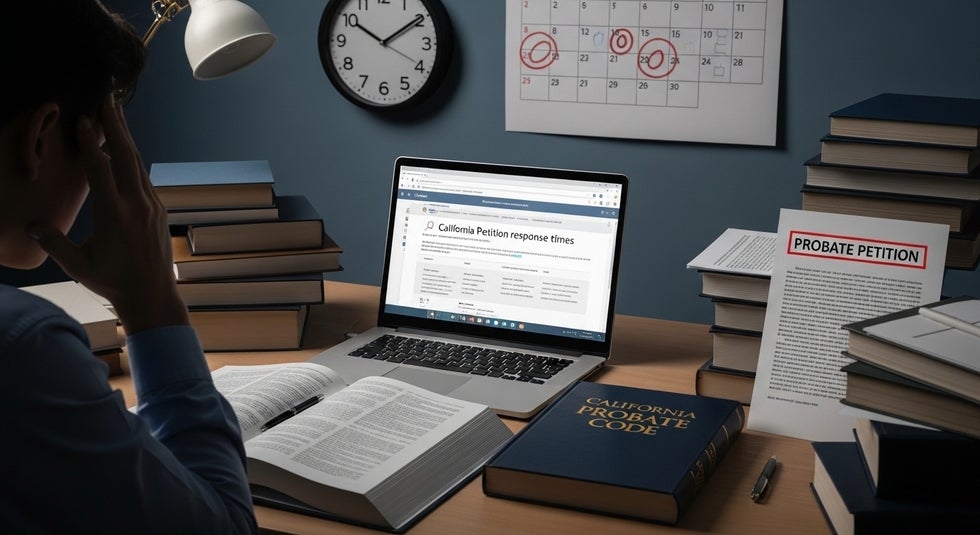
The Clock Starts the Moment You Are Served
Most people assume they have weeks to figure out their next move after receiving legal papers. In a California probate proceeding, that assumption can be a costly mistake. Under Probate Code Section 1290.6, the deadline to serve and file your response is far shorter than most respondents expect — and missing it carries consequences that are very difficult to walk back.
If you have been served with a probate petition, understanding this deadline is not just useful background information. It is the single most time sensitive piece of knowledge you need right now.
The 10 Day Rule: Shorter Than You Think
When a probate petition is served on you through personal service or standard methods of notice, you have just 10 days to serve and file your response. Ten days. That is not a typo, and it is not a guideline — it is a legal deadline under California law.
Think about what ten days actually means in practice. There is a weekend in there. There may be holidays. You need time to read and understand the petition, locate an attorney, have a consultation, retain counsel, give your attorney enough background to draft a meaningful response, review that draft, finalize it, and get it served and filed with the court. All of that has to happen inside a window that is gone almost before you realize it opened.
This is not a deadline designed with the respondent's convenience in mind. It is short by design, and it rewards people who act immediately after being served. If you have been reading this after receiving service and you are already a few days in, stop reading and call an attorney today.
You can find additional context about what it means to be a respondent in a California probate case on the Bulldog Law blog, including a breakdown of what happens if no response is filed at all.
When You Get 30 Days Instead
There is one circumstance under Probate Code 1290.6 where the deadline extends to 30 days: when the petition is served by publication or posting under the method described in Section 1290.4(b)(2). This type of service is typically used when a respondent's address is unknown or when standard personal service has not been possible.
Thirty days is meaningfully more breathing room, but it still passes quickly especially when legal proceedings, family stress, and the practical demands of daily life are all competing for your attention at the same time. Thirty days feels long until it does not.
If you are not sure which method of service was used in your case, that is something to clarify right away. The difference between 10 days and 30 days is significant, and you want to know exactly how much time you are working with before making any assumptions about your schedule.
Two Ways the Deadline Can Be Extended
The law does recognize that rigid deadlines are not always workable, and it provides two legitimate paths to more time.
The first is a written agreement between the parties. If both sides consent in writing to extend the deadline for filing a response, that agreement is valid and enforceable. This kind of stipulation is not uncommon in cases where both parties want more time to explore settlement or where the issues are complex enough that a rushed response would not serve anyone well. However, this requires the other side to agree — and there is no guarantee they will.
The second path is a court order. If you can demonstrate good cause, a judge has the authority to extend the time for serving and filing your response. What constitutes good cause depends on the specific facts of your situation, but it typically involves circumstances beyond your control that prevented you from meeting the original deadline. Courts do not grant these extensions casually, and simply failing to act quickly enough on your own is unlikely to qualify.
In either case, pursuing an extension is not a substitute for moving quickly from the start. Extensions are a safety valve for genuine emergencies, not a routine workaround for delays that could have been avoided.
What Happens If You Miss the Deadline
This is the question that matters most, and the answer is serious. As we have covered on the Bulldog Law blog, California Probate Code 1290 establishes that when a respondent who has been properly served does not file a response, the allegations in the petition are deemed admitted. Every factual claim the petitioner made is treated as true by default.
Missing the response deadline does not just put you behind — it can effectively end your ability to contest the case on the merits. The petitioner does not have to prove anything that you have already conceded through your silence. A court proceeding that might have gone in your favor now faces a much steeper climb, and in many cases the opportunity to present a defense at all may be gone.
This is not meant to frighten you. It is meant to make the stakes completely clear. The rules exist, they are enforced, and the courts do not generally offer respondents second chances simply because the deadline seemed unfair or confusing.
Why Respondents Need a Defense Attorney Immediately
There is a common pattern in probate disputes where respondents initially believe they can handle things themselves, or that the matter will resolve informally before it reaches a court hearing. Sometimes that is true. More often, by the time a petition has been filed and served, the other side is already several steps ahead they have retained counsel, they have framed the narrative in their favor, and they have set a hearing date.
Going into that process without representation and without a timely filed response puts you at an enormous disadvantage. An experienced probate defense attorney can assess the petition, identify weaknesses in the claims being made, negotiate an extension if one is genuinely warranted, and file a response that preserves every available defense on your behalf.
The 10 day deadline under Probate Code 1290.6 is the first test of how seriously you are taking this proceeding. Treat it accordingly.
If you are looking for more information on probate proceedings, respondent rights, and what to expect in a contested matter, browse the resources available at the Bulldog Law blog. And if you have already been served, do not wait another day to get legal guidance.
We offer criminal defense, immigration, personal injury and cryptocurrency legal services in both English and Spanish. Call us at (888) 928-1609 for a free consultation.