
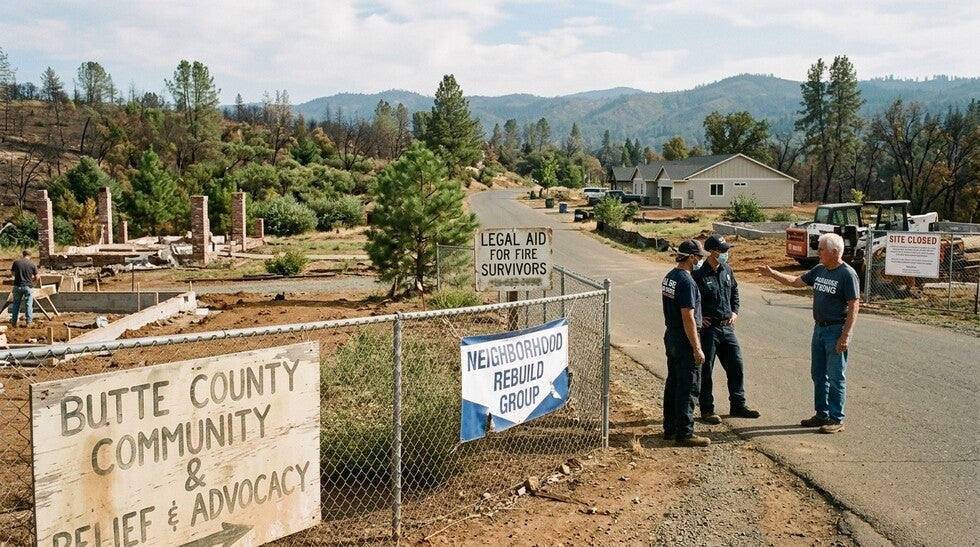
Camp Fire-Related Criminal Cases in Butte County require more than a generic criminal defense strategy. The 2018 Camp Fire destroyed thousands of homes and businesses across Paradise, Concow, Magalia, and surrounding communities. The years that followed produced insurance claims, contractor relationships, FEMA applications, permit disputes, temporary housing arrangements, storage conflicts, and property disagreements that can sometimes be misread as criminal conduct.
Some cases involve real fraud allegations. Others begin as civil disputes, documentation gaps, valuation disagreements, contractor disagreements, or post-disaster confusion. The defense must separate criminal intent from good-faith mistakes, incomplete records, unclear agreements, emotional pressure, displacement, and the practical reality of rebuilding after catastrophic loss.
Camp Fire-Related Criminal Cases in Butte County and criminal intent
The most important question in many Camp Fire-related cases is not whether a form was imperfect, a contractor dispute occurred, or an insurance company disagreed with a loss estimate. The question is whether prosecutors can prove beyond a reasonable doubt that the accused person acted with the required criminal intent.
That distinction matters in insurance fraud, contractor fraud, theft, false statements, FEMA fraud, permit cases, and property disputes. A person may be wrong without being criminal. A claim may be overstated because records were destroyed, memories were imperfect, or valuation was difficult. A contractor may have performed poor work or fallen behind schedule without intending to steal. A displaced family may have a genuine ownership dispute over stored property without committing theft.
Bulldog Law's article on when a civil dispute becomes a criminal case is especially relevant because many post-disaster allegations start in paperwork, contracts, insurance negotiations, or property disagreements before law enforcement gets involved.
Camp Fire insurance fraud allegations and loss documentation
Camp Fire insurance claims were unusually difficult. Many homeowners lost not only structures, but also receipts, photos, inventories, tax records, electronics, heirlooms, business documents, and proof of ownership. That makes later reconstruction of contents, additional living expenses, repairs, business interruption, and replacement costs complicated.
Insurance fraud allegations may arise when prosecutors claim a person knowingly submitted false information to obtain payment. The defense should examine whether the statement was actually false, whether the person knew it was false, whether the person intended to deceive, and whether the issue was instead a good-faith dispute over valuation, coverage, category, timing, or documentation.
Important evidence can include:
- Insurance policies, declarations, endorsements, and coverage letters.
- Emails, claim notes, adjuster communications, and recorded statements.
- Pre-fire photos, family records, receipts, tax documents, and bank statements.
- Contractor estimates, repair invoices, debris removal documents, and permit records.
- Additional living expense records, hotel receipts, rental records, and mileage logs.
- Documents showing what records were destroyed in the fire itself.
Insurance issues can also affect people outside the criminal court system. For example, HOA owner insurance protection in personal lawsuits shows why coverage language and defense obligations can matter when property damage or personal liability disputes arise after a community-wide event.
Paradise rebuild contractor fraud and unlicensed contracting
Paradise reconstruction created enormous demand for contractors, subcontractors, debris removal, grading, foundation work, framing, roofing, plumbing, electrical, HVAC, finish work, and repair services. That demand also created disputes over deposits, scope of work, change orders, delays, materials, code compliance, workmanship, and licensing.
Business and Professions Code section 7028 can apply when someone acts as a contractor without the required California contractor license. A first conviction can carry misdemeanor exposure, and repeat violations can become more serious. But the defense should examine the exact work performed, the price, whether the person was acting as a contractor, whether an exemption applies, what license classification was allegedly required, and what the homeowner understood.
Contractor fraud is different from unlicensed contracting. Fraud requires proof of deception and intent. A contractor who accepted money and never intended to perform is in a different position from someone who performed work, encountered supply shortages, changed scope, misunderstood a permit requirement, or became involved in a civil payment dispute.
Rental, repair, and access disputes can also be mischaracterized. Bulldog Law's discussion of rental disputes turning into criminal allegations helps explain why disagreements over property, possession, payment, and access should not automatically be treated as crimes.
Permit violations and unauthorized construction during the rebuild
Rebuilding after the Camp Fire required navigating permits, inspections, local code requirements, fire safety standards, rebuilding rules, debris removal requirements, utility issues, and occupancy rules. Some homeowners and contractors became accused of performing work without the right permit, working outside the scope of an approved permit, or occupying a structure before final approval.
Permit-related cases can involve local code enforcement, administrative penalties, civil remedies, or misdemeanor allegations. The defense should determine what permit was required, whether an application was pending, whether the accused relied on a contractor, whether the rule changed, whether the work was emergency stabilization, and whether the alleged violation was knowing or accidental.
In many cases, the practical pressure to return home after displacement explains why decisions were made quickly. That explanation does not automatically defeat a charge, but it can be important to intent, mitigation, negotiations, and whether a compliance-based resolution is appropriate.
FEMA assistance disputes and federal exposure
FEMA disaster assistance cases may involve allegations of inflated claims, duplicate benefits, false addresses, household composition disputes, occupancy issues, or applications for property not actually affected. These cases can be federal, and federal procedure is different from a state criminal case in Butte County Superior Court.
The defense should evaluate whether the applicant understood the eligibility rules, whether the application information was accurate when submitted, whether any error was corrected, whether the applicant relied on someone else, whether displacement created confusion about residence, and whether the government can prove knowing false statements or fraud.
A FEMA fraud allegation should be treated seriously from the beginning. Federal agents, subpoenas, search warrants, interviews, bank records, disaster-assistance records, and electronic applications can all become evidence. A person should not try to explain the application alone without counsel.
Displaced community property and possession cases
The Camp Fire displaced families into hotels, rentals, RVs, shared homes, storage units, relatives' properties, temporary shelters, and out-of-county housing. That displacement created unusual property arrangements. Belongings were stored together, moved by friends, recovered from lots, donated, salvaged, replaced, or held for long periods.
These facts can generate theft, embezzlement, possession of stolen property, trespass, burglary, or fraud allegations. But criminal intent may be difficult to prove when the real issue is unclear ownership, shared storage, missing receipts, family conflict, contractor access, abandoned property assumptions, or confusion after displacement.
Defense evidence may include:
- Storage agreements, rental records, moving receipts, and text messages.
- Photos showing where property was kept before and after the fire.
- Insurance inventories and replacement lists.
- Witnesses who helped move, store, or recover property.
- Donation, salvage, cleanup, or debris-removal records.
- Communications showing permission or a good-faith belief in permission.
Insurance exclusions can also shape expectations. Bulldog Law's article on homeowner insurance and stolen cryptocurrency illustrates how policy limits, exclusions, and nontraditional property losses can surprise people who assume insurance covers every category of loss.
HOA, community association, and shared-property insurance issues
Some Camp Fire-related disputes may involve homeowners associations, shared roads, common areas, community facilities, association insurance, board notices, special assessments, repair obligations, or member communications. These disputes are usually civil, but they can become part of a criminal investigation if prosecutors allege false claims, misuse of funds, theft, embezzlement, or intentional concealment.
HOA insurance requirements can matter when multiple owners, board members, contractors, and insurers are involved. Bulldog Law's article on California HOA crime insurance requirements explains why association coverage can become important when allegations involve theft, dishonesty, or misuse of association funds.
Member notice can also matter. If an association changed coverage, reduced limits, or failed to explain insurance changes after a disaster, the dispute may affect civil liability, board governance, and member expectations. Bulldog Law's guide to HOA insurance alerts and member notifications addresses why communication records can become critical.
When a dispute focuses on whether coverage changed, whether members were warned, or whether a board acted properly, HOA insurance notification requirements for coverage changes can help frame the distinction between civil governance issues and possible criminal allegations.
Insurance consequences after related criminal cases
A criminal case can affect insurance in ways that extend beyond the courtroom. Insurers may deny coverage, reserve rights, raise premiums, investigate misrepresentation, or use a conviction to support exclusion arguments. The impact depends on the policy, the conduct, the final conviction, and whether the alleged act was intentional, negligent, accidental, or unrelated to coverage.
Even unrelated criminal cases can create insurance consequences. Bulldog Law's article on how insurance may change after a DUI shows how a criminal conviction can affect financial life long after the court case ends.
In Camp Fire-related cases, the defense should coordinate criminal exposure with insurance consequences. A plea that sounds minor in criminal court may create problems with coverage, restitution, civil litigation, professional licensing, government benefits, or future rebuilding claims.
Virtual assets, cryptocurrency, and nontraditional property losses
Not every post-disaster loss involves furniture, tools, vehicles, or construction materials. Some claims or disputes may involve cryptocurrency, digital wallets, online accounts, NFTs, digital business records, gaming assets, or virtual property. These assets may not fit neatly into traditional insurance categories.
When a person reports digital asset loss after a fire, hack, theft, or device destruction, the defense should examine wallet records, exchange histories, blockchain transactions, device backups, cloud records, insurance policy language, and whether the alleged loss was covered at all.
Bulldog Law's article on why traditional insurance can fail cryptocurrency holders is relevant when a dispute involves digital property that insurers, prosecutors, or investigators may not fully understand.
Arson allegations after the Camp Fire
The Camp Fire itself was attributed to utility equipment failure, not arson. But separate fires after 2018 can still lead to arson allegations in Paradise, Magalia, Concow, Chico, Oroville, or other Butte County communities. Those cases require independent fire investigation and should not be treated as connected to the Camp Fire unless the evidence supports that connection.
Arson defense may involve origin-and-cause analysis, weather, electrical systems, accelerant testing, witness timing, video, motive, expert review, and whether the fire was accidental, electrical, weather-related, negligent, or intentionally set. Prosecutors must still prove the elements of the charged offense beyond a reasonable doubt.
Where Camp Fire-Related Criminal Cases in Butte County are handled
State criminal cases in Butte County are handled in the Superior Court of California, County of Butte. The North Butte County Courthouse is located at 1775 Concord Avenue, Chico, CA 95928. The Butte County Courthouse is located at One Court Street, Oroville, CA 95965-3303. These are public court facilities, and Bulldog Law has no affiliation, endorsement, partnership, special access, or special relationship with the court.
Many Paradise, Concow, Magalia, and Chico-area state criminal cases may be associated with the North Butte County Courthouse, while assignment can depend on court procedures, filing location, offense type, and current local practice. Federal matters, including many FEMA fraud allegations, may proceed in federal court rather than Butte County Superior Court.
A Camp Fire-related criminal case may involve arraignment, protective orders, bail or release conditions, discovery, subpoenas, financial records, insurer communications, expert review, restitution claims, negotiations, preliminary hearing, trial, and parallel civil or administrative disputes.
What to do after a Camp Fire-related arrest or investigation
Do not make statements about insurance claims, FEMA applications, contractor work, permits, property ownership, storage, or rebuild disputes without legal advice. These cases are document-heavy, and an informal explanation can be misinterpreted or used as an admission.
Practical steps include:
- Preserve insurance claims, policies, adjuster emails, inventories, and payment records.
- Save FEMA applications, letters, benefit records, and appeal documents.
- Keep contractor agreements, invoices, permits, inspection reports, and change orders.
- Do not delete texts, emails, photos, accounting files, or cloud records.
- Preserve receipts, bank statements, tax records, and proof of destroyed documents.
- Identify witnesses who understood the rebuild, storage, or property arrangement.
- Do not contact alleged victims or insurers in a way that could worsen the case.
- Tell counsel immediately if federal agents, FEMA investigators, or insurance investigators are involved.
Camp Fire-Related Criminal Cases in Butte County lawyers in California
Bulldog Law helps clients facing Camp Fire-Related Criminal Cases in Butte County, including Paradise rebuild fraud allegations, insurance fraud investigations, contractor disputes, unlicensed contractor charges, permit violations, FEMA-related federal exposure, displaced community property cases, HOA insurance disputes, and related civil-criminal crossover issues.
No lawyer can promise dismissal, reduction, or a specific outcome. What Bulldog Law can do is review the documents, identify civil disputes that have been overcharged, challenge intent, preserve insurance and rebuild evidence, coordinate federal and state issues, and build a defense that accounts for the unique facts of the Camp Fire recovery.