
Updated November 2026 | The Bulldog Law | California Criminal Defense
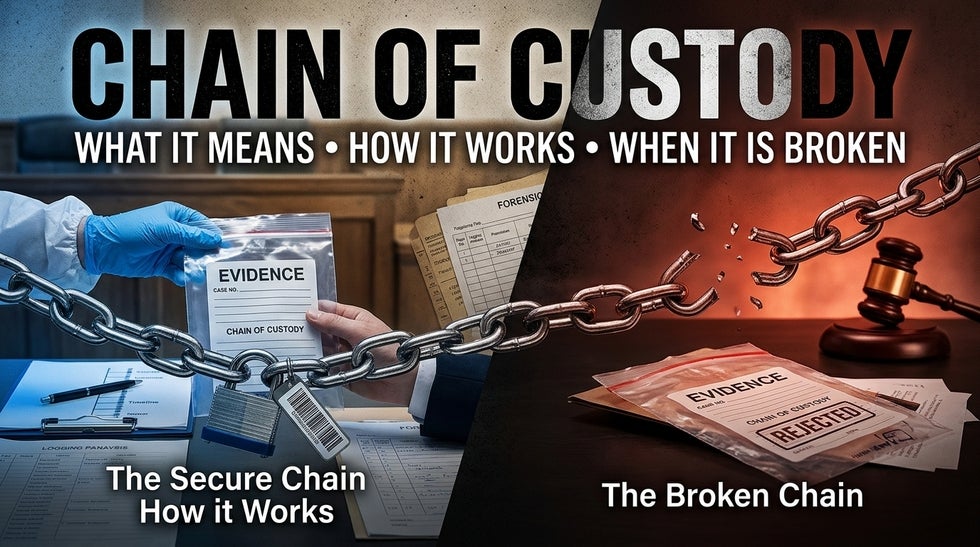
Chain of custody is the documented record of every person who collected, handled, stored, and tested a piece of evidence, from the moment police seized it to the moment it is shown to a jury. It exists to prove two things: that the item in court is the same one taken at the scene, and that nobody changed it along the way. When the record has an unexplained gap, a judge can exclude the evidence or the jury can discount it, and in cases built on a lab result that is often the end of the prosecution.
Our attorneys request the complete custody records in every case that involves drugs, blood, DNA, a firearm, or a phone. The paperwork is tedious, and it is where a surprising number of cases come apart.
What chain of custody means
Before any object can be used as evidence, the party offering it has to authenticate it: show that it is what they claim it is. California's rule is in Evidence Code 1400 and the sections that follow. A gun with a serial number or a signed letter can be recognized on sight by a witness. A plastic bag of white powder cannot. For evidence that looks like every other item of its kind, the chain of custody is the method of authentication: a continuous account of possession that connects the item on the witness stand to the defendant's case.
The links in the chain
|
Step |
What should be documented |
Common failures |
|
Collection |
Who found the item, where, when; photographs before it is moved |
No photographs; several officers and no record of who collected what |
|
Packaging and sealing |
Separate container for each item; tamper-evident seal initialed and dated |
Items packaged together; unsealed or resealed containers |
|
Labeling |
Case number, item number, description, collector's name |
Wrong case number; descriptions that do not match the item |
|
Transport |
Who carried it from the scene and how long it took |
Evidence left in a patrol car or locker with no entry |
|
Storage |
Booking into a secure property room; temperature control where required; access log |
Unlogged access; refrigeration failures for biological samples |
|
Transfer to the lab |
Signed release and signed receipt, with dates and times |
Time gaps between release and receipt |
|
Analysis |
Analyst's identity, condition of the seal on arrival, bench notes, what was consumed in testing |
Seal condition not recorded; samples from different cases handled together |
|
Return and court |
Return to storage, release to the prosecutor, presentation at trial |
Weight or count differs from the original report |
Each transfer adds a link. The more hands an item passes through, the more entries there must be, and the more places a record can fail.
The legal standard in California
The prosecution does not have to prove a perfect chain. Under People v. Riser, a decision the California Supreme Court has followed for decades, the party offering the evidence must show that, taking all the circumstances into account, including the ease or difficulty of tampering with that kind of item, it is reasonably certain there was no alteration.
- If a vital link is missing, so that it is as likely as not that the item was altered or is a different item, the evidence must be excluded.
- If there is only the barest speculation of tampering, the evidence comes in and the doubt goes to its weight, meaning the defense may argue it to the jury.
That distinction between admissibility and weight shapes the strategy. A motion to exclude succeeds when the defense can point to a concrete gap: a missing signature at a transfer, a broken seal nobody noted, days unaccounted for, a discrepancy in weight. When the judge admits the evidence anyway, the same facts are used on cross-examination to give the jury a reason to doubt the result.
Who has to testify
Not every person who touched the evidence must appear. The United States Supreme Court said so in Melendez-Diaz v. Massachusetts, while holding something that matters more in practice: a laboratory report prepared for prosecution is testimonial, and the defendant has a right to confront the analyst. The prosecution cannot prove a drug or blood alcohol result with a certificate alone, and the Court's later decisions have limited the use of substitute witnesses who merely repeat an absent analyst's conclusions. A missing analyst is frequently a bigger problem for the prosecution than a missing property clerk.
Where chain of custody decides cases
Drug cases
The substance must be shown to be the one seized from the defendant, and the weight must be reliable. Discrepancies between the weight in the arrest report and the lab report, substances from several arrests booked together, and field tests never confirmed by a laboratory are recurring issues in drug prosecutions.
DUI blood tests
California regulations govern how blood is drawn, preserved, labeled, stored, and retained for retesting. A vial without the required preservative and anticoagulant, a sample left unrefrigerated, or a label that does not match the arrest record all go to whether the reported alcohol level can be trusted in a DUI case.
DNA and biological evidence
Tiny quantities make contamination the central risk. Records should show that items were collected with clean tools, packaged separately, dried and stored correctly, and processed apart from reference samples. Our page on forensic evidence covers the limits of these methods.
Digital evidence
Phones, computers, and video can be altered without leaving visible signs. A sound process documents the seizure, isolates the device from networks, creates a forensic copy with tools that block changes to the original, and records hash values that will match only if the data is unchanged.
Workplace and probation drug tests
Outside the criminal courtroom, the phrase usually refers to the custody and control form that follows a urine specimen from collection to the laboratory. Errors on that form are a standard basis for contesting a positive result in employment, licensing, and probation matters.
How the defense attacks a weak chain
The work starts with discovery. Under Penal Code 1054.1, the prosecution must disclose its evidence and reports, and our attorneys ask specifically for:
- The property report and every evidence tag.
- Transfer, storage, and access logs for the property room.
- Laboratory submission forms and the lab's internal chain of custody.
- Bench notes, instrument printouts, and photographs of the item and its seals as received.
- Body camera video of the collection.
- Maintenance and audit records for the laboratory and any history of error by the analyst.
From those records the defense builds a timeline and looks for the entry that is not there. The issues are then raised in a motion to exclude before trial and with each witness at trial. Where evidence was lost or destroyed, a separate motion can seek sanctions, and where favorable information was withheld, the rules on Brady violations apply.
Chain of custody is a different question from whether the evidence was lawfully obtained. An illegal search is challenged with a motion to suppress; a broken chain is challenged as a failure of authentication. Many cases involve both.
When evidence is deliberately altered
Most breaks are carelessness. Intentional conduct is a crime. Under California Penal Code 141, knowingly altering, planting, or concealing physical evidence with the intent that someone be charged with a crime is a misdemeanor for a private person and a felony for a peace officer.
Frequently asked questions
What is chain of custody?
Chain of custody is the documented record of everyone who collected, handled, transferred, stored, and tested a piece of evidence, from the moment it was seized until it is presented in court. Its purpose is to show that the item offered at trial is the same item that was collected and that it has not been altered, contaminated, or swapped.
Why is chain of custody important?
Evidence is only useful if the jury can trust it. For items that are not unique on their face, such as a bag of powder, a blood sample, or a DNA swab, the record of who had it and when is the only way to show that the lab result belongs to the defendant's case. A gap gives the defense a basis to ask that the evidence be excluded or given little weight.
What happens if the chain of custody is broken?
It depends on how serious the break is. If the gap makes it genuinely uncertain whether the item is the same one or whether it was altered, the judge can exclude it. If the problem is minor, the judge will usually admit the evidence and let the defense argue the weakness to the jury. In drug and DUI cases, excluding the tested item often ends the prosecution.
Does every person who handled the evidence have to testify?
No. The prosecution must show it is reasonably certain the evidence was not altered, and it can do that through some of the handlers together with the documentation. Under the confrontation clause, though, the analyst whose test result is offered against the defendant generally must testify and be available for cross-examination.
What is the standard for chain of custody in California?
The party offering the evidence must show that, taking all the circumstances into account, it is reasonably certain there was no alteration. California courts have applied that test since People v. Riser. Where there is only the barest speculation of tampering, the evidence is admitted and any doubt goes to its weight.
How do you challenge chain of custody?
Start by obtaining the complete records in discovery: the property report, evidence tags, transfer and storage logs, laboratory submission forms, and the lab's internal tracking and bench notes. Compare dates, times, signatures, seal descriptions, and weights. A defense attorney then raises the gaps in a pretrial motion to exclude and on cross-examination of each handler.
What is a chain of custody form?
It is the document that travels with the evidence. Each person who takes possession records a name, date, time, and purpose, and signs. In workplace and federally regulated drug testing, the term refers to the Custody and Control Form that tracks a urine specimen from the donor to the laboratory.
Does chain of custody apply to digital evidence?
Yes. For phones, computers, and video, examiners document the seizure, create a forensic copy using tools that prevent changes to the original, and calculate a hash value, a digital fingerprint that will change if the data changes. Matching hash values, together with the access log, are the digital equivalent of an unbroken seal.
Related reading from our attorneys
- Forensic evidence in criminal cases: its role and limits
- Nine signs your case will be dismissed
- Brady violations in a criminal trial
Charged on the strength of a lab result? Ask who had the evidence, and when
The Bulldog Law's criminal defense attorneys obtain and audit the custody records in every case that depends on physical evidence. Call (888) 928-1609 or reach us online.