
Updated October 2026 | The Bulldog Law | California Criminal Defense
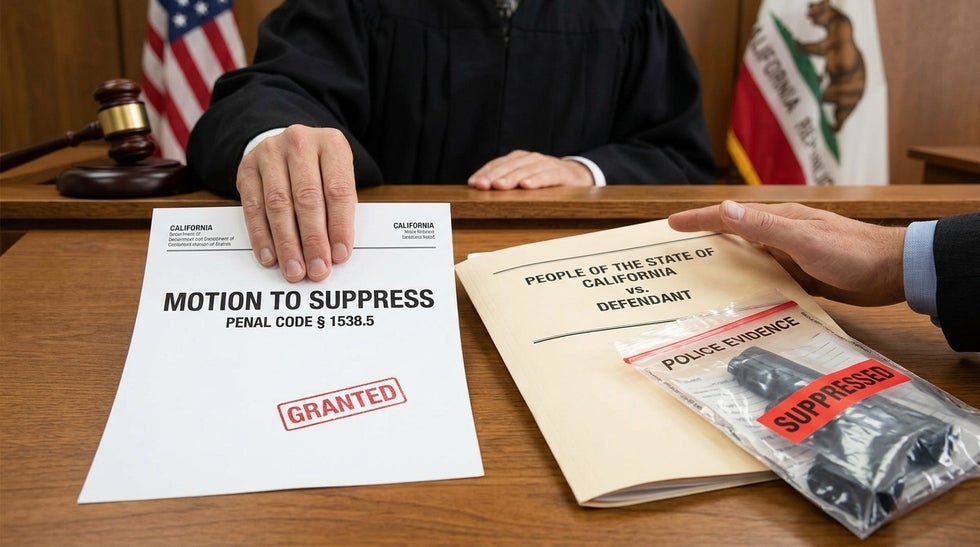
A motion to suppress asks the court to exclude evidence that police obtained by violating the Fourth Amendment: a search without a warrant and without an exception, a stop without reasonable suspicion, an arrest without probable cause, a warrant that was defective or executed unlawfully, and everything found as a result. In California the motion is filed under Penal Code 1538.5, it is decided by a judge after a hearing at which the officers testify, and when the search was warrantless the prosecution carries the burden of proving it was lawful. A granted motion removes the evidence permanently. In possession cases, drugs, firearms, stolen property, the seized item is the case, and the dismissal follows. The exclusionary rule is the principle; the 1538.5 motion is the only way to use it.
The Bulldog Law's attorneys file suppression motions in a large share of the drug, weapon, and DUI cases we handle, because those cases begin with a stop and a search, and the stop and the search are where police most often cut corners. The motion is not a technicality. It is the mechanism the courts built to enforce the Constitution, it is decided on facts that are usually on video, and it is the single most common way a possession case ends without a conviction. What follows is what the statute covers, when and how the motion is made, what the hearing looks like, the exceptions the prosecution argues, and what happens when the motion is granted or denied. Call (888) 928-1609 or message our team if your case began with a search.
The rule and the statute
The exclusionary rule comes from Mapp v. Ohio, the 1961 Supreme Court decision that applied to state prosecutions the principle that evidence obtained in violation of the Fourth Amendment may not be used against the defendant. Our attorneys explain the rule's scope on our exclusionary rule page and its reach to derivative evidence on our page about the fruit of the poisonous tree. The rule has one purpose, deterring unlawful police conduct, and the courts have shaped its exceptions around that purpose.
Penal Code 1538.5 is California's procedure. Subdivision (a) lets a defendant move to suppress as evidence any tangible or intangible thing obtained as a result of a search or seizure on the grounds that the search was without a warrant and unreasonable, or that the warrant was insufficient on its face, the property seized was not described in it, there was no probable cause for it, or it was executed unreasonably. Since Proposition 8 in 1982, California courts apply federal Fourth Amendment law, not the broader protections the state constitution once provided; the California Supreme Court confirmed in In re Lance W. that evidence is excluded only where federal law requires it. The statute covers physical evidence and observations. It does not cover statements; a confession obtained in violation of Miranda or coerced is excluded through a separate motion under the Fifth Amendment, which our attorneys file alongside the 1538.5 motion when both apply.
What can be suppressed
Anything the unlawful search or seizure produced, and anything that flowed from it. The drugs found in a car after a stop that lacked reasonable suspicion, the subject of our reasonable suspicion and probable cause page. The firearm found in a home entered without a warrant and without the exigent circumstances the prosecution claims. The contents of a phone searched without a warrant after Riley v. California. The blood sample drawn from a DUI suspect without consent or a warrant after Missouri v. McNeely. The evidence found under a search warrant whose affidavit did not establish probable cause, or that relied on an informant with no shown reliability. The officer's own observations after an unlawful entry. The identification made after an illegal arrest. And, under the fruit of the poisonous tree doctrine, the evidence found later because of what the first unlawful search revealed: the second search, the confession, the witness.
Standing is the threshold question. The defendant must have had a reasonable expectation of privacy in the place searched or the thing seized: a driver in his own car, a resident in her home, an overnight guest in the host's apartment. A passenger generally has standing to challenge the stop of the car but not the search of the trunk; a person who denied owning the bag cannot challenge the search of the bag. Our attorneys evaluate standing before anything else, because a motion without it is denied without reaching the search.
When and how the motion is made
In a felony case, the motion may be made at the preliminary hearing, where the officers are already testifying and the magistrate rules on it, or it may be set for a special hearing in the superior court after the information is filed under subdivision (i). The choice is strategic: a motion at the preliminary hearing is decided on the evidence presented there, with the defense cross-examining the officers before the prosecution has fully prepared them; a special hearing allows a fuller record and more time to obtain the footage and the records. A defendant who loses at the preliminary hearing may renew the motion once in the superior court under subdivision (i), with the transcript and, in some circumstances, new evidence. In a misdemeanor case, the motion is made in the trial court before trial under subdivision (g), and the prosecution may appeal a grant to the appellate division.
The motion is in writing, under subdivision (a)(2), and must state the grounds and the evidence to be suppressed with enough particularity that the prosecution knows what it must justify; a motion that simply says the search was unlawful can be denied for insufficiency. The written motion sets out the facts, usually from the police report, identifies whether a warrant existed, and states the theory: no reasonable suspicion for the stop, no probable cause for the arrest, no exception for the warrantless search, a defective warrant. Our attorneys file it with the body camera and dash camera footage, the dispatch log, the warrant and affidavit, and the officer's prior testimony where it exists, because the hearing is decided on what actually happened, and the report is the officer's version.
The hearing
The suppression hearing is a mini-trial before the judge alone. The prosecution calls the officers, the defense cross-examines, the defense may call its own witnesses including the defendant on the limited issue of the search without waiving the right not to testify at trial, and both sides argue. The rules of evidence apply, hearsay is admissible on certain questions such as what an informant told an officer, and the judge decides the facts and applies the law.
The burden is where the hearing is won. Under People v. Williams and the cases that follow it, when the search was conducted without a warrant, the defendant's burden is only to establish that fact, and the prosecution must then prove, by a preponderance of the evidence, that the search was justified by an exception. The prosecution, not the defendant, has to explain why the officer stopped the car, why he ordered the driver out, why he searched the trunk, and each step has to be supported by the facts the officer knew at the time, not by what the search found. When the search was conducted under a warrant, the burden is reversed: the defendant must show the warrant was invalid or its execution unlawful, and the warrant carries a presumption of validity. Most suppression motions involve warrantless searches, which is why most are winnable.
The officer's testimony is tested against the record. The body camera shows whether the officer asked for consent or announced a search. The dispatch log shows how long the stop lasted and when the dog was called. The dash camera shows the driving the officer described. The report, written after the search, is compared with the testimony, and the discrepancy is the argument. Our attorneys prepare for a suppression hearing the way we prepare for trial, because for a possession case it is the trial.
The exceptions the prosecution argues
Consent. The most common justification and the most contested. Consent must be voluntary, given by someone with authority over the place, and limited to its scope. A request to search phrased as a command, consent obtained after the officer said he would get a warrant anyway, consent from a passenger to search the driver's bag, and a search that exceeded what was agreed are each challenged. The prosecution proves consent; the defendant does not disprove it.
Search incident to arrest. A lawful arrest allows a search of the person and the area within immediate control, and, under Arizona v. Gant, a vehicle only if the arrestee could reach it or the officer reasonably believes it contains evidence of the crime of arrest. An arrest for driving on a suspended license does not justify a trunk search.
Automobile exception. A vehicle may be searched without a warrant on probable cause that it contains contraband or evidence. The question is the probable cause, and since legalization the odor of marijuana alone does not supply it in California.
Plain view, inventory, and inevitable discovery. An officer lawfully in a place may seize what is in plain view. A lawfully impounded vehicle may be inventoried under a standard policy, not as a pretext. And evidence that would inevitably have been found by lawful means is admitted despite the violation, an exception the prosecution invokes and must prove with specifics, not speculation.
Good faith. Under United States v. Leon, evidence seized under a warrant that was later found invalid is admitted if the officer reasonably relied on it. The exception applies to warrants, not to warrantless searches, and not where the affidavit was so lacking that no reasonable officer could have relied on it, or where the officer misled the magistrate.
Attenuation. Evidence found after a violation is admitted if the connection is sufficiently remote, as when an outstanding warrant is discovered during an unlawful stop under Utah v. Strieff. The exception has limits, and a stop that was flagrantly unlawful is not cured by a warrant check.
What happens when the motion is granted, and when it is not
A granted motion removes the suppressed evidence from the case. In a possession case, the prosecution typically moves to dismiss the same day; the dismissal is on the prosecution's motion and is usually without prejudice, but a case that cannot be proven without the suppressed evidence is not refiled. In a case with other evidence, the case continues without the suppressed items, which may change the charges or the plea offer. The prosecution may seek review: in a felony, by appeal under Penal Code 1238 or by petition for writ, and under subdivision (j) it may refile the case once and relitigate the motion before a different judge if the magistrate granted it at the preliminary hearing.
A denied motion preserves the issue. The defendant may renew it in the superior court under subdivision (i) if it was denied at the preliminary hearing, may seek a writ before trial under subdivision (i), and may raise the ruling on appeal after a conviction, including a conviction by plea, since a plea does not waive a suppression ruling under Penal Code 1538.5(m). A denied motion also shapes the negotiation: a close question on the stop is a reason for the prosecution to offer a lesser charge rather than risk the writ.
The cases where the motion matters most are the ones that begin with an ordinary traffic stop and end with a felony: the tint stop that led to a trunk search, the DUI blood draw without a warrant, the drug possession found during a consent search the driver did not understand he could refuse, the firearm found in a house entered on a welfare check. In each, the question is not whether the item was there; it is whether the police were allowed to look, and a prosecution that cannot answer that question has the clearest weakness a case can have.
Frequently asked questions
What is a motion to suppress?
A request that the judge exclude evidence from the case because police obtained it by violating the Constitution. In California it is filed under Penal Code 1538.5 and covers anything seized in an unlawful search or seizure: drugs, weapons, phones, blood results, and what police found as a result. If the motion is granted, the prosecution cannot use that evidence at trial, and in many cases it has nothing left and dismisses.
What happens if a motion to suppress is granted?
The suppressed evidence is out of the case for good, and the prosecution has to decide whether it can proceed without it. In drug and gun possession cases, where the seized item is the whole case, the usual result is a dismissal. The prosecution may appeal the ruling, or refile under Penal Code 1538.5(j) once and try again on the same motion before a different judge, but it cannot simply put the evidence back in.
What is the difference between a motion to suppress and the exclusionary rule?
The exclusionary rule is the principle; the motion to suppress is the procedure. The rule, from Mapp v. Ohio, says evidence obtained through an unconstitutional search or seizure cannot be used against the defendant. The motion is how a defendant invokes the rule in a specific case, with a written notice, a hearing where officers testify, and a ruling. Without the motion, the rule does nothing.
Who has the burden at a suppression hearing?
It depends on whether there was a warrant. If police searched without a warrant, the defendant need only show that, and the burden shifts to the prosecution to prove the search fell within an exception. If police had a warrant, the defendant must show the warrant was defective or was executed unlawfully. Either way the standard is a preponderance of the evidence, and the judge decides, not a jury.
Does a suppression motion delay the case?
It usually adds a few weeks. In a felony case the motion can be made at the preliminary hearing or by a special hearing afterward; in a misdemeanor it is set for its own hearing before trial. The time is used to obtain the body camera footage, the warrant and affidavit, and the dispatch records the hearing turns on, and the delay is almost always worth it when the motion has a basis.
Related reading from our attorneys
Your case started with a search? That is where our defense starts too
The Bulldog Law's defense attorneys litigate Penal Code 1538.5 motions at preliminary hearings and special hearings in courts across California, with the footage, the records, and the officer's own report as the evidence. Visit our criminal defense page, call (888) 928-1609, or reach us online.