
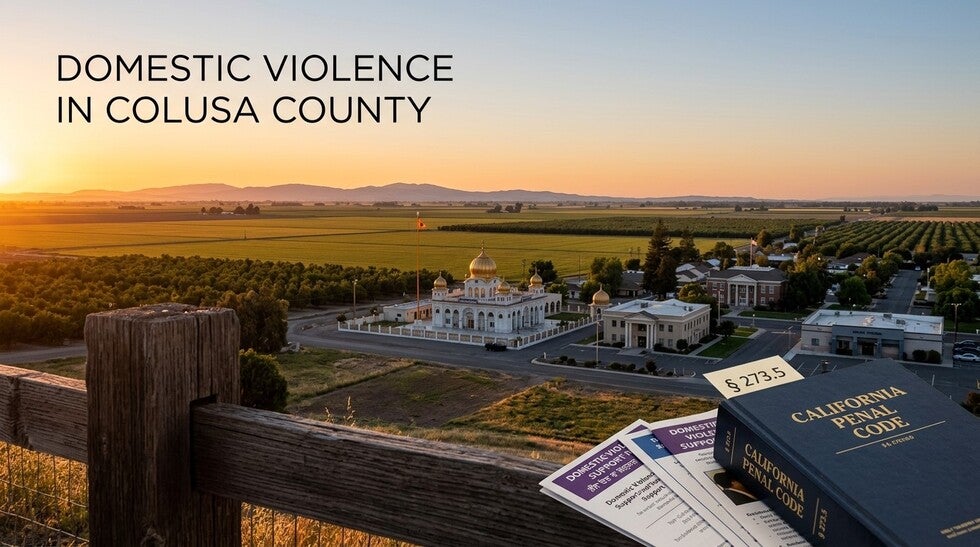
A domestic violence arrest in Colusa County sets multiple consequences in motion at the same time. The formal charges. The emergency protective order that takes effect immediately. The Lautenberg federal firearms prohibition that attaches to both felony and misdemeanor convictions. The immigration consequences that hit H-2A workers and DACA recipients within days. And in a 22,000-person county where the same people encounter each other through every dimension of daily life, the community visibility that follows a DV arrest everywhere.
Understanding all of those consequences from the first day is the only way to defend against all of them. And in Colusa County, the defense has to start before most people have even had time to fully process what happened.
In Colusa County, the DA Files DV Charges From the Evidence, Not the Alleged Victim's Cooperation
When Colusa County Sheriff deputies, Colusa PD, or Williams PD respond to a domestic violence call, they document everything from the scene: injuries, the 911 recording, body camera footage, and the immediate statements made by everyone present. That documentation goes directly to the Colusa County DA.
The alleged victim's subsequent decision not to cooperate is weighed against that independent evidence, it is not a veto. Colusa County's no-drop policy places charging authority with the DA at the Colusa County Superior Court at 532 Oak Street in Colusa. Defendants who expect the case to disappear when the alleged victim doesn't cooperate regularly encounter active prosecution weeks later, built on body camera footage and 911 recordings they didn't anticipate.
The defense must begin from the day of arrest regardless of the alleged victim's position. By the time most people realize the DA is moving forward without the victim's cooperation, critical evidence windows have already closed.
For context on California's formal DV response policy framework, our page on California Penal Code § 13701 domestic violence response policies covers the mandatory response and documentation requirements that law enforcement follows, and that produce the independent evidence the DA relies on.
The Charge and Its Permanent Federal Consequences
PC § 273.5, corporal injury to a spouse or cohabitant, is a wobbler. The felony version carries two, three, or four years. The misdemeanor carries up to one year. But here is what most people don't understand until it's too late: both designations, felony and misdemeanor alike, trigger the Lautenberg Amendment's permanent federal firearms prohibition under 18 U.S.C. § 922(g)(9).
That is not a temporary restriction. It is a lifetime federal ban on possessing any firearm or ammunition. For agricultural workers who use firearms in their work, for hunters, and for anyone whose firearm ownership is part of their daily life, the Lautenberg consequences are as significant as anything the criminal court imposes.
Both designations also require a certified 52-week Batterer's Intervention Program and both carry immigration consequences for non-citizen defendants. The only outcome that avoids all of these consequences simultaneously is DV diversion under PC § 1000.6, which produces a full charge dismissal upon completing the BIP, with no formal conviction entered at all.
Our page on domestic battery charges and defenses covers the related PC § 243(e)(1) domestic battery charge that is sometimes filed alongside or instead of PC § 273.5, and the key distinctions between the two in terms of penalties and diversion eligibility.
The Punjabi Sikh Community: Gurdwara Network Visibility
Colusa County is part of California's Sacramento Valley Sikh community, the broader Punjabi agricultural community that extends through Sutter, Yuba, Butte, and the surrounding counties, centered around the Gurdwara networks and connected by extended family relationships and agricultural business ties that span county lines.
A DV conviction in Colusa County doesn't stay in Colusa County. The community's religious congregations, the family relationships spanning multiple counties, and the agricultural business community connections create a visibility environment where the conviction's consequences extend substantially beyond the formal legal record. Employment in the community's extensive rice, almond, and walnut operations, social standing in Gurdwara congregations, and the matrimonial considerations that affect entire extended families all intersect with a DV conviction in ways that a criminal record check alone doesn't capture.
Honestly, I've seen cases where the matrimonial dimension was the thing a family was most concerned about, not the criminal record itself. A DV conviction circulating through extended family networks across Sutter, Yuba, and Butte counties can affect marriage prospects for children and siblings in ways that last for years.
DV diversion under PC § 1000.6, producing full charge dismissal, is the only outcome that protects this dimension alongside the legal record. A dismissal is what the Gurdwara community networks formally respond to. We evaluate diversion eligibility at the first consultation in every Colusa County Sikh community DV case at the Oak Street courthouse and pursue diversion as the absolute priority outcome wherever the defendant qualifies.
Small-County Visibility: 22,000 People
Colusa County has approximately 22,000 residents spread across Colusa, Williams, and the rural agricultural areas. In a county this small, the same people encounter each other through every dimension of daily life, the limited number of grocery stores, the schools, the agricultural employment networks, the community organizations, and the gathering places that all county residents share.
A DV conviction's visibility in this environment is effectively total. Employers, neighbors, fellow community members, and extended family networks all become aware of a DV proceeding and its outcome. There is no meaningful anonymity. The formal community knowledge of an arrest travels through Colusa County faster than most people expect.
DV diversion under PC § 1000.6 producing full dismissal carries meaning in this environment that goes beyond the formal legal record. A dismissal is what the small-county community knowledge network formally responds to, alongside the legal outcome. We pursue diversion as the priority resolution in every case where it is available, precisely because the community dimension makes the distinction between a conviction and a dismissal matter more here than it would in a larger county.
H-2A Agricultural Workforce: Immigration Stakes
Colusa County's extensive rice, almond, walnut, and processing tomato operations employ a substantial H-2A agricultural workforce. For those workers, a PC § 273.5 conviction creates immediate and severe immigration consequences.
A PC § 273.5 conviction constitutes a crime of domestic violence under federal immigration law, triggering deportability and permanently affecting future H-2A visa applications. For H-2A workers whose seasonal employment sustains families across an international border, the rice harvest, the almond harvest, the walnut and tomato seasons that define the Colusa County agricultural calendar, this consequence is not abstract. It is the loss of the employment that the entire family depends on, potentially permanently.
According to USCIS guidance on domestic violence and immigration, domestic violence convictions are among the specific grounds that trigger deportability under federal immigration law, making the distinction between a conviction and a diversion dismissal a question of whether a family can remain together and employed.
DV diversion under PC § 1000.6, full charge dismissal upon completing the 52-week BIP, is the only outcome that avoids both the Lautenberg federal firearms trigger and the immigration consequence simultaneously. We evaluate diversion eligibility and coordinate with immigration analysis at the first consultation in every applicable Colusa County H-2A community DV case.
For more background on how criminal convictions interact with DACA and H-2A immigration status, our page on understanding the DACA program walks through the immigration consequences framework in detail.
Self-Defense Evidence
According to the U.S. Department of Justice guidance on the Lautenberg Amendment and domestic violence misdemeanors, even a misdemeanor DV conviction triggers the permanent federal firearms prohibition, which is why the defense strategy from day one must account for the full scope of consequences, not just the criminal charge.
In bilateral DV cases where the defendant also sustained injuries, photographs of the defendant's own injuries are the most time-sensitive evidence in the entire case. They must be taken within hours, before bruises fade. This is the single most important action a defendant can take immediately after an arrest.
Body camera footage from Colusa County Sheriff deputies, Colusa PD, and Williams PD has limited retention windows, data gets overwritten on a schedule that doesn't wait for your attorney to ask for it. Prior threatening conduct by the alleged victim, the complete history between the parties, and community witness accounts from Colusa County's interconnected networks are all developed from the first day of representation.
In cases where a DV arrest arose from or alongside a physical altercation, our Colusa County assault and battery PC § 240/242 defense page covers the related charges that sometimes accompany DV arrests and how they interact with the primary PC § 273.5 defense strategy.
The Courthouse
Colusa County Superior Court 532 Oak Street, Colusa, CA 95932
After a DV Arrest in Colusa County
Comply absolutely with every EPO term, even if the alleged victim initiates contact. Violation of an EPO is a separate criminal charge.
Photograph your own injuries immediately. This is the most time-sensitive action, bruises fade within hours.
If you are a Sikh community member, contact The Bulldog Law immediately. DV diversion analysis is the priority for the Gurdwara network and matrimonial considerations.
If you are H-2A or any non-citizen, contact The Bulldog Law immediately about immigration consequences.
If you own firearms, ask The Bulldog Law immediately about Lautenberg compliance and surrender requirements.
Call (888) 928-1609.
Colusa County: Colusa County office | Colusa: Colusa office | Williams: Williams office | (888) 928-1609
DV Defense Questions in Colusa County
How does the Sikh community context affect DV defense priorities in Colusa County?
Colusa County is part of California's Sacramento Valley Sikh community, the broader Punjabi agricultural community extending through Sutter, Yuba, Butte, and surrounding counties, connected by Gurdwara networks and extended family relationships. The religious congregations, family relationships spanning multiple counties, and agricultural business connections create visibility where a DV conviction carries consequences extending beyond the formal legal record.
Employment in agricultural operations, Gurdwara social standing, family relationships, and matrimonial considerations affecting entire extended families all intersect with a Colusa County DV conviction. DV diversion under PC § 1000.6 producing full charge dismissal is the resolution that protects this dimension alongside the legal record. We pursue diversion as the absolute priority outcome in every Colusa County Sikh community DV case at the Oak Street courthouse.
Can the Colusa County DA proceed if the alleged victim recants?
Yes. The 911 recording, body camera footage, injury photographs, and officer observations go to the DA regardless of the alleged victim's subsequent position. In cases where the body camera footage is compelling and injuries were well-documented, the DA proceeds at the Oak Street courthouse with the independent evidence.
Defendants who expect the case to disappear when the alleged victim doesn't cooperate regularly encounter active prosecution weeks later, on evidence they didn't anticipate. The defense must begin from the day of arrest, regardless of the alleged victim's position.
How does a DV conviction affect H-2A workers in Colusa County?
A PC § 273.5 conviction constitutes a crime of domestic violence under federal immigration law, triggering deportability and permanently affecting future H-2A visa applications. For Colusa County's H-2A agricultural workforce employed in the rice, almond, walnut, and tomato operations, this consequence is immediate and severe, affecting the seasonal employment that sustains families across an international border.
DV diversion under PC § 1000.6 producing full charge dismissal upon completing the 52-week BIP is the only outcome that avoids both the Lautenberg federal firearms trigger and the immigration consequence simultaneously. We evaluate diversion eligibility and coordinate with immigration analysis at the first consultation in every applicable Colusa County H-2A community DV case.
For more on Colusa County Sikh community Gurdwara network visibility, small-county DV visibility in a 22,000-person community, H-2A immigration stakes, DV diversion full-dismissal eligibility, Lautenberg federal firearms consequences, and DV defense at the Colusa County Superior Court in Colusa, visit The Bulldog Law criminal defense blog.