
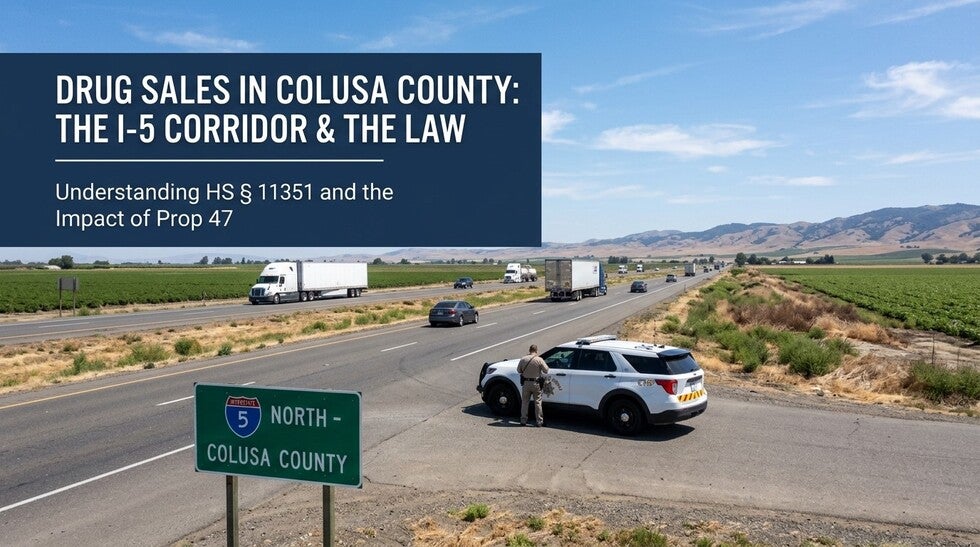
A lot of people hear "Prop 47" and assume it changed everything about drug charges in California. It changed a lot, but not everything. And in Colusa County, one of the most important things it did not change is the difference between simple possession and possession for sale. That distinction is where a misdemeanor ends and a straight felony begins. And for Colusa County's Punjabi Sikh H-2A agricultural workforce, that line is also where a solvable legal problem ends and a permanent immigration catastrophe begins.
Proposition 47 Made Simple Possession a Misdemeanor. HS § 11351 and § 11352 Are Still Straight Felonies.
Proposition 47 reduced simple possession of most controlled substances for personal use to a misdemeanor under HS § 11350. That was a meaningful change. PC 1000 diversion eligibility returned for qualifying cases. People facing possession charges got access to treatment-based outcomes instead of felony records.
But HS § 11351, possession for sale, was never touched by Prop 47. It remains a straight felony. And HS § 11352, transportation for sale, carries three, four, or nine years in state prison. Neither charge falls under Prop 47's misdemeanor framework, no matter how the case looks on the surface.
The prosecution sometimes attempts to upgrade a simple possession case to possession for sale based on quantity, packaging, the presence of scales, cash, or communications found with the drugs. The upgrade is often the most contested issue in a Colusa County drug case. And challenging that upgrade, reducing the charge back to simple possession, is where Prop 47's misdemeanor framework returns, where PC 1000 diversion eligibility returns, and where the permanent immigration bar is avoided.
The defense objective in every Colusa County drug sales case is the same: challenge the upgrade from simple possession to possession for sale. Everything else flows from that challenge.
If you want to understand how these same charges are handled in a neighboring Sacramento Valley county with a similar agricultural and interstate corridor context, our Sutter County drug sales HS § 11351 defense page covers the same legal framework applied to comparable facts.
The Interstate 5 Stop Challenge
Interstate 5 is one of California's primary drug trafficking corridors. It moves controlled substances between Southern California, the Bay Area, Sacramento, and the Pacific Northwest. The stretch through western Colusa County, with Williams sitting at the junction of I-5 and Highway 20, sees active drug interdiction by the CHP, the DEA Sacramento Field Division, and federal task force participation on a routine basis.
The enforcement intensity on this stretch of I-5 is real. And sometimes that intensity produces stop justifications built on profile rather than a specific observed Vehicle Code violation. A traffic stop that was triggered by who someone looked like, what kind of car they drove, or where they were coming from, rather than an actual observed violation, is not a lawful stop under the Fourth Amendment.
We examine every Colusa County I-5 drug trafficking stop for the specific documented basis at the first consultation. The dashcam footage goes against the documented stop reason. When they don't match, when the officer's report describes a Vehicle Code violation that the footage doesn't show, a suppression motion is filed at the Colusa County Superior Court on Oak Street. When that motion is granted, all evidence obtained from the unlawful stop is suppressed. Without the controlled substance, the HS § 11352 charge cannot proceed, regardless of quantity.
The constitutional stop challenge is the most powerful defense in most Colusa County I-5 drug trafficking cases. It's also the defense that requires immediate action, dashcam footage and other electronic records have limited retention windows. Every day that passes after an arrest is a day that evidence can be lost.
HS § 11352 transportation for sale is the charge most commonly filed in I-5 vehicle stop drug cases. It carries three, four, or nine years, substantially more exposure than HS § 11351. The stop challenge is the foundation. We pursue it in every applicable case.
For more on how HS § 11352 drug trafficking charges work along California's interstate corridors, our Solano County drug trafficking HS § 11352 page covers the same transportation-for-sale statute applied to another heavily interdicted California highway corridor.
The Punjabi Sikh H-2A Workforce: The Permanent Bar
This is the part of a Colusa County drug sales case that most people don't fully understand until it's too late.
An HS § 11351 conviction constitutes a drug trafficking aggravated felony under 8 U.S.C. § 1101(a)(43)(B). That designation permanently bars cancellation of removal, asylum, adjustment of status, and all future H-2A guestworker visa applications. Not temporarily. Not subject to waiver. Permanently.
For Colusa County's Punjabi Sikh agricultural community, connected to the broader Sacramento Valley Sikh community across Sutter, Yuba, and surrounding counties, the H-2A workforce employed in the county's rice, almond, walnut, and processing tomato operations faces this permanent consequence from a single conviction. The employment that sustains a family across an international border, the ability to return each season, the agricultural work that multiple family members may depend on, all of it closes permanently the moment a conviction is entered.
And beyond the immigration record, the conviction's visibility through the Gurdwara networks, extended family relationships across multiple counties, and agricultural business community connections creates community-level consequences that follow a person far beyond what the court record says.
The upgrade challenge at the Oak Street courthouse, reducing from HS § 11351 to simple possession misdemeanor, is the only defense outcome that avoids the permanent immigration consequence and substantially limits the community visibility consequences. We address the full immigration analysis from the first consultation in every case involving the Colusa County Punjabi Sikh H-2A community.
For context on how criminal adjudications interact with DACA and H-2A immigration status more broadly, our page on understanding the DACA program walks through the immigration consequences framework in detail.
National Wildlife Refuge Federal Drug Cases
Drug sales and transportation cases arising on the Sacramento National Wildlife Refuge, the Colusa National Wildlife Refuge, or other federal land in Colusa County don't proceed in the California state system at the Oak Street courthouse. They proceed under federal drug statutes in the Eastern District of California in Sacramento.
The federal framework applies different penalty structures, different procedural rules, and different sentencing guidelines than California state proceedings. Federal drug charges often carry mandatory minimum sentences that state courts don't impose. The distinction matters enormously.
The boundary between federal refuge land and state or private land is the critical jurisdictional line in every applicable case. A stop or contact that occurred on or near a wildlife refuge requires immediate analysis of exactly where it happened. We confirm the specific location at the first consultation in every Colusa County drug case arising near the refuges, because getting this question wrong changes the entire defense strategy.
The Upgrade Challenge in Colusa County's Rural Context
In most Colusa County drug sales cases, the prosecution's upgrade from simple possession to possession for sale relies on circumstantial factors: quantity, packaging, the presence of scales, cash, and communications. These are inferences, not direct evidence of intent to sell.
But in Colusa County's rural agricultural context, those inferences need to be examined very carefully. Purchasing patterns in a small rural county reflect the infrequent access opportunities that rural life creates. A quantity that implies sales volume in an urban market may reflect nothing more than the bulk purchasing pattern of someone who can't easily get back to a supply source for weeks. Cash on a farmworker isn't evidence of drug dealing, it's how agricultural workers often get paid and operate.
According to the California Legislative Information page on HS § 11352, the transportation-for-sale charge requires proof that the transportation was for sale, a specific intent element that distinguishes it from mere transportation. That intent element, combined with the rural context challenge to the circumstantial upgrade factors, gives the defense meaningful ground to work with in every applicable Colusa County case.
Reducing from HS § 11351 to HS § 11350 simultaneously restores the Prop 47 misdemeanor baseline, restores PC 1000 diversion eligibility, and avoids the permanent drug trafficking aggravated felony immigration bar. We contest every circumstantial upgrade factor through the specific rural agricultural context at the Oak Street courthouse. Our page on the impact of Proposition 47 in California explains the full scope of what Prop 47 changed, and didn't change, for drug offense sentencing.
Fentanyl and SB 44 Enhancements
SB 44, effective 2024, created enhanced felony exposure for certain fentanyl scenarios. Fentanyl trafficking along the I-5 corridor has become a prosecution priority at the Oak Street courthouse, with the DEA Sacramento Field Division treating this stretch of Northern California as an active interdiction zone.
According to the DEA Sacramento Field Division, the Sacramento Valley corridor, including the I-5 stretch through Colusa County, is among the agency's priority interdiction areas for fentanyl trafficking moving through Northern California. That enforcement focus means fentanyl cases in Colusa County are prosecuted aggressively and with federal task force involvement from early stages.
We analyze every Colusa County fentanyl case for SB 44 applicability and pursue the upgrade challenge and every available defense in every case. The SB 44 enhancement analysis happens at the first consultation, not after charges have already been structured in a way that's harder to challenge.
The Courthouse
Colusa County Superior Court 532 Oak Street, Colusa, CA 95932
After a Drug Sales Arrest in Colusa County
Invoke your right to remain silent immediately. Do not explain the drugs, quantity, packaging, or purpose to anyone before speaking with an attorney.
Do not consent to additional searches, particularly on I-5 stops.
If stopped on I-5 or Highway 20, note the specific reason the officer gave for the stop, and write it down as soon as you can.
If you are a Sikh community member, H-2A worker, or any non-citizen, contact The Bulldog Law immediately. Immigration analysis begins simultaneously with the criminal defense.
If the contact occurred near a National Wildlife Refuge, note whether you were on federal land.
Call (888) 928-1609.
Colusa County: Colusa County office | Colusa: Colusa office | Williams: Williams office | (888) 928-1609
Drug Sales Defense Questions in Colusa County
How does the I-5 stop challenge work in Colusa County drug trafficking cases?
Interstate 5 through western Colusa County, with Williams at the I-5 and Highway 20 junction, sees active drug interdiction by CHP, the DEA, and federal task force participation. The interdiction intensity sometimes produces stops based on profile rather than specific observed conduct. A constitutional stop requires reasonable articulable suspicion of a specific Vehicle Code violation.
When the documented stop reason doesn't match the dashcam footage, a suppression motion is filed at the Colusa County Superior Court on Oak Street. When granted, all evidence is excluded. Without the controlled substance, the HS § 11352 charge cannot proceed. The stop challenge is the most powerful defense in most Colusa County I-5 drug trafficking cases.
How does HS § 11351 permanently affect the Punjabi Sikh H-2A workforce?
An HS § 11351 conviction constitutes a drug trafficking aggravated felony under 8 U.S.C. § 1101(a)(43)(B), permanently barring cancellation of removal, asylum, adjustment of status, and all future H-2A guestworker visa applications. For Colusa County's Punjabi Sikh agricultural community, connected to the broader Sacramento Valley Sikh community across Sutter, Yuba, and surrounding counties, the H-2A workforce employed in rice, almond, walnut, and tomato operations faces this permanent consequence. Beyond immigration, conviction visibility through the Gurdwara networks and extended family relationships creates community-level consequences. The upgrade challenge reducing HS § 11351 to simple possession misdemeanor at the Oak Street courthouse is the only defense outcome that avoids both.
Does Prop 47 apply to drug sales charges in Colusa County?
No. Proposition 47 reduced simple possession for personal use to a misdemeanor, but possession for sale under HS § 11351 and transportation for sale under HS § 11352 remained straight felonies. The prosecution sometimes attempts to upgrade a simple possession case to possession for sale based on quantity, packaging, or other circumstantial factors.
The upgrade challenge, contesting every circumstantial factor through the specific facts, including the rural purchasing patterns of a small agricultural county, is what reduces the case back to simple possession where Prop 47's misdemeanor framework and PC 1000 diversion eligibility return. We pursue the upgrade challenge in every applicable Colusa County case at the Oak Street courthouse.
For more on I-5 interdiction stop challenges, the Punjabi Sikh H-2A permanent immigration bar, National Wildlife Refuge federal drug jurisdiction, the rural-context upgrade challenge, SB 44 fentanyl enhancements, and drug sales defense at the Colusa County Superior Court in Colusa, visit The Bulldog Law criminal defense blog.