
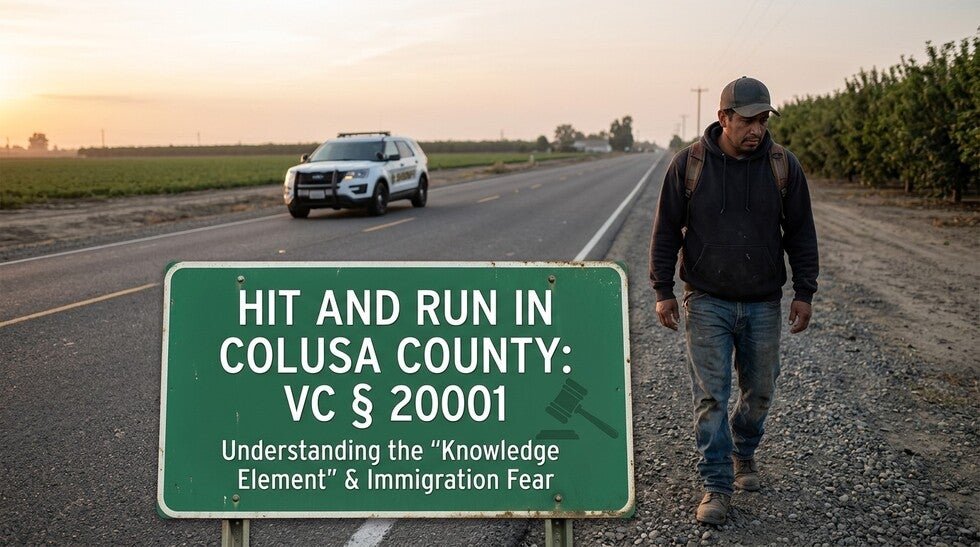
Two very different situations. Two very different people. Both ended up facing the same charge at the Colusa County Superior Court. And in both cases, the legal question that decides everything is this: did the evidence actually prove that the driver knew they were in an accident and then willfully chose not to stop?
That question, the knowledge element and the willfulness element, is where hit and run defense in Colusa County is won or lost.
Two Moments in Colusa County
Picture a driver heading north on Interstate 5 through Colusa County on a December morning. Tule fog has dropped visibility to about a hundred feet. The Sacramento Valley's fog season is in full force. Near the Williams interchange, the driver feels something, a thump, or maybe just the tire rolling over a bump in the road surface. The fog is too thick to see anything clearly behind. The driver keeps going north. What they didn't know was that a vehicle with a damaged panel had pulled to the shoulder, hidden completely by the fog.
Now picture something entirely different. A Punjabi Sikh H-2A agricultural worker, driving a personal vehicle back from a weekly errand, makes contact with a parked car in a parking lot. He felt it. He heard it. He drove away, not because he was trying to escape responsibility, but because one overwhelming thought took over: any contact with law enforcement could surface his immigration status and put his family's entire harvest employment at risk. That fear didn't come from guilt about the accident. It came from a place of survival.
The legal question in both situations is identical: did the evidence establish that the driver knew they were in an accident and willfully failed to stop and fulfill their legal duties?
Two completely different stories. The same charge. And in both cases, the details of what actually happened matter enormously to the defense.
The Charges
VC § 20001 covers collisions involving injury or death. Every driver has a legal duty to stop at the scene, provide identifying information, and offer reasonable assistance. Failure to do so is a wobbler, it can be charged as a misdemeanor carrying up to one year in jail, or as a felony carrying two, three, or four years in state prison.
VC § 20002 covers property damage only and is always charged as a misdemeanor. In eligible property damage cases, civil compromise under PC § 1377 is the top resolution priority, and it can produce a full dismissal without any conviction.
Both charges require the prosecution to prove beyond a reasonable doubt that the driver knew they were in an accident and willfully failed to fulfill their legal duties. That burden of proof is the starting point for every defense.
If you want to understand how criminal intent works in California law more broadly, our page on mens rea and criminal intent breaks down how the knowledge and willfulness elements apply across different charges.
Interstate 5 Tule Fog and the Knowledge Element
Interstate 5 runs through the Sacramento Valley in western Colusa County. From November through February, Tule fog is a real and serious seasonal condition on this stretch of highway. According to Caltrans, Tule fog is a dense ground fog that forms in the Sacramento and San Joaquin valleys during the winter months, regularly reducing visibility to near zero, and it is one of the most dangerous driving conditions in California.
In these conditions, visibility under a hundred feet, the fog's muffling effect masking sound, a wet road surface that changes how a tire feels, and the high speeds of interstate travel, a contact event that would be completely obvious in clear weather can become genuinely uncertain in the moment it occurs.
A thump on I-5 in dense Tule fog is not the same thing as a thump on a clear, dry road in full daylight. The sensory information available to the driver is fundamentally different. And the knowledge element under VC § 20001 and VC § 20002 requires actual awareness that an accident occurred, not just that something might have happened.
We challenge that knowledge inference through independent accident reconstruction that accounts for the specific fog conditions documented in the CHP report, and through forensic analysis of the contact evidence to determine how perceptible that contact would have been to a reasonable driver under those exact seasonal conditions. We retain accident reconstruction experts in every Colusa County I-5 Tule fog hit and run case at the Oak Street courthouse. Every knowledge inference that doesn't account for the specific atmospheric conditions at the time of contact gets challenged.
The Colusa County Superior Court handles these cases with the specific geography of I-5 in mind. The fog defense isn't abstract, it's tied to real, documented conditions on a specific stretch of highway during a specific time of year. That specificity is what makes it effective.
The Punjabi Sikh H-2A Workforce: Immigration Fear and Willfulness
For Colusa County's Punjabi Sikh H-2A agricultural workforce, a hit and run situation sometimes has nothing to do with avoiding responsibility for the accident itself. It has everything to do with immigration fear.
The specific, rational terror that any law enforcement contact could surface immigration status, and put the rice, almond, walnut, and tomato harvest employment that sustains a family across an international border at serious risk, produces a flight response that happens fast. It's not calculated. It's not consciousness of guilt about the collision. It's survival instinct overwhelming everything else in that moment.
Honestly, until you understand the economic reality of an H-2A worker's situation, it can be easy to misread that departure as guilt. But the two things are completely different, and that difference matters legally.
Immigration fear is not a complete defense to VC § 20001 or VC § 20002. Let's be clear about that. But it is powerfully relevant to the willfulness element, the requirement that the failure to stop was deliberate and intentional. When departure from a scene was driven by immigration fear rather than a desire to escape accountability for the accident, that distinction goes directly to the heart of what "willful" means.
We present this specific Colusa County Punjabi Sikh H-2A immigration context at the Oak Street courthouse in every applicable case as part of a comprehensive defense strategy. That defense also includes full analysis of the underlying immigration consequences, because for an H-2A worker, a conviction can mean far more than fines or jail time. Our law firm serving Colusa County understands the agricultural community's specific relationship with law enforcement contact, and we build that context into every defense.
For families navigating the intersection of criminal charges and immigration status, our page on understanding the DACA program provides important background on how criminal adjudications interact with immigration status and discretionary review.
Civil Compromise: Property Damage Cases
Civil compromise under PC § 1377 is one of the cleanest resolution tools available in eligible hit and run cases, and it's the first thing we evaluate in every VC § 20002 property damage hit and run case.
Here's how it works. When the property owner receives full compensation and acknowledges satisfaction to the Colusa County Superior Court at 532 Oak Street in Colusa, the result is a full dismissal without any conviction on record. No plea. No finding. Clean.
For Colusa County's Punjabi Sikh H-2A agricultural workers whose immigration status is affected by any conviction, for professional licensees, agricultural operators, and community members whose background checks and small-county community standing depend on a clean record, civil compromise in a property damage hit and run case is the outcome that protects everything. A conviction, even a misdemeanor, can ripple through an H-2A renewal, a professional license, and a community where everyone knows your name.
We identify civil compromise availability at the first consultation in every eligible Colusa County hit and run case. If it is available, we pursue it as the priority.
According to the California Legislative Information page on VC § 20001, the statute applies specifically to drivers who fail to stop after an accident involving injury or death, making the distinction between VC § 20001 and VC § 20002 (property damage only) a critically important first step in every case. Civil compromise is available only in the misdemeanor property damage track.
Watson Murder Upgrade
When a fatal collision occurs on I-5, Highway 20, or any Colusa County road and the defendant has a prior DUI conviction with the Watson advisement on record, the prosecution has the option to charge second-degree murder. The Watson upgrade converts what might otherwise be a vehicular manslaughter case into a murder charge carrying 15 years to life.
Watson upgrade risk requires evaluation from the very first consultation in every fatal collision case where a prior DUI exists. The Watson advisement from the prior DUI, the advisement that the defendant understood that driving under the influence could kill someone, is the legal bridge that supports the murder charge.
We challenge the Watson advisement's completeness in every applicable case at the Oak Street courthouse, including whether adequate interpretation was provided to non-English-speaking defendants in the prior DUI proceeding. If the advisement wasn't properly given, or wasn't properly interpreted, that challenge goes directly to whether the murder upgrade can stand.
This is also closely connected to how similar hit and run cases are handled in neighboring counties. Our hit and run defense page for Calaveras County covers related legal issues that can arise across Northern California road corridors.
The Courthouse
Colusa County Superior Court 532 Oak Street, Colusa, CA 95932
After a Hit and Run Arrest in Colusa County
Do not discuss the collision, what you heard or felt, or why you continued without an attorney.
Preserve all dashcam footage, GPS records, and vehicle data immediately. Retention windows are limited and data can be lost quickly.
Do not repair the vehicle until after consulting an attorney.
If you are a Punjabi Sikh H-2A worker or any non-citizen, contact The Bulldog Law about immigration fear context and the willfulness element analysis immediately.
If this occurred on I-5 or Highway 20 in foggy conditions, document the specific visibility conditions and contact location as clearly as you can remember.
Ask The Bulldog Law about PC § 1377 civil compromise eligibility at the first consultation for property damage cases.
Call (888) 928-1609.
Colusa County: Colusa County office | Colusa: Colusa office | Williams: Williams office | (888) 928-1609
If your case also involves weapons-related charges arising from the same incident or traffic stop, our Colusa County weapons defense page covers how those charges are handled at the Oak Street courthouse.
Hit and Run Defense Questions in Colusa County
How does I-5 Tule fog create a knowledge defense in Colusa County?
The knowledge element of VC § 20001 and VC § 20002 requires actual awareness that an accident occurred. On I-5 through Colusa County in dense Tule fog, where visibility can be reduced to under a hundred feet, where the fog's muffling effect masks sound, where the wet road surface masks tire response, and where the high speeds of interstate travel compound the disorientation, contact events are genuinely uncertain in ways that clear-weather conditions don't produce.
We retain accident reconstruction experts to analyze the specific fog conditions at the time of the contact, the perceptibility of the collision under those conditions, and whether the contact was objectively likely to have produced awareness in a driver under those specific I-5 seasonal conditions. Every knowledge inference that doesn't account for those conditions gets challenged at the Oak Street courthouse.
Can immigration fear affect the willfulness analysis for Punjabi Sikh H-2A hit and run cases in Colusa County?
Not as a complete defense, but as powerful context for the willfulness element. Willfulness requires that the failure to stop was deliberate and intentional. When departure from a collision scene was driven by immigration fear rather than consciousness of guilt about the accident itself, that distinction is relevant and meaningful to the legal analysis at the Oak Street courthouse.
The Colusa County Punjabi Sikh H-2A community's specific relationship to law enforcement contact, where any contact risks surfacing immigration status and jeopardizing the rice, almond, walnut, and tomato harvest employment that sustains a family, is presented as part of a comprehensive defense addressing every available legal argument alongside the underlying immigration consequence analysis.
How does civil compromise resolve a hit and run in Colusa County?
Civil compromise under PC § 1377 is available for misdemeanor VC § 20002 property damage hit and run when the property owner receives compensation and acknowledges satisfaction to the Colusa County Superior Court at 532 Oak Street in Colusa. Full dismissal without conviction is the result.
For Colusa County's Punjabi Sikh H-2A agricultural workers whose immigration status is affected by any conviction, for professional licensees, agricultural operators, and community members whose background checks matter and whose small-county community standing depends on a clean record, civil compromise in a property damage hit and run case is the resolution that protects everything. We identify civil compromise availability at the first consultation in every eligible case.
For more on I-5 Tule fog knowledge defense, Punjabi Sikh H-2A immigration fear willfulness, civil compromise for property damage cases, Watson murder upgrade evaluation, and hit and run defense at the Colusa County Superior Court in Colusa, visit The Bulldog Law criminal defense blog.