
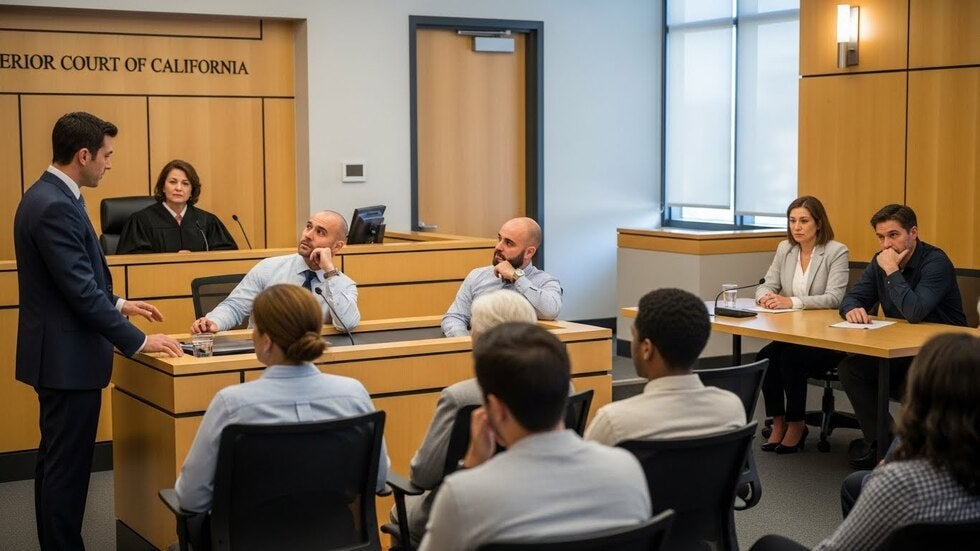
The right to trial by jury stands as one of the most fundamental protections in American criminal justice. California's Penal Code Section 1046 establishes that criminal trial juries are formed using the same procedures that govern civil jury selection. While this statutory language appears simple, the jury formation process involves complex procedures that significantly impact defendants' constitutional rights and trial outcomes. Understanding how juries are assembled, questioned, and selected proves essential for anyone facing criminal charges where jury trial remains an option.
At Bulldog Law, we recognize that jury selection often determines case outcomes before a single witness testifies. Our experienced trial attorneys understand the intricate procedures governing jury formation and use strategic voir dire techniques to identify jurors who will evaluate evidence fairly and hold the prosecution to its burden of proof beyond a reasonable doubt, reflecting the critical role of jury duty in the justice system.
The Constitutional Foundation of Jury Trials
The Sixth Amendment to the United States Constitution guarantees criminal defendants the right to trial by impartial juries. This protection ensures that the government cannot convict citizens through proceedings controlled entirely by judges or prosecutors. By requiring that peers from the community determine guilt or innocence, the jury system creates democratic checks on prosecutorial power and judicial authority.
California's Constitution similarly protects jury trial rights, establishing that criminal defendants may demand that their cases be decided by juries rather than judges alone. These constitutional provisions create more than theoretical rights. They establish enforceable protections that defendants can invoke to ensure their cases receive community evaluation rather than being decided solely by government officials.
The requirement that juries be impartial creates obligations extending beyond simply assembling groups of citizens. Courts must ensure that jury selection procedures do not systematically exclude particular demographic groups or create panels biased against defendants. The Supreme Court has repeatedly emphasized that jury composition must reflect fair cross sections of communities rather than favoring prosecution friendly demographics.
How Criminal and Civil Jury Formation Procedures Align
Penal Code Section 1046 directs that criminal trial juries form through the same procedures used for civil cases. This statutory alignment means that the detailed jury selection rules contained in California's Code of Civil Procedure apply equally to criminal proceedings. Understanding civil jury procedures therefore becomes essential for criminal defense attorneys and defendants navigating the trial process.
The jury formation process begins with summoning potential jurors from voter registration lists, Department of Motor Vehicles records, and other sources intended to create representative pools of community members. Counties maintain jury commissioner offices responsible for assembling qualified individuals who may be called for jury service. These initial pools must reflect community demographics without systematic exclusion of particular groups.
From the general jury pool, courts randomly select panels of potential jurors for specific cases. These panels, called venires, typically include more individuals than will ultimately serve on juries to account for excusals during voir dire. In criminal cases, venire sizes vary depending on case complexity and anticipated challenges, but panels commonly include thirty to sixty potential jurors for felony trials.
Once venires are assembled, courts conduct voir dire examinations where judges and attorneys question potential jurors to identify biases, assess fairness, and determine suitability for service. Voir dire serves dual purposes of educating jurors about case issues and allowing parties to exercise challenges removing unsuitable individuals from panels.
The Voir Dire Process in Criminal Cases
Voir dire represents the critical phase where criminal juries are actually formed from larger venire pools. California law grants both judges and attorneys roles in questioning potential jurors, though the extent of attorney participation varies by jurisdiction and judicial preference. Some judges conduct most questioning themselves with limited attorney involvement, while others allow extensive attorney led voir dire.
Initial voir dire typically involves judges explaining basic trial procedures, estimating trial length, and asking preliminary questions identifying potential jurors with scheduling conflicts, hardships, or obvious biases. Judges also provide brief case descriptions and identify parties and witnesses, asking whether potential jurors have relationships with anyone involved that might affect their impartiality.
After preliminary judicial questioning, attorneys receive opportunities to ask additional questions exploring potential jurors' backgrounds, experiences, and attitudes relevant to case issues. Defense attorneys use voir dire to identify jurors predisposed toward prosecution, assess who will actually hold the government to its burden of proof, and build rapport with individuals who may serve on the final panel.
Effective criminal defense voir dire extends beyond asking generic questions about fairness. Skilled attorneys explore potential jurors' attitudes toward law enforcement, their understanding of the presumption of innocence, their willingness to hold prosecutors to the reasonable doubt standard, and their ability to presume defendants innocent throughout proceedings. These probing questions reveal subtle biases that generic fairness inquiries miss.
Voir dire also provides opportunities for defense attorneys to begin advocating for their clients by introducing favorable legal principles and highlighting weaknesses in prosecution theories. While judges prohibit arguing cases during jury selection, attorneys can frame questions in ways that educate potential jurors about defense themes they will hear during trial.
Peremptory Challenges and Challenges for Cause
California law provides two mechanisms for removing potential jurors during selection. Challenges for cause allow unlimited removal of individuals who demonstrate actual bias, personal connections to cases, or other factors that would prevent fair evaluation of evidence. Either party may challenge potential jurors for cause, and judges decide whether sufficient grounds exist for removal.
Common bases for cause challenges include expressed inability to be fair, fixed opinions about guilt, relationships with parties or witnesses, prior knowledge of cases from media coverage, and strong feelings about charged offenses that would prevent impartial deliberation. Defense attorneys must clearly establish grounds for cause challenges through careful questioning that creates records demonstrating bias.
Peremptory challenges allow parties to remove limited numbers of potential jurors without stating reasons. In felony cases, defendants receive ten peremptory challenges while prosecutors receive six. In misdemeanor cases, defendants receive six peremptory challenges and prosecutors receive six. This allocation gives defendants numerical advantages reflecting the constitutional principle that doubt should resolve in favor of the accused.
While parties need not provide reasons for peremptory challenges, the Supreme Court has established that challenges cannot be exercised based on race or gender. If one party believes the other has used peremptory challenges to systematically exclude jurors based on protected characteristics, they may raise Batson Wheeler objections requiring the challenging party to provide race neutral or gender neutral explanations.
Strategic Considerations in Jury Selection
Criminal defense attorneys must approach jury selection strategically rather than reflexively exercising challenges against any potential juror expressing law enforcement sympathy. The goal is not assembling panels uniformly favorable to defendants but rather ensuring fair minded individuals who will evaluate evidence objectively and hold prosecutors to their constitutional burdens.
Identifying defense favorable jurors requires understanding subtle indicators beyond obvious statements of bias. Attorneys assess potential jurors' life experiences, professional backgrounds, communication styles, and attitudes toward authority. Former prosecutors or law enforcement officers do not automatically warrant challenges if they demonstrate genuine fairness and understanding that the government must prove guilt beyond reasonable doubt.
Educational background influences how jurors process evidence and deliberate. Individuals with higher education often expect more rigorous proof and question assumptions more readily, while those with less formal education may defer to authority figures like police officers or prosecutors. Neither educational level is inherently favorable or unfavorable to defendants, but understanding jurors' analytical approaches helps attorneys tailor presentation strategies.
Employment history provides insights into jurors' problem solving approaches and attitudes toward rules. Scientists, engineers, and academics typically demand empirical proof and logical consistency. Business owners and managers may focus on practical outcomes rather than technical legal distinctions. Service workers often bring empathy and skepticism of elite authority. Defense counsel should consider how different professional backgrounds might influence deliberation dynamics.
Personal experiences with law enforcement significantly affect juror attitudes. Individuals who have been arrested, questioned, or treated dismissively by police often possess healthy skepticism about officer credibility. Conversely, those who have been crime victims or have law enforcement family members may unconsciously favor prosecution. Careful questioning about law enforcement interactions reveals biases that generic fairness questions miss.
Understanding Jury Composition Requirements
California law requires that jury venires represent fair cross sections of communities. This requirement means that jury summoning procedures cannot systematically exclude cognizable groups including racial minorities, women, or other demographic categories. When venire composition dramatically diverges from county demographics, defendants may challenge jury arrays as unconstitutionally unrepresentative.
However, the fair cross section requirement applies only to venire composition, not to final seated juries. Parties may exercise peremptory challenges in ways that result in final panels lacking diversity without violating fair cross section protections. The constitutional requirement ensures that initial pools include all community segments but does not guarantee that particular cases will be tried by diverse juries.
Defendants alleging fair cross section violations must demonstrate that distinctive groups were systematically excluded from venires, that the exclusion was not fair and reasonable in relationship to the number of such persons in the community, and that underrepresentation resulted from systematic exclusion in the jury selection process. Proving these elements requires statistical evidence showing significant disparities between community demographics and jury pool composition.
The Role of Alternate Jurors
California courts routinely select alternate jurors who hear all evidence and deliberate only if regular jurors cannot complete service. Alternates provide insurance against mistrials that would otherwise result if jurors become ill, experience family emergencies, or must be removed for misconduct during trials. The number of alternates varies based on trial length and judicial discretion, with longer trials typically including more alternates.
Alternate jurors are selected through the same voir dire process as regular jurors and face the same qualification requirements. Parties exercise peremptory challenges against potential alternates just as they do for regular panel members. Until deliberations begin, alternates do not know their status, ensuring they remain engaged throughout proceedings.
When regular jurors cannot continue service, judges randomly select alternates to replace them. In lengthy trials, multiple substitutions may occur, requiring careful tracking of which individuals actually deliberate. Defense attorneys must remain vigilant that substituted alternates received all evidence and instructions that original jurors heard.
Jury Selection in High Profile Cases
Cases receiving extensive media coverage present unique jury selection challenges. Potential jurors often have heard about charges, viewed news reports, or formed preliminary opinions before arriving at court. While prior knowledge does not automatically disqualify individuals, defense counsel must carefully probe whether pretrial publicity created fixed opinions incompatible with fair evaluation of trial evidence.
Change of venue motions offer potential remedies when pretrial publicity makes selecting impartial juries impossible in counties where offenses allegedly occurred. However, courts grant venue changes reluctantly, requiring defendants to demonstrate that extensive negative coverage created pervasive bias throughout the county. Successful venue motions typically require professional jury consultant analysis showing that representative community members have formed guilty opinions.
Even without venue changes, defense attorneys in high profile cases may request expanded voir dire allowing thorough examination of pretrial publicity effects. Judges sometimes permit written questionnaires that potential jurors complete before oral questioning, allowing counsel to identify bias efficiently without consuming excessive court time on preliminary inquiries.
Protecting Jury Selection Rights
Defendants possess various rights throughout jury selection that must be zealously protected. Courts cannot arbitrarily limit voir dire time or prevent attorneys from asking relevant questions exploring bias. Judges must excuse jurors for cause when actual bias is demonstrated rather than forcing parties to exhaust peremptory challenges removing obviously unsuitable individuals.
When courts improperly restrict voir dire or wrongly deny cause challenges, defendants suffer prejudice that may warrant appellate relief. Documenting jury selection errors requires creating clear trial records showing what questions judges prohibited, which cause challenges were wrongly denied, and how limitations prejudiced defense case preparation.
If you face criminal charges where jury trial remains possible, contact Bulldog Law to discuss your case. Our experienced trial attorneys understand the complex jury selection procedures that often determine case outcomes and will work strategically to ensure your case is heard by fair, impartial jurors who will hold the prosecution to its constitutional burden of proving guilt beyond a reasonable doubt.