
Updated October 2026 | The Bulldog Law | California Theft Crimes Defense
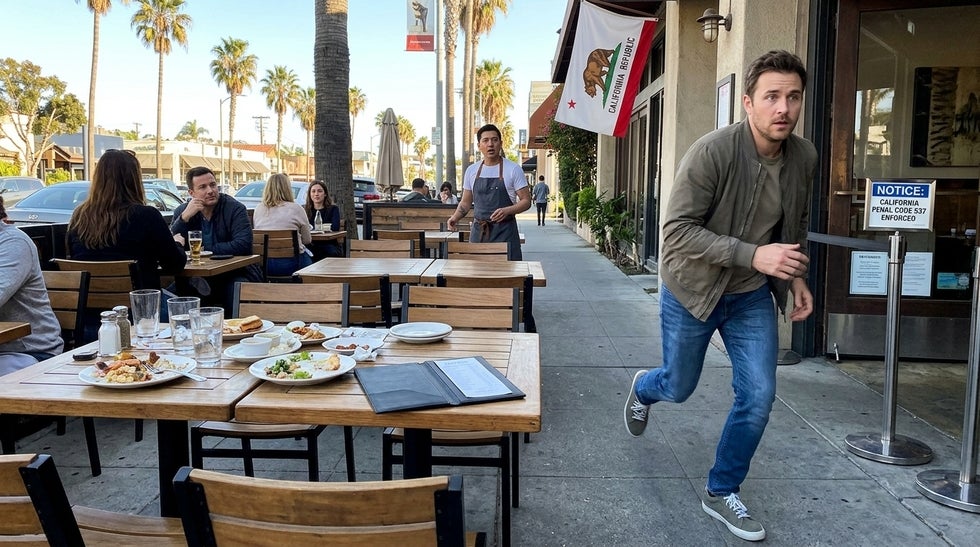
Dining and dashing, leaving a restaurant, bar, hotel, or similar business without paying, is a crime in California under Penal Code 537, the statute that calls it defrauding an innkeeper. The offense requires intent to defraud: obtaining food, drink, lodging, or services with the purpose of not paying for them. A bill of $950 or less is a misdemeanor punishable by up to six months in county jail and a $1,000 fine; a bill over $950 is a wobbler, chargeable as a felony with up to three years. A customer who forgot, who believed a companion had paid, or who refused a disputed charge has not committed the crime, because the intent is missing. Restaurant staff may detain a suspected walkout under the citizen's arrest rules, within limits, and may not take the loss out of the server's pay.
The Bulldog Law's attorneys see Penal Code 537 cases that are rarely what the headline suggests. A group dinner where the person who was supposed to pay left early. A hotel guest whose card was declined after checkout. A bar tab left open after an argument with the bartender. A college student on a dare. And the occasional serial offender who has done it at a dozen restaurants and is facing a felony on the aggregate. The statute treats them the same on paper and the courts treat them very differently in practice, because the element that matters is intent, and intent is where these cases are won. What follows is what the statute requires, what the business can do when it happens, the penalties, and how first offenses resolve. Call (888) 928-1609 or message our team.
Penal Code 537: defrauding an innkeeper
Penal Code 537(a) makes it a crime to obtain any food, fuel, services, or accommodations at a hotel, inn, restaurant, boardinghouse, lodging house, apartment house, bungalow court, motel, marina, marine facility, autocamp, ski area, or public or private campground, without paying therefor, with intent to defraud the proprietor or manager. The list is long because the statute has been amended for a century to keep up with the businesses people walk out of; it covers the restaurant tab, the bar tab, the hotel room, the campsite, the gas pump at a marina, and the lift ticket. Subdivision (b) separately punishes obtaining credit at those businesses by a false pretense, and removing one's baggage from a hotel without paying, which addresses the guest who checks out through the parking lot.
The elements the prosecution must prove: the defendant obtained food, services, or accommodations from a covered business; did not pay for them; and did so with the specific intent to defraud, meaning the intent, at the time of obtaining them or at the time of leaving, not to pay. The statute itself supplies some evidence of intent: subdivision (c) provides that leaving without paying, or giving false information to obtain credit, is prima facie evidence of intent to defraud, which means the prosecution can get to the jury on the walkout alone, but the defendant can rebut it with evidence of what actually happened.
The $950 line
If the value obtained is $950 or less, the offense is a misdemeanor: up to six months in county jail and a fine of up to $1,000. If more than $950, it is a wobbler, chargeable as a misdemeanor or as a felony with 16 months, two, or three years, the same structure as grand theft. A single restaurant bill rarely crosses the line; a hotel stay, a catered event, a bar tab for a large party, or a series of walkouts aggregated by the prosecution under a single-plan theory does. Our attorneys contest aggregation where the incidents were separate, because the difference is a misdemeanor and a felony.
When it is not a crime
Intent to defraud is the whole case, and most dine and dash arrests involve people who did not have it.
The honest mistake. A customer who left believing the bill was paid, by a companion, by a card on file, by a group that said they had it covered, did not intend to defraud. The prosecution's prima facie evidence under subdivision (c) is rebutted by the circumstances: the customer's return to pay once contacted, the companion's account, the text messages about who was covering dinner.
The dispute. A customer who refused to pay a disputed charge, a wrong item, an unauthorized gratuity, a cover charge not disclosed, a room that was not as booked, has a contract dispute with the business, not a criminal intent. The customer who offered to pay the undisputed portion and was refused is in the strongest position. The business's remedy is civil; the criminal statute does not enforce contested bills.
The declined card. A customer whose card was declined and who could not pay on the spot has not committed the crime if the intent to pay was real; the test is intent to defraud, not ability to pay at the register. The customer who leaves contact information and returns to pay is a civil debtor; the customer who gives a false name and a fake number has supplied the intent.
The group. In a group walkout, each person is charged with their own conduct. The person who ordered and left intending not to pay has violated the statute; the person who believed the host was paying has not. The prosecution sometimes charges everyone at the table, and the sorting happens afterward, with the facts of who said what about the bill. The related theory of theft by false pretenses applies where a person obtained the meal on an affirmative lie, such as a claim to be a critic or an employee's guest.
What the business can do when it happens
Detention. A proprietor or employee who has probable cause to believe a customer is leaving without paying may detain the customer for a reasonable time to investigate and to summon police, under the merchant's privilege in Penal Code 490.5 for retail theft and the general citizen's arrest authority in Penal Code 837. The detention must be reasonable in manner and duration: staff may block the door and ask the customer to wait for police; they may not use force beyond what is necessary to detain, search the customer, or hold them for hours. A detention that exceeds those limits exposes the business to civil liability and is a reason prosecutors decline to file.
Police response. Officers responding to a dine and dash call take a report, identify the customer, and, for a misdemeanor, usually issue a citation rather than make a custodial arrest, as our page on citation release explains. For a customer who has already left, the business provides the description, the receipt, and the video, and the case is referred to the prosecutor for a filing decision.
Civil remedies. The business may sue for the bill in small claims court, and Penal Code 490.5 allows a merchant to demand a civil penalty of $50 to $500 plus the value of the loss from an adult who took merchandise, a provision some restaurants invoke by demand letter. Payment of the bill is also the foundation of the civil compromise described below.
What the business may not do. California Labor Code 2802 requires employers to indemnify employees for losses incurred in the course of their duties, and the Labor Commissioner has long held that a customer's walkout is a cost of business that may not be deducted from the server's wages or tips. A restaurant that charges the server for the table has committed a wage violation, and the practice, which is widespread, is one reason restaurants pursue customers criminally: the loss is theirs.
Penalties and how cases resolve
A first-offense misdemeanor under Penal Code 537, for a bill in the tens or low hundreds of dollars, almost never results in jail. The realistic outcomes, in rough order of frequency: the case is not filed once the bill is paid; the case is filed and resolved by civil compromise under Penal Code 1377, under which a misdemeanor with a civil remedy is dismissed when the victim acknowledges satisfaction, meaning the bill was paid; the defendant completes diversion and the charge is dismissed; or the defendant pleads to the misdemeanor, or to a lesser offense such as disturbing the peace, with a fine and restitution of the bill. Our attorneys pursue the civil compromise first in nearly every first-offense case, because it ends the matter with no conviction and the restaurant is paid, which is what the restaurant wanted.
A felony filing over $950, or a case with a pattern of walkouts, is handled as a theft case: the amount is contested, the aggregation is contested, and the resolution is a misdemeanor with restitution where the record allows. A conviction under 537 is a theft offense and a crime of dishonesty, with the employment and licensing consequences those carry, and for non-citizens a crime involving moral turpitude with immigration consequences; a misdemeanor conviction is eligible for expungement after probation. Minors, who account for a large share of dine and dash incidents, are handled in juvenile court and almost always diverted. Our attorneys' pages on shoplifting and on the differences among theft, burglary, and robbery cover the related statutes, and a walkout that involved a bad check is addressed on our check fraud page.
Hotels, bars, and the other covered businesses
Hotels. The hotel case is the one most likely to cross $950 and the one subdivision (b) addresses specifically: a guest who removes baggage without paying, or who obtained the room on a false pretense, is charged under 537, and the hotel may hold the guest's property under the innkeeper's lien in Civil Code 1861 until the bill is paid. A declined card at checkout is not a crime if the guest makes arrangements; a false name on the registration is.
Bars. An open tab left behind is the bar version, and the bar usually holds the card that opened the tab, so the dispute is about the amount rather than the walkout. Where no card was taken, the bar's evidence is the server's identification, and the intent question is complicated by the intoxication the bar served.
Gas, campgrounds, and the rest. Driving off from a marina fuel pump, leaving a campground without paying, and using a ski lift without a ticket are each covered. Gas stations on land are covered by the general theft statutes rather than 537, and the drive-off is petty theft.
Frequently asked questions
Is dine and dash a crime in California?
Yes. Leaving a restaurant, bar, hotel, or similar business without paying, with the intent to defraud, is the crime of defrauding an innkeeper under Penal Code 537. It is a misdemeanor if the amount is $950 or less, punishable by up to six months in county jail and a $1,000 fine, and a wobbler, chargeable as a felony with up to three years, if the amount is more than $950. The $950 line is the same one that divides petty theft from grand theft.
Is dine and dash a felony?
Only if the unpaid bill exceeds $950, which is rare for a restaurant tab and more common for a hotel stay or a large event. Below $950 it is a misdemeanor. Prosecutors also look at priors: a person with prior theft convictions can face enhanced charges under Penal Code 666 for a petty theft offense, though 537 itself is not on that statute's list.
What happens if you dine and dash and get caught?
Most of the time, the restaurant calls the police, the officer takes a report or issues a citation, and the case is filed as a misdemeanor or, for small amounts and no record, not filed at all. Restaurant staff may detain you until police arrive under California's citizen's arrest rules, but they may not use excessive force or hold you indefinitely. A first offense usually resolves with payment of the bill, a fine, diversion, or a civil compromise that ends the case.
What if I forgot to pay or there was a dispute about the bill?
Then it is not a crime. Penal Code 537 requires intent to defraud, meaning you intended to get the food, drink, or room without paying for it. A person who walked out distracted, thought a companion had paid, was overcharged and refused to pay the disputed portion, or left after unreasonable service is not a defrauder. The restaurant has a civil claim for the bill; the prosecutor does not have a criminal case without intent.
Can a restaurant make the server pay for a dine and dash?
Not legally. California Labor Code 2802 and the Labor Commissioner's position bar employers from deducting a customer's unpaid bill from an employee's wages or tips, because the loss is a cost of doing business, not the employee's fault absent dishonesty or gross negligence. A server who was charged for a walkout has a wage claim, and the practice is itself a reason restaurants pursue the customer criminally rather than absorb the loss.
Related reading from our attorneys
Cited for a walkout? Pay the bill, and let us handle the rest
The Bulldog Law's theft defense attorneys resolve Penal Code 537 cases across California, from civil compromises on a first offense to felony filings over aggregated bills. Visit our criminal defense page, call (888) 928-1609, or reach us online.