
Updated August 2026 | The Bulldog Law | California Criminal Defense
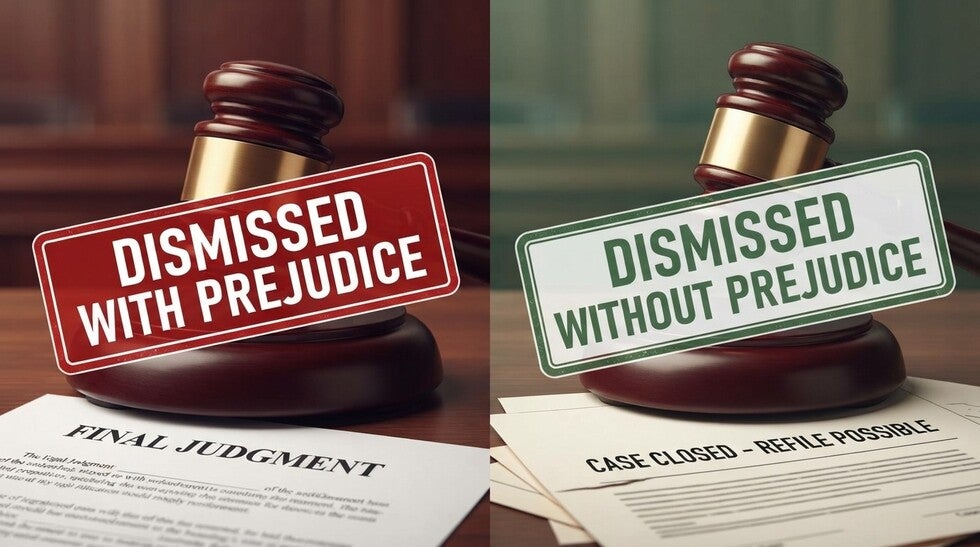
A case dismissed with prejudice is over for good the prosecutor cannot bring the same charge against you again. A case dismissed without prejudice is closed for now, but the charge can be refiled within the limits set by California Penal Code 1387 and the statute of limitations. In California criminal court, most dismissals are technically without prejudice the first time, which is why the words you hear at the hearing matter less than what the law says can happen next.
If a judge just dismissed your case, or your attorney told you the district attorney "dismissed without prejudice," you probably have one question: is this really finished? The difference in plain English, walks through the California rules that decide whether a charge can come back, and covers what a dismissal does and does not do to your record. If you want a lawyer to look at your specific dismissal order, contact The Bulldog Law or call (888) 928-1609.
What "Dismissed With Prejudice" Means
"With prejudice" is a legal term that means the dismissal is final on the merits. The court has closed the case in a way that prevents the same party from bringing the same claim or charge again. In a criminal case, that means the prosecution is barred from refiling the charge based on the same conduct.
A dismissal with prejudice is not the same as an acquittal, but it has a similar practical effect: no conviction, no sentence, and no future prosecution for that offense. The difference between a dismissal and a not guilty verdict is explained in our guide to acquitted vs. not guilty. An acquittal comes after a trial; a dismissal ends the case before a verdict is ever reached.
In California criminal practice, judges rarely write the phrase "with prejudice" into a minute order. Instead, finality comes from three sources: the two-dismissal rule in Penal Code 1387, the constitutional protection against double jeopardy once a trial has started, and the running of the statute of limitations. Each is covered below.
What "Dismissed Without Prejudice" Means
"Without prejudice" means the dismissal does not decide the merits of the case and does not stop the prosecutor from filing the same charge again. The case is closed on the court's calendar, the defendant is released from any bail or conditions tied to that case number, but the underlying accusation is not legally dead.
Common reasons a California prosecutor dismisses without prejudice include a missing witness, a lab result that has not come back, a defect in the complaint, a suppression ruling the DA wants to fix by refiling with different evidence, or a decision to move the case to a different courthouse or to federal court. When you hear that a case was dismissed "in the furtherance of justice" under Penal Code 1385, that is usually a dismissal that can be refiled once unless one of the finality rules below has already kicked in.
Why Most California Criminal Dismissals Start Out "Without Prejudice"
California does not let prosecutors refile a case indefinitely, but it does give them a limited second chance. The rule lives in Penal Code section 1387. In simplified terms:
- Felonies: one dismissal is generally not a bar. The DA can refile the same felony one time. A second dismissal of the same felony charge bars any further prosecution for that offense.
- Misdemeanors charged alone: one dismissal is generally a bar. The DA cannot refile a stand-alone misdemeanor after it has been dismissed once.
- Misdemeanors charged with a felony: treated like the felony, so one refiling is allowed.
The dismissals that count toward this rule include a dismissal at the preliminary hearing (Penal Code 871), a successful motion to set aside the information (Penal Code 995), a speedy trial dismissal (Penal Code 1382), and a dismissal in the furtherance of justice (Penal Code 1385). Understanding what happens at each stage, starting with your arraignment, helps you see where a dismissal is most likely to happen and how many chances the prosecution has left.
Exceptions that allow another filing
Penal Code 1387 contains a few carve-outs. A felony that has been dismissed twice can still be refiled if a judge finds substantial new evidence that could not have been discovered earlier with reasonable diligence, or if the earlier dismissal was the product of excusable neglect in a violent felony case under Penal Code 1387.1. Certain domestic violence and DUI misdemeanors that were dismissed because a witness was unavailable can be refiled once. And a complaint dismissed in favor of a grand jury indictment on the same facts does not count as a termination.
This is why an experienced defense attorney reads the reason written in the dismissal order very carefully. Whether the case is truly finished depends on which subdivision of Penal Code 1387 applies, not on a generic label.
When a Dismissal Becomes Final for Good
Three events convert a "can be refiled" dismissal into a "cannot be refiled" dismissal in California.
1. The two-dismissal bar under Penal Code 1387
Once the statutory number of dismissals has been reached - two for a felony, one for a stand-alone misdemeanor the bar attaches automatically. No separate order is needed. If the DA tries to file again, your attorney files a motion to dismiss under Penal Code 1387 and the court must grant it unless an exception applies.
2. Jeopardy has attached
The Double Jeopardy Clause of the Fifth Amendment and Article I, section 15 of the California Constitution prevent a second prosecution for the same offense once jeopardy attaches. In a jury trial, jeopardy attaches when the jury is sworn. In a bench trial, it attaches when the first witness is sworn. A dismissal granted after that point for example, a Penal Code 1118.1 motion for acquittal granted mid-trial, or a dismissal after the prosecution rests is final. The prosecution cannot refile, and it cannot appeal in most circumstances.
3. The statute of limitations has run
Even a dismissal that could legally be refiled becomes practically final once the limitations period expires. In California, most misdemeanors must be filed within one year of the offense (Penal Code 802) and most felonies within three years (Penal Code 801), with longer periods for serious sex offenses, offenses against elders and children, fraud discovered later, and no limit at all for murder and certain other crimes. Note that the clock is paused while a case is pending, so the time your first case sat in court does not count against the DA. Your attorney will calculate the remaining window from the dismissal date.
Quick Comparison: With Prejudice vs Without Prejudice
|
Question |
Dismissed with prejudice |
Dismissed without prejudice |
|
Can the DA refile the same charge? |
No |
Yes, within PC 1387 limits and the statute of limitations |
|
Is there a conviction? |
No |
No |
|
Does bail or release conditions end? |
Yes |
Yes, until any refiled case |
|
Can the arrest be sealed (PC 851.91)? |
Yes, right away |
Yes, once refiling is no longer possible |
|
Counts as a conviction for immigration? |
No |
No, but a refiled case can change that |
|
Typical in California criminal court? |
After trial starts, or after the PC 1387 bar |
Most first dismissals |
Civil vs Criminal: Why the Phrase Sounds Familiar
Most of what you read online about "dismissed with prejudice" comes from civil litigation, where the phrase is used constantly. A civil court dismisses with prejudice when the plaintiff has had a fair chance and lost on the merits, or when the parties settle and agree the claim can never be brought again. A civil dismissal without prejudice lets the plaintiff correct a problem and file again.
In criminal court the concept is the same, but the vocabulary is different. Judges and prosecutors talk about dismissals under Penal Code 1385, 995, 871, or 1382, and about whether the case "can be refiled." If you search your court file and cannot find the words "with prejudice," that is normal. The finality of a criminal dismissal is determined by statute and the Constitution, not by a label.
What Happens to Your Record After a Dismissal
A dismissal is far better than a conviction, but it does not erase the arrest by itself. The arrest still appears in the California Department of Justice criminal history (the RAP sheet), and the case still appears in the superior court index. Here is how to clean that up.
Arrest record sealing under Penal Code 851.91
Since 2018, Penal Code 851.91 lets a person seal an arrest that did not result in a conviction. A dismissed case qualifies once the charge can no longer be refiled either because the Penal Code 1387 bar applies, jeopardy attached, or the statute of limitations has run. Sealing is generally a matter of right, meaning the court must grant it if you meet the requirements, with limited exceptions for patterns of domestic violence, child abuse, or elder abuse arrests. Once sealed, the arrest is treated as if it did not occur for most purposes, and you can lawfully answer "no" to most private employer questions about arrests.
Factual innocence under Penal Code 851.8
If you can show there was no reasonable cause to believe you committed the offense, Penal Code 851.8 allows you to petition for a finding of factual innocence. The standard is demanding, but the remedy is stronger than sealing: the arrest records are sealed and then destroyed, and the arrest is deemed never to have occurred. The petition generally must be filed within two years of the arrest or the filing of the accusatory pleading, whichever is later, though the court can extend that deadline for good cause.
Diversion dismissals
If your case was dismissed after you completed a diversion program drug diversion under Penal Code 1000, mental health diversion under Penal Code 1001.36, or judicial diversion under Penal Code 1001.95 the dismissal has its own record protections. Our guide to record sealing after diversion under Penal Code 1001.9 explains how to make sure the arrest is treated as if it never happened.
Expungement is not the tool
People often ask whether they need to "expunge" a dismissed case. You do not. Expungement under Penal Code 1203.4 applies to convictions. A dismissal has no conviction to expunge. If you had a separate case that did end in a conviction, our guide on what expungement means and how to expunge a record covers that process.
Immigration and Employment Consequences of a Dismissal
For immigration purposes, a dismissal is not a conviction under the federal definition in 8 U.S.C. 1101(a)(48)(A), as long as you did not enter a guilty or no contest plea that was later withdrawn as part of a program. That distinction matters: some diversion programs require a plea up front, and federal immigration authorities may treat that plea as a conviction even after the state court dismisses the case. Anyone who is not a U.S. citizen should read about the deportation consequences of criminal convictions before agreeing to any plea-based resolution, even one that ends in dismissal.
For employment, California Labor Code 432.7 prohibits most employers from asking about, or basing a hiring decision on, an arrest that did not result in a conviction. A dismissed case falls squarely within that protection. Licensing boards, law enforcement employers, and positions requiring a security clearance have broader access, which is another reason to pursue sealing under Penal Code 851.91 once the case is truly final.
How Defense Attorneys Win Dismissals
Prosecutors do not dismiss cases as a favor. They dismiss when the defense makes the case too weak, too expensive, or too risky to keep pursuing. Some of the most common paths to dismissal in California include:
- A Penal Code 1538.5 motion to suppress evidence obtained through an unlawful search, seizure, or a Miranda violation, leaving the DA without enough admissible evidence.
- A preliminary hearing where the magistrate finds no probable cause on one or more counts (Penal Code 871).
- A Penal Code 995 motion arguing the defendant was held to answer without reasonable or probable cause.
- A speedy trial dismissal under Penal Code 1382 when the prosecution is not ready within the statutory deadlines and cannot show good cause. Related timing rights start with the 48-hour arraignment rule.
- A Penal Code 1385 dismissal in the furtherance of justice, often negotiated after the defense shows the prosecutor the weaknesses in the case.
- Completion of a diversion program that ends in a dismissal by operation of law.
If you are trying to gauge where your own case stands, our article on the nine signs that a criminal case is weak describes the same indicators defense attorneys use when they push for a dismissal. And if the prosecution is offering a plea instead, understand the difference between a no contest and a guilty plea before you decide.
What to Do Right After a Dismissal
- Get a certified copy of the minute order showing the dismissal, the code section, and the stated reason.
- Ask your attorney whether the charge can be refiled and, if so, calculate the deadline under the statute of limitations.
- Confirm that bail was exonerated and any bond was released.
- Calendar the earliest date you can petition to seal the arrest under Penal Code 851.91, and evaluate whether a Penal Code 851.8 factual innocence petition is realistic.
- If you are not a U.S. citizen, have an immigration attorney review the dismissal and any plea history.
Frequently Asked Questions
Does "dismissed with prejudice" mean I was found not guilty?
No. A dismissal ends the case before a verdict, while a not guilty verdict comes from a judge or jury after trial. Both leave you without a conviction, but they are different legal events. A dismissal with prejudice does mean the prosecutor cannot bring the same charge again, which is the practical result most people care about.
Can the DA refile a felony that was dismissed in California?
Usually once. Under Penal Code 1387, a felony that is dismissed on a motion or at a preliminary hearing can generally be refiled one time. A second dismissal of the same felony charge is a bar to any further prosecution, with narrow statutory exceptions for newly discovered evidence, excusable neglect in certain violent felony cases, and a few other situations.
Can a misdemeanor be refiled after it is dismissed?
Generally no. For a misdemeanor charged on its own, a single dismissal under Penal Code 1387 bars refiling. There are exceptions for certain domestic violence and DUI misdemeanors dismissed because a witness was unavailable, and for misdemeanors that were charged together with a felony.
Does a dismissed case stay on my record?
The arrest and the court filing remain in law enforcement and court databases unless they are sealed. If the charge was dismissed and can no longer be refiled, you can petition to seal the arrest under Penal Code 851.91. If you can show you were factually innocent, Penal Code 851.8 lets you ask that the arrest records be sealed and destroyed. A dismissed case does not need a Penal Code 1203.4 expungement because there is no conviction to expunge.
Is a dismissal with prejudice the same thing in a civil lawsuit?
The label is the same, but the mechanics differ. In civil cases the phrase is common and is often ordered by the court or agreed to in a settlement. In California criminal cases the phrase is rarely written into the order itself. Whether a criminal dismissal is final depends on Penal Code 1387, whether jeopardy attached, and the statute of limitations, not on the words "with prejudice" appearing in the minute order.
Talk to a California Criminal Defense Attorney About Your Dismissal
A dismissal is a good outcome, but "can the DA refile" is a question that deserves a precise answer. The Bulldog Law defends clients in criminal cases across California and helps former clients seal arrests, respond to refiled charges, and protect their immigration status after a dismissal. Visit our California criminal defense page to learn more, or call (888) 928-1609 for a confidential consultation. You can also reach us online.