
Updated November 2026 | The Bulldog Law | California Record Clearing
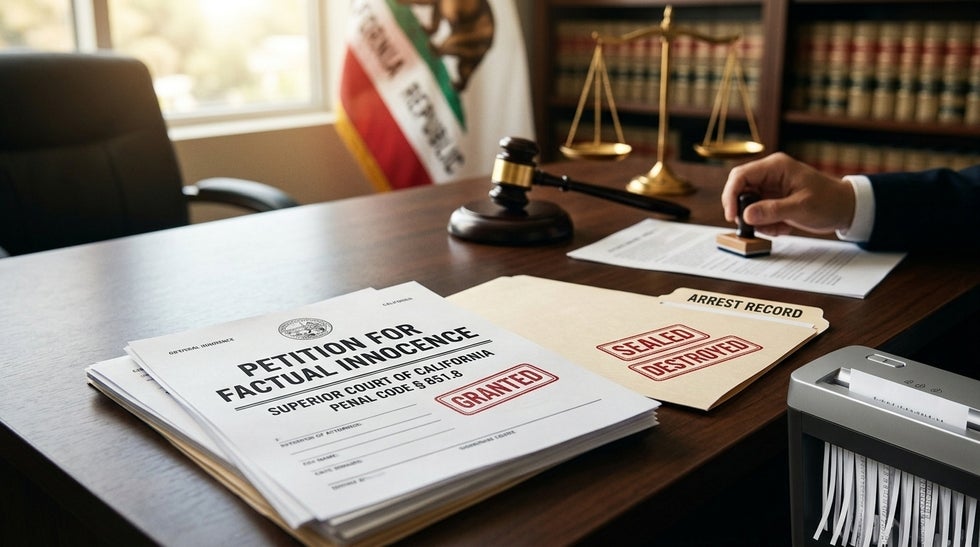
If you were arrested in California for something you did not do, you can ask for an official finding of factual innocence. Under Penal Code 851.8, when a court or law enforcement agency finds that no reasonable cause exists to believe you committed the offense, the arrest record is sealed, later destroyed, and treated as if the arrest never occurred. No other remedy erases a record so completely. The standard is high, the deadline is two years, and for many people ordinary sealing is easier to obtain; which one to pursue depends on what the evidence can prove.
An arrest stays on a record even when no charge is ever filed. Our attorneys see the damage on employment and licensing background checks years later, and the first question is always whether the case can meet the innocence standard or should be sealed another way.
Who can ask
|
Situation |
Where the petition goes |
Statute |
|
Arrested, no charges filed |
First to the arresting law enforcement agency. If it denies the request or does not respond within 60 days, to the superior court |
Penal Code 851.8(a), (b) |
|
Charges filed and later dismissed |
The court that dismissed the case, with notice to the prosecutor |
Penal Code 851.8(c) |
|
Acquitted after trial |
The trial judge, who may make the finding when it appears the defendant was factually innocent |
Penal Code 851.8(e) |
|
Convicted, and the conviction later reversed or vacated |
Not this statute. Other provisions govern findings of innocence after conviction |
Penal Code 1485.55, 851.86 |
The full text is in Penal Code 851.8.
The standard
The petitioner must show that no reasonable cause exists to believe he or she committed the offense for which the arrest was made. Reasonable cause is the same low level of suspicion that justifies an arrest. To win, the evidence must leave no such suspicion: a person of ordinary care and prudence, knowing all the facts, would not believe or even strongly suspect that the petitioner is guilty.
Three consequences follow.
- A dismissal is not enough. Cases are dismissed because witnesses do not appear, evidence is suppressed, or the prosecutor cannot prove the charge beyond a reasonable doubt. None of those establishes innocence.
- An acquittal is not enough. A not guilty verdict means the charge was not proved. Factual innocence means the person did not do it.
- The whole record counts. The judge may consider police reports, declarations, and any evidence that is material, relevant, and reliable, including evidence that would not have been admissible at trial.
The initial burden is on the petitioner. If that burden is met, it shifts to the prosecutor to show that reasonable cause does exist.
Cases that succeed
- Mistaken identity: the wrong person was arrested, or someone used the petitioner's name or identification.
- Another person was later identified, charged, or confessed.
- Video, records, or forensic results prove the petitioner was elsewhere or did not commit the act.
- The reported crime did not happen: the accusation was recanted and shown to be false, or the property was never stolen.
- The conduct was not a crime, for example a lawful prescription or a valid license the officer did not check.
Cases that usually fail are those in which the evidence was conflicting, a witness simply stopped cooperating, or the defense was a legal one such as an unlawful search.
Deadline
The petition must be filed within two years of the arrest or of the filing of the accusatory pleading, whichever is later. The statute allows relief from the deadline for good cause, and the prosecutor can agree to waive it. Evidence of innocence often emerges late, so a late petition is not hopeless, but it should explain why it was not brought sooner.
What happens when it is granted
- The law enforcement agency and the Department of Justice seal their arrest records for three years from the date of the arrest and then destroy them.
- Any agency that received the arrest information is asked to seal and destroy its copies.
- The arrest is deemed not to have occurred, and the person may answer any question about it accordingly.
- The court records are sealed and destroyed on the same schedule.
- The finding is not admissible in any later lawsuit.
Private background check companies that already hold the data must be dealt with separately; our page on criminal background checks explains how to dispute inaccurate reports.
Factual innocence compared with other remedies
|
Remedy |
Who qualifies |
Proof of innocence? |
Result |
|
Factual innocence, Penal Code 851.8 |
Arrested and not convicted |
Yes |
Records sealed and destroyed; arrest deemed not to have occurred |
|
[Sealing an arrest](https://www.thebulldog.law/pc-851-91-seal-arrest-record-california), Penal Code 851.91 |
Arrest that did not result in a conviction |
No. Available as a matter of right in most cases |
Records sealed from public view; still available to criminal justice agencies |
|
Automatic relief under the [clean slate law](https://www.thebulldog.law/california-clean-slate-law-sb-731-automatic-record-sealing) |
Eligible arrests and convictions after waiting periods |
No |
Record withheld from most background checks without a petition |
|
[Expungement](https://www.thebulldog.law/what-does-expunge-mean-how-to-expunge-record), Penal Code 1203.4 |
Convicted and completed the sentence |
No |
Conviction dismissed; record shows the dismissal |
For most people whose case ended without a conviction, Penal Code 851.91 is the practical choice: it is nearly automatic and has no innocence requirement. The factual innocence petition is worth the added effort when the evidence of innocence is strong and the person needs the record destroyed, for example for a professional license, a security clearance, immigration, or because of the nature of the accusation. The Judicial Council's forms are on the California Courts self-help site.
After a wrongful conviction
People who were convicted and later cleared are covered by different provisions. A court that vacates a conviction can find the person factually innocent, and that finding supports a claim for compensation under Penal Code 4900. The terminology is explained on our page about what it means to be exonerated.
Frequently asked questions
What is a petition for factual innocence?
It is a request under California Penal Code 851.8 for an official finding that you were factually innocent of the offense you were arrested for. If it is granted, the arrest records are sealed and later destroyed, and the arrest is deemed not to have occurred. It is the strongest form of record clearing California offers.
Who can file a petition for factual innocence?
A person who was arrested and never charged, a person whose charges were dismissed, and a person who was acquitted at trial. It is not available to someone who was convicted of the offense. A person whose conviction was later overturned uses different statutes.
What is the standard for factual innocence?
The court must find that no reasonable cause exists to believe the person committed the offense. That is a demanding test. It is not enough that the case was dismissed or that there was reasonable doubt. The evidence has to show that a person of ordinary care and prudence would not suspect the petitioner of the crime.
How long do you have to file?
Two years from the date of the arrest or the filing of the accusatory pleading, whichever is later. A court may hear a late petition on a showing of good cause, and the deadline can be waived, but a petition filed years later should explain the delay.
What happens to the records if the petition is granted?
The arresting agency and the Department of Justice seal their records of the arrest for three years from the arrest date and then destroy them. Other agencies that received the information are notified to do the same. The person may state that the arrest never happened.
What is the difference between factual innocence and sealing an arrest record?
Sealing under Penal Code 851.91 is available as a matter of right to most people whose arrest did not lead to a conviction, with no need to prove innocence, but the records continue to exist and can be seen by criminal justice agencies. A factual innocence finding requires proof of innocence and results in destruction of the records.
Does the prosecutor have to agree?
No, although agreement helps. When no charges were filed, the petition goes first to the law enforcement agency, which may grant it with the prosecutor's concurrence. If the agency denies it or does not respond within 60 days, the person can petition the superior court, where a judge decides after a hearing.
Is factual innocence the same as being exonerated?
It is one form of it. Exonerated is a general word for being cleared. A finding of factual innocence is a specific judicial declaration under California law, and it carries concrete legal effects: destruction of records after an arrest, and, for a person wrongly convicted, a basis for compensation.
Related reading from our attorneys
- Sealing an arrest record under Penal Code 851.91
- What it means to be exonerated
- What it means to expunge a record
Arrested for something you did not do? The record does not clear itself
The Bulldog Law's criminal defense attorneys file factual innocence petitions and arrest sealing motions across California and advise on which remedy fits. Call (888) 928-1609 or reach us online.