
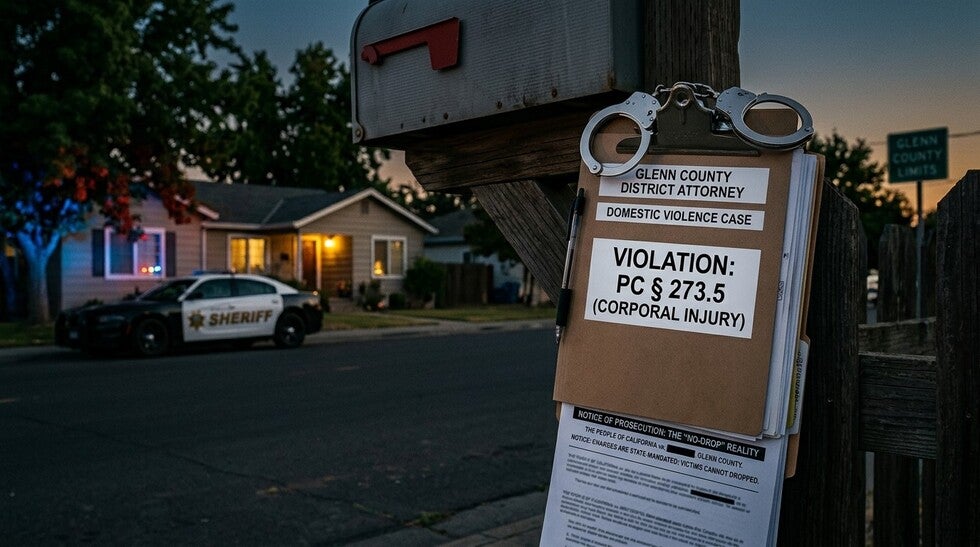
A domestic violence arrest in Glenn County is not like one in Los Angeles or Sacramento. This is a county of 28,000 people. Everyone knows everyone. And the Glenn County DA does not wait for the alleged victim to cooperate before filing charges. If you or someone you care about is facing a PC § 273.5 charge in Glenn County right now, what happens in the first few days matters more than most people realize.
In a small farming and dairy county where Willows, Orland, and the surrounding agricultural communities overlap in every part of daily life, a DV conviction touches everything, your job, your neighbors, your family, and for many workers, your immigration status. This guide breaks down exactly how these cases work at the Glenn County Superior Court in Willows, and what a real defense looks like.
In Glenn County, the DA Files DV Charges From the Evidence, Not the Alleged Victim's Cooperation
When the Glenn County Sheriff, Willows PD, or Orland PD respond to a domestic violence call, they do not just write a report. They document everything they can: photographs of injuries, the 911 recording, body camera footage, and any statements made at the scene. All of that documentation goes straight to the Glenn County DA.
What happens next surprises a lot of people. The alleged victim's later decision not to cooperate, not to press charges, not to testify, is weighed against that independent evidence. It is not a veto. The DA makes the charging call, not the alleged victim.
Glenn County operates under a no-drop policy. That means once the evidence is in the DA's hands, the case moves forward unless the legal defense gives them a reason not to. The Glenn County Superior Court at 526 W Sycamore Street in Willows handles these cases, and prosecutors there are experienced with exactly this dynamic.
Why the No-Drop Policy Matters for Your Defense
A lot of people think: "She said she doesn't want to press charges, so the case will go away." That is not how Glenn County works. We have seen defendants come in weeks after the arrest shocked that they are still being prosecuted, even after the alleged victim told officers she wanted to drop it.
The body camera footage, the 911 call, the injury photos, those already exist. The defense has to be built around that evidence from day one, not from the assumption the case will disappear.
If you are dealing with a protective order alongside the DV charge, our overview of how criminal protective orders work in California explains your obligations and what violating one can mean for your case.
The Charge and Its Permanent Federal Consequences
PC § 273.5, corporal injury to a spouse or cohabitant, is a wobbler in California. That means the DA can charge it as either a felony or a misdemeanor depending on the facts and the defendant's history.
As a felony, it carries two, three, or four years in state prison. As a misdemeanor, it carries up to one year in county jail. Those are serious enough on their own. But the consequence most people do not think about until it is too late is the federal one.
Both designations, felony and misdemeanor alike, trigger the Lautenberg Amendment's permanent federal firearms prohibition under 18 U.S.C. § 922(g)(9). Both require a certified 52-week Batterer's Intervention Program. Both carry immigration consequences for non-citizen defendants.
The Lautenberg Firearms Ban in Glenn County's Rural Context
Honestly, the Lautenberg consequence hits differently in Glenn County than it does in a city. This is ranch country. Dairy country. Hunting country. Firearms are a routine part of life here, protecting property, controlling pests on agricultural land, hunting during season.
A DV conviction, even a misdemeanor, strips that away permanently under federal law. No hunting rifle during deer season. No firearm on the ranch. No gun for property protection. That is a life-changing consequence that does not go away.
We make sure every client understands this from the first consultation. It shapes every decision we make about how to fight the case.
Small-County Visibility: 28,000 People
Glenn County has around 28,000 residents spread across Willows, Orland, and the rural dairy and agricultural areas. That sounds abstract until you think about what it actually means.
The same 28,000 people shop at the same stores, go to the same schools, work in the same agricultural employment networks, and see each other at the same community events. There is no anonymity here. A DV proceeding becomes known to employers, neighbors, family members, and the extended community very quickly.
That community visibility is one of the reasons DV diversion under PC § 1000.6 matters so much in Glenn County beyond just the legal record. Diversion produces a full charge dismissal after completing the 52-week Batterer's Intervention Program, leaving no conviction on the record. In a small county, that clean outcome is what the community responds to, not just the formal legal paperwork.
Diversion as the Priority Outcome
We evaluate diversion eligibility at the first consultation in every Glenn County DV case at the Willows courthouse. Where the defendant qualifies, we pursue diversion as the top priority, because in a 28,000-person community, there is no such thing as a quiet conviction.
To understand how domestic violence charges can change your life beyond just the criminal record, our blog covers the long-term effects that go far beyond the courtroom, employment, housing, custody, and community standing.
H-2A and Latino Agricultural Workforce Immigration Stakes
Glenn County's dairy operations, almond orchards, rice fields, and other agricultural businesses employ a large H-2A and Latino agricultural workforce. For those workers, a PC § 273.5 conviction is not just a criminal matter. It is an immigration matter with immediate and severe consequences.
Under federal immigration law, a PC § 273.5 conviction is classified as a crime of domestic violence. That triggers deportability. It also permanently affects future H-2A visa applications and can eliminate other paths to immigration relief. For a worker whose paycheck supports family across an international border, this consequence hits immediately, not years later.
According to the U.S. Citizenship and Immigration Services (USCIS), a conviction for a crime of domestic violence is one of the enumerated grounds of deportability under the Immigration and Nationality Act. There is no workaround once the conviction is final.
DV diversion under PC § 1000.6, full charge dismissal upon completing the 52-week BIP, is the only outcome that avoids both the Lautenberg firearms trigger and the immigration consequence at the same time. We evaluate diversion eligibility and coordinate with immigration analysis at the first consultation in every applicable Glenn County H-2A and Latino community DV case.
Why Diversion Is the Only Clean Outcome for Non-Citizens
A plea to a lesser charge sounds attractive. Sometimes it is the right move. But for a non-citizen defendant, even a reduced charge can carry immigration consequences depending on how it is framed and what the federal immigration system treats it as. This is not an area where general criminal defense experience is enough. The immigration analysis has to be part of the defense strategy from day one.
If you want to understand how immigration document status intersects with California criminal charges more broadly, our page on using false citizenship or immigration documents under PC 114 gives useful context about how the systems interact.
When the Alleged Victim Wants to Recant
This is one of the most common situations we see. A couple gets into a heated argument. Someone calls 911. Officers arrive, document what they see, and make an arrest. By the next morning, or the next week, the alleged victim regrets making that call. They want the case to go away. They tell the DA they will not cooperate.
But the 911 recording already exists. The body camera footage already exists. The injury photographs already exist. The officer's written observations from that night already exist. All of that went to the Glenn County DA the night of the arrest.
The recantation gets weighed against all of it. In cases where the independent evidence is strong, where the footage is clear and the injuries were well-documented, the DA proceeds at the Willows courthouse regardless of the alleged victim's later position. Defendants who expect the case to disappear when the alleged victim backs out regularly find themselves facing active prosecution weeks later on evidence they never thought would be used.
Building the Defense From Day One
The defense has to start from the day of the arrest. Not after the preliminary hearing. Not after the DA makes their first offer. Day one.
Because the alleged victim's cooperation or non-cooperation does not control the case, the defense must focus on the actual evidence: what the body camera shows, what the 911 call captures, what the injury photographs document, and what independent witnesses observed. Every one of those elements can be challenged, contextualized, or countered, but only if the defense begins immediately.
Understanding how temporary versus permanent domestic violence restraining orders work is also important for defendants navigating what comes right after an arrest, since the restraining order terms start immediately and violations create separate criminal exposure.
Self-Defense Evidence
Some Glenn County DV cases are not one-sided. In a lot of them, both people were involved in the physical confrontation. The person who called 911 first, or whose injuries were more visible to the arriving officers, gets labeled the victim. The other person gets arrested. That does not mean the full story was captured.
Photographs of the defendant's own injuries are the most time-sensitive evidence in any bilateral Glenn County DV case. Bruises and marks fade fast. They need to be photographed within hours of the incident, not days later. By the time most people think to document their own injuries, the visible evidence is already gone.
Body camera footage from the Glenn County Sheriff, Willows PD, and Orland PD has limited retention windows. Prior threatening conduct by the alleged victim, the full history between the parties, and witness accounts must all be gathered from the first day of representation.
According to the National Domestic Violence Hotline, research consistently shows that a meaningful percentage of domestic violence incidents involve bidirectional physical conflict, meaning both parties may have injuries worth documenting. Ignoring that evidence is a defense mistake with real consequences.
Gathering the Right Evidence Before It Disappears
Waiting is the biggest mistake defendants make. Every day that passes is another day that evidence degrades or disappears. Bruises fade. Footage gets overwritten. Witnesses' memories soften.
At The Bulldog Law, the first consultation is also the first step in evidence preservation. If you have injuries, document them now. If you think there were witnesses, write down their names before you forget. The case is built from what exists, and what exists shrinks every day you wait.
The Courthouse
Glenn County Superior Court
526 W Sycamore Street, Willows, CA 95988
After a DV Arrest in Glenn County
Comply absolutely with every EPO term, even if the alleged victim initiates contact.
Photograph your own injuries immediately. This is the most time-sensitive action you can take.
If you are H-2A, Latino agricultural workforce, or any non-citizen, contact The Bulldog Law immediately about immigration consequences.
If you own firearms, ask The Bulldog Law immediately about Lautenberg compliance and surrender requirements.
Ask The Bulldog Law about DV diversion eligibility at the first consultation.
Call (888) 928-1609.
Willows: Willows office | Orland: Orland office | Glenn County: Glenn County office | (888) 928-1609
Frequently Asked Questions: DV Defense in Glenn County
How does small-county visibility affect DV defense priorities in Glenn County?
Glenn County's approximately 28,000 residents form a tightly connected community where the same people encounter each other through every part of daily life, the grocery stores, the schools, the dairy and agricultural employment networks, and community gathering places. A DV conviction's visibility is effectively total in this environment. DV diversion under PC § 1000.6, which produces full charge dismissal upon completing the 52-week BIP and leaves no conviction on the record, carries significance well beyond the formal legal outcome. We evaluate diversion eligibility at the first consultation in every Glenn County DV case and pursue it as the priority outcome wherever the defendant qualifies.
Can the Glenn County DA proceed if the alleged victim recants?
Yes. The 911 recording, body camera footage, injury photographs, and officer observations go to the DA regardless of what the alleged victim says afterward. Where that independent evidence is strong, the DA proceeds at the Willows courthouse without needing the alleged victim's active cooperation. Defendants who expect the case to disappear when the alleged victim backs out regularly find themselves facing active prosecution on evidence they did not anticipate. The defense must begin from the day of arrest.
How does a DV conviction affect H-2A and Latino agricultural workers in Glenn County?
A PC § 273.5 conviction constitutes a crime of domestic violence under federal immigration law, triggering deportability and permanently affecting future H-2A visa applications and other immigration relief. For Glenn County's agricultural workforce, whose employment sustains families across an international border, the consequence is immediate and severe. DV diversion under PC § 1000.6, full charge dismissal upon completing the 52-week BIP, is the only outcome that avoids both the Lautenberg federal firearms trigger and the immigration consequence simultaneously.
What is the Lautenberg Amendment and why does it matter in Glenn County?
The Lautenberg Amendment under 18 U.S.C. § 922(g)(9) permanently prohibits anyone convicted of a misdemeanor or felony domestic violence offense from possessing or owning firearms. In Glenn County's rural, agricultural, and ranching communities, where firearms are commonly used for hunting, farm protection, and daily ranch work, this lifetime ban is one of the most significant consequences of a DV conviction, and it applies to misdemeanor convictions just as firmly as felony ones.
What self-defense evidence should I preserve after a DV arrest in Glenn County?
Photograph your own injuries immediately, bruises fade within hours or days. Write down the names of any witnesses before memories fade. Body camera footage from the Glenn County Sheriff, Willows PD, and Orland PD has limited retention windows, so it must be requested and preserved through legal action early in the case. Prior threatening conduct by the alleged victim and the complete history between the parties are also critical to developing a full defense picture.
For more on Glenn County small-county DV visibility, H-2A and Latino agricultural workforce immigration stakes, DV diversion full-dismissal eligibility, Lautenberg federal firearms consequences, and DV defense at the Glenn County Superior Court in Willows, visit The Bulldog Law criminal defense blog.