
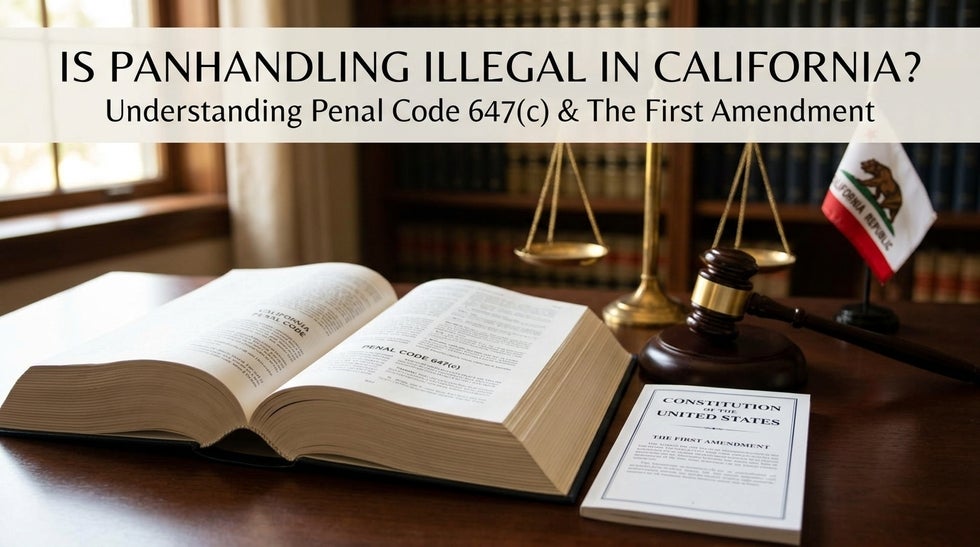
Updated October 2026 | The Bulldog Law | California Criminal Defense
Asking for money is not a crime in California. Courts treat a request for charity as speech protected by the First Amendment, and holding a sign, sitting with a cup, or asking a passerby for change is lawful under state law. What Penal Code 647(c) prohibits is accosting other people in a public place for the purpose of begging or soliciting alms, a misdemeanor that courts read narrowly to mean approaching and confronting someone, not simply asking. Cities add their own rules, and the ones that survive court challenges target conduct rather than content: aggressive panhandling such as following, blocking, touching, or threatening; solicitation in captive locations like ATMs, bus stops, and lines; and standing in roadways and medians for traffic safety. Violations are typically cited, not arrested, and resolved through diversion, homeless court, or dismissal.
The Bulldog Law's attorneys see panhandling citations rarely on their own and often as the start of something else: a citation for begging that became a trespass charge when the person would not leave, a refusal to give a name that became a resisting charge, an argument with a passerby that became a criminal threats allegation. Understanding what the begging law actually covers is the first step in all of them, because the underlying conduct was usually lawful. What follows is the state statute, the constitutional limits, the local ordinances, the roadway rules, and how these cases end. Call (888) 928-1609 or message our team.
Penal Code 647(c): accosting for alms
California's disorderly conduct statute, Penal Code 647, lists a series of misdemeanors, and subdivision (c) applies to anyone who accosts other persons in any public place or in any place open to the public for the purpose of begging or soliciting alms. The penalty is that of any 647 misdemeanor: up to six months in county jail and a fine of up to $1,000. Our attorneys' page on disorderly conduct covers the other subdivisions, including public intoxication under 647(f).
The word that matters is accosts. Courts have construed it to require more than a request: approaching a person and confronting them in a manner that is likely to be intimidating or alarming, rather than simply speaking to them or holding out a hand. A person sitting on a sidewalk with a sign who never approaches anyone has not accosted anyone. A person who walks up to a stranger, asks for money, and moves on when refused has, at most, a weak case against them. A person who follows, blocks, or physically confronts the stranger is the case the statute was written for.
The statute has a constitutional history. In Blair v. Shanahan in 1991, a federal district court held that 647(c) violated the First Amendment by singling out speech requesting charity; the judgment was later vacated after settlement, and the statute remains on the books, but its enforceability against peaceful requests has been doubtful ever since. The Supreme Court's 2015 decision in Reed v. Town of Gilbert, holding that laws targeting speech by its content receive strict scrutiny, led courts across the country to strike down panhandling ordinances that applied to requests for money but not other speech. The result in California is that prosecutors rarely file 647(c) against peaceful begging, and the cases that are filed involve conduct that would be unlawful regardless of what was said.
Local ordinances: aggressive panhandling and location rules
Most California cities regulate panhandling through municipal codes rather than the Penal Code, and the ordinances that have survived share a design: they target conduct and location, not the request. Typical provisions prohibit aggressive panhandling, defined as soliciting while following a person after refusal, blocking passage, touching without consent, using threats or profanity directed at the person, or soliciting in a group in a manner that intimidates. Location provisions prohibit solicitation within a set distance of ATMs and bank entrances, at bus and transit stops, in outdoor dining areas, in lines waiting for entry, and on private property after being asked to leave. Violations are usually infractions or misdemeanors, and many cities have repealed or stopped enforcing broader rules after litigation.
The infraction or misdemeanor designation matters. An infraction carries a fine, no jail, and no right to a jury; a misdemeanor carries jail exposure and a record. A citation that is ignored becomes a failure to appear and, eventually, a bench warrant, which is how a small ordinance violation becomes an arrest months later.
Roadways, medians, and off-ramps
Solicitation at intersections and freeway off-ramps is regulated mostly through traffic law. The Vehicle Code prohibits standing in a roadway to solicit a ride, employment, or business from vehicle occupants, and prohibits pedestrians on freeways and many ramps entirely. Cities restrict standing in narrow medians. Courts have struck down median and roadway rules that targeted solicitation specifically while permitting other activity, and upheld rules applied to everyone for traffic safety. A person standing on a sidewalk at an off-ramp is generally lawful; a person walking between stopped cars in a lane is generally not, for traffic reasons rather than begging ones. Giving money from a car is not itself unlawful anywhere in California, though stopping in a traffic lane to do it may be.
Private property and the context of homelessness
Shopping centers, stores, gas stations, and parking lots are private property, and the owner may ask a person soliciting there to leave; refusing is trespass under Penal Code 602. California's constitution protects some speech in large shopping centers that function as public forums, under the Pruneyard line of cases, but the protection is limited and subject to reasonable rules, and it does not extend to individual stores or small centers. Most panhandling enforcement on private property is trespass enforcement.
Panhandling enforcement is entangled with homelessness, and the legal landscape shifted in 2024 when the Supreme Court held in City of Grants Pass v. Johnson that enforcing public camping bans against people with no shelter does not violate the Eighth Amendment. That decision concerned camping, not begging, and does not change the First Amendment rules that protect peaceful requests for money. It has, however, increased enforcement activity generally, and with it the encounters that produce related charges.
The charges that actually follow
In our attorneys' experience, the begging itself is rarely the charge that matters. The encounter produces others. Trespass for refusing to leave private property. Resisting or obstructing under Penal Code 148 for refusing to give a name or pulling away during a citation. Disturbing the peace under Penal Code 415 for a loud argument. Criminal threats when a refusal led to angry words. Public intoxication. Prowling or loitering ordinances. Each of those is defended on its own elements, and the defense frequently begins with the point that the initial contact was lawful speech, which shapes how the rest of the encounter is viewed.
How these cases are resolved
Panhandling citations and related low-level charges are among the most commonly diverted cases in California. Many counties operate homeless courts or community courts that resolve citations through participation in services, shelter, treatment, or case management rather than fines, and dismiss them on completion. Misdemeanor diversion under Penal Code 1001.95 is available at the judge's discretion for most misdemeanors, and mental health diversion under 1001.36 where a qualifying condition contributed. Our attorneys also challenge citations on constitutional grounds where the ordinance targets the content of the request, and on factual grounds where the conduct did not amount to accosting or aggressive solicitation. A person who received a citation should appear or have counsel appear; the citation release process is a promise to appear, and the failure to appear is a separate offense.
Frequently asked questions
Is panhandling illegal in California?
Not in itself. Asking for money is speech protected by the First Amendment, and passively holding a sign or sitting with a cup is not a crime under state law. California's Penal Code 647(c) makes it a misdemeanor to accost other people in a public place for the purpose of begging, which courts read to mean approaching and confronting someone, not simply asking. Cities add their own rules, usually limited to aggressive conduct and specific locations such as ATMs, transit stops, and medians, and many broader ordinances have been struck down.
What is aggressive panhandling?
Soliciting in a way that intimidates or threatens: following someone after they refuse, blocking their path, touching them, using threatening language, or soliciting in a confined location such as at an ATM or in line. Most California cities that regulate panhandling now target aggressive conduct rather than asking itself, because courts have upheld rules aimed at conduct while striking down rules aimed at the content of the request.
What is the penalty for panhandling under Penal Code 647(c)?
It is a misdemeanor under California's disorderly conduct statute, punishable by up to six months in county jail and a $1,000 fine. In practice, police issue citations rather than making arrests, and cases are commonly resolved through homeless court, diversion, or dismissal. Local ordinance violations are often infractions with small fines.
Can you be arrested for asking for money at a freeway off-ramp or median?
Possibly, but usually under traffic and safety laws rather than begging laws. Vehicle Code provisions prohibit standing in a roadway to solicit a ride, employment, or business from vehicle occupants, and many cities restrict standing in medians. Courts have scrutinized median bans that single out solicitation, and some have been struck down, but rules applied to everyone for traffic safety reasons are more likely to survive.
Is it illegal to give money to panhandlers?
No. California law does not punish giving. A few cities have tried to discourage giving at intersections through traffic ordinances aimed at drivers who stop in a lane, but handing money to someone on a sidewalk is lawful everywhere in the state.
Related reading from our attorneys
- Disorderly conduct under Penal Code 647
- Trespass under Penal Code 602
- Resisting or obstructing an officer: Penal Code 148
Cited for panhandling, or for what happened after? The first contact is usually lawful, and that matters
The Bulldog Law's defense attorneys resolve panhandling, trespass, and public-order citations across California through diversion, homeless court, and constitutional challenges where ordinances overreach. Visit our criminal defense page, call (888) 928-1609, or reach us online.