
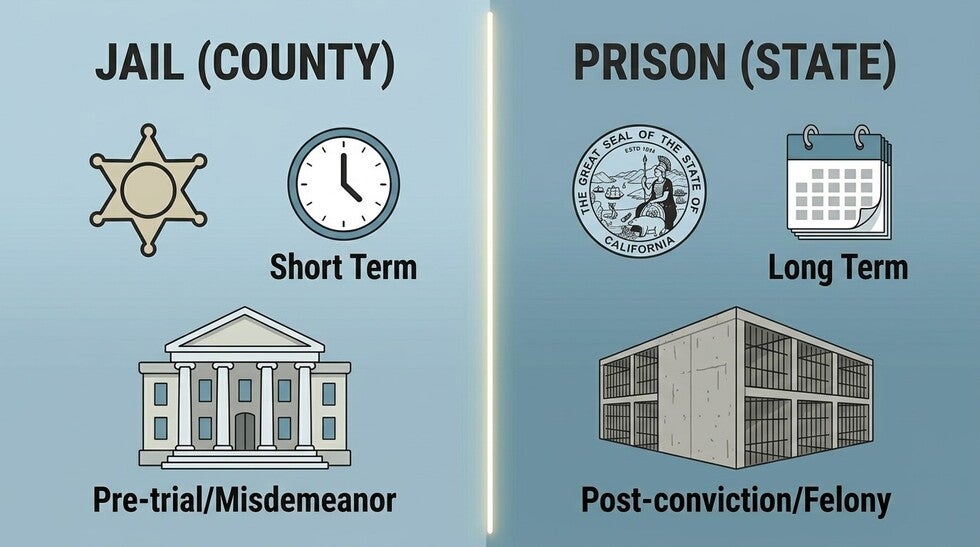
Jail and prison are not the same thing, but most people use those words like they are. I get it. Until you or someone you care about is arrested, the difference feels like a small detail. But in California, that detail can mean the difference between going home in six months or being sent hundreds of miles away for years. Jail is run by the county (usually the sheriff) and holds people short-term, those awaiting trial and those serving sentences of one year or less. Prison is run by the state (the CDCR) and holds people serving felony sentences longer than a year after conviction.
California adds a twist most states don't have. Since the 2011 Realignment law (AB 109), thousands of people convicted of lower-level felonies serve their entire sentences, sometimes several years, in county jail instead of state prison. This guide from The Bulldog Law's criminal defense team explains both institutions, who ends up in each, how Realignment rewrote the rules, how federal prison differs, and why the jail-or-prison question is really a sentencing question your defense can shape.
What Is the Difference Between Jail and Prison?
The difference comes down to who runs it, who is held there, and for how long. The clean comparison:
Who runs it, jails are operated by counties, almost always the county sheriff; prisons are operated by the State of California through the California Department of Corrections and Rehabilitation (CDCR).
Who is inside, jails hold a mix: people awaiting trial who haven't been convicted of anything, and people serving sentences of a year or less (plus Realignment felons, more on that below); prisons hold only convicted felons serving terms longer than a year.
How long, jail stays are measured in days to months (with Realignment exceptions); prison terms are measured in years.
Conviction status, you can sit in jail while legally innocent, simply because bail wasn't granted or posted; nobody is in prison without a felony conviction.
Who Ends Up in Jail?
People end up in jail for all kinds of reasons, sometimes not even because of a conviction. After an arrest, you go straight to the county jail for booking. If you can't post bail, you stay there until your case resolves. That means someone accused of a crime but not yet convicted can sit in jail for weeks or even months.
Sentenced misdemeanor offenders also go to jail, DUI, petty theft, simple battery, for example. Their time is capped at one year per count. I've seen people surprised to learn that a misdemeanor conviction can still mean real custody time, even if it's not "prison."
Who Ends Up in Prison?
Prison is for people who have been convicted of a felony and sentenced to more than a year. These are the more serious cases, violent crimes, sex offenses that require registration, and other serious felonies. Before AB 109, most felony convictions resulted in state prison. That changed dramatically after 2011.
What Is Jail?
Jail is the county's short-term detention system, the place people go after arrest, while awaiting trial, and to serve misdemeanor sentences of up to one year. Every criminal case that involves custody starts here: booking after arrest, the holding period before arraignment, and pretrial detention for those who don't make bail, the stage walked through in the firm's guide to what happens after a California arrest.
Sentenced misdemeanants, DUI, petty theft, simple battery, serve their time here too, capped at a year per count. Life inside reflects the mission: constant turnover, mixed populations (pretrial and sentenced together), limited programming, and facilities built for churn rather than rehabilitation.
Conditions Inside County Jail
Honestly, county jail is often harder day-to-day than prison. I've spoken with many clients who have done time in both. The conditions in jail are rougher not because the facility is more dangerous necessarily, but because there's less structure. You can be moved around constantly. Programming is minimal. Visits can be harder to arrange.
Counties run work-release, electronic monitoring, and home-detention alternatives that skilled counsel can often substitute for cell time. If you're facing a misdemeanor, your lawyer can sometimes negotiate for these alternatives instead of actual custody, which is why having the right defense matters from the start.
What Is Prison?
Prison is the state's long-term system, CDCR institutions holding people convicted of felonies and sentenced to more than a year. Entry runs through a reception center, where the CDCR classifies each person by security level (Level I minimum through Level IV maximum) based on the offense, sentence length, and history, then assigns an institution.
Because stays are long, prisons are built with structure jails lack: education and vocational programs, work assignments, credit-earning opportunities that shorten sentences, and defined visitation systems. Release typically comes with parole or post-release supervision, the sentence's tail that follows people home.
Which Offenses Still Send You to Prison?
Which felonies still go to prison after Realignment: serious felonies, violent felonies, sex offenses requiring registration, and defendants with those kinds of priors, the categories the California criminal charges list maps offense by offense.
The CDCR security classification system places people across four levels. Level I is minimum security, low-risk people in open dormitories. Level IV is the most restrictive, for those with long sentences and serious histories. Where you land in that system affects your daily experience significantly, which is yet another reason why the outcome at sentencing matters so much.
California's Twist: Realignment (AB 109 and PC § 1170(h))
Since 2011, California's Realignment law sends people convicted of non-serious, non-violent, non-sex felonies to county jail, not state prison, even for multi-year terms. AB 109 rewrote the map: lower-level felony sentences are now served under Penal Code § 1170(h) in county facilities, in terms of 16 months, two years, or three years (longer for some offenses).
Judges can also impose "split sentences", part in custody, part on mandatory supervision in the community. The result is the answer that surprises everyone: in California, a felony conviction does not automatically mean prison. It often means county jail.
How Realignment Changed the System
According to the California Department of Corrections and Rehabilitation (CDCR), prior to Realignment, more than 60,000 felon parole violators returned to state prison each year, with an average stay of 90 days. After AB 109 took effect on October 1, 2011, most parole violations shifted to county jails, and annual new admissions to state prison dropped from roughly 55,000–65,000 to fewer than 36,000 per year. According to a Public Policy Institute of California (PPIC) study, the law significantly reduced the state prison population, though California didn't reach the court-mandated population cap until after Proposition 47 passed in 2014.
The difference between a § 1170(h) jail felony and a prison-bound one turns on how the offense is charged and what priors are alleged. That charging fight, wobbler reductions, striking priors, contesting serious/violent allegations, is defense work with years of consequences, and it starts with understanding what the criminal charge actually alleges.
If you're facing a felony and want to understand where you might end up, reach out to The Bulldog Law. We fight these charging decisions in every case we take.
Federal Prison vs. State Prison: What's Different?
Federal prison is a third system entirely, run by the federal Bureau of Prisons (BOP) for federal convictions, with its own facilities, rules, and no traditional parole. Convictions in United States District Court, drug trafficking, fraud, firearms, federal offenses of every kind, route to BOP institutions ranging from minimum-security camps to maximum-security penitentiaries, placed anywhere in the country.
The Federal Parole Difference
The defining difference: the federal system abolished parole decades ago, so defendants serve the vast majority of their sentences with only modest good-conduct credit. If someone is sentenced to 10 years federally, they will serve close to that time, not half of it.
Federal cases are a specialty of their own, sentencing guidelines, mandatory minimums, and BOP placement advocacy handled by the firm's federal criminal defense practice. Federal cases move fast and hit harder. Don't face them without someone who knows the system.
Is Jail Worse Than Prison?
Ask people who have done both and the answer is uncomfortable: many say county jail is harder time, hour for hour, but prison time is longer time, and length usually matters most.
Jail's hardships are instability: constant intake churn, pretrial and sentenced populations mixed, little programming, limited yard and visitation, and days built around waiting.
Prison's hardships are duration and distance: years measured out far from family, inside a classification system with real dangers at higher levels, but with routines, jobs, education, and credits that give the time structure and an earlier exit.
Why the Comparison Matters for Your Defense
For defense strategy, the comparison is practical, not philosophical. A negotiated outcome's where and how long, jail vs. § 1170(h) vs. prison, straight time vs. split sentence vs. diversion that avoids custody entirely, changes what a client actually lives through. And it is negotiated, not assigned by fate.
I've had clients say the best outcome they got wasn't avoiding conviction, it was avoiding CDCR. Getting a sentence reduced from two years in state prison to a split sentence in county jail, with half served on mandatory supervision, is a real win. It keeps people closer to family, closer to their jobs, and out of a system designed for long-term incarceration.
How Does the Sentence Decide Where You Go?
Follow the severity ladder and the destination follows: infractions mean no custody, misdemeanors mean county jail up to a year, and felonies split between § 1170(h) county terms and CDCR prison based on the offense and priors.
The full ladder, infraction vs. misdemeanor up through wobblers and straight felonies, is where every custody outcome is really decided:
Whether a wobbler files as a misdemeanor. Whether a strike prior is alleged or stricken. Whether probation or a split sentence replaces custody. Whether diversion erases the case altogether.
Your Record After Custody
When custody ends, the record remains. That's when expungement and record-clearing become the next fight. Under Penal Code § 1203.4, people who completed probation may be able to petition to have their conviction dismissed from most private employer background checks. It's not automatic, and it's not available for everyone, but for those who qualify, it can change what doors are open to them after a case ends.
The jail-or-prison question, asked early enough, is a question your lawyer helps answer.
Frequently Asked Questions
What is the main difference between jail and prison?
Jail is county-run and short-term: it holds people awaiting trial (not yet convicted) and people serving sentences of one year or less. Prison is state-run, in California, by the CDCR, and holds only people convicted of felonies serving terms longer than a year. California's Realignment law blurs the line in one direction: people convicted of non-serious, non-violent, non-sex felonies serve their terms in county jail under PC § 1170(h), sometimes for multiple years.
Can you go to prison for a misdemeanor?
No. In California, the maximum custody for a misdemeanor is one year in county jail per count, misdemeanors never carry state prison. Prison is reserved for felony convictions with terms over a year, and even many felonies now stay in county jail under Realignment. That one-year county ceiling is a big part of why charging decisions matter so much: whether a wobbler offense files as a misdemeanor or a felony changes not just the sentence length but the entire institution, and it is exactly what defense negotiation targets.
What is Realignment (AB 109) in California?
Realignment is the 2011 law that shifted responsibility for lower-level felonies from the state to the counties. Under Penal Code § 1170(h), felonies that are not serious, not violent, and not sex-registrable, for defendants without those kinds of priors, are served in county jail rather than state prison, in terms of 16 months, two years, or three years (longer for some offenses), often as "split sentences" combining custody with mandatory supervision. Practically, it means a California felony conviction frequently leads to jail, not prison, depending on how the case is charged and defended.
Do you go to jail or prison for a felony in California?
It depends on the felony. Serious felonies, violent felonies, registrable sex offenses, and defendants with those priors go to CDCR state prison. Most other felonies, the non-serious, non-violent, non-sex category, are served in county jail under PC § 1170(h), sometimes with a split sentence that converts part of the term to supervised release. Because the destination turns on charging choices, prior-conviction allegations, and negotiation, the same conduct can end in prison, county jail, probation, or diversion, which is why the answer is built by the defense, not just read off a chart.
Does jail time count as a criminal record?
Yes. Any arrest creates an arrest record, and any conviction, even for a misdemeanor resulting in jail time, creates a criminal record. In California, certain convictions may be eligible for dismissal under PC § 1203.4 (expungement) after probation is completed successfully. This can help with most private employer background checks, though it does not erase the record entirely and does not apply to all situations.
Jail or prison is never just vocabulary, it is the difference between months and years, between a facility ten minutes from family and one across the state, between a sentence with an off-ramp and one without. Those differences are negotiated at charging and sentencing, which means they are winnable. The Bulldog Law's criminal defense team fights the custody question in every case it takes. Contact the firm online or call (888) 928-1609 for a free consultation.