
Updated October 2026 | The Bulldog Law | California Juvenile Defense
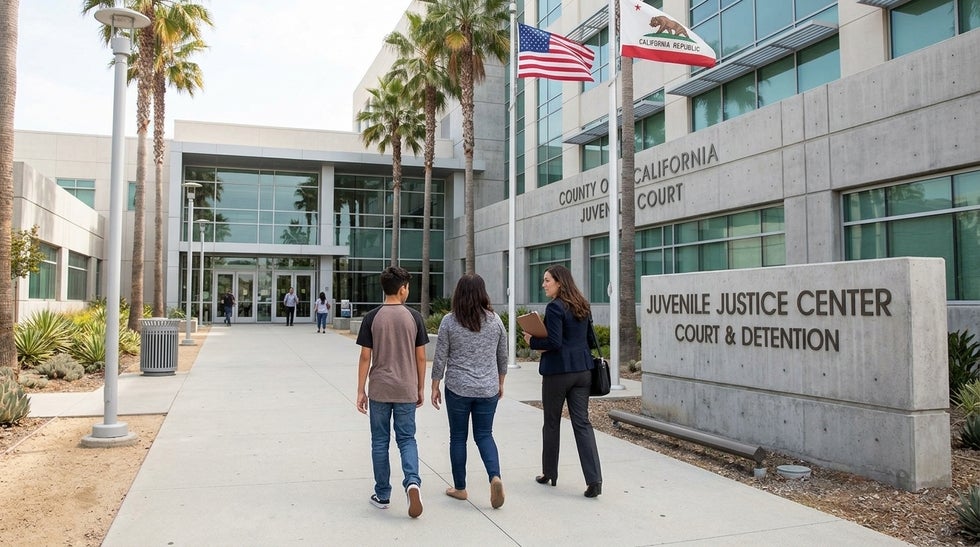
Juvenile hall is the county's secure detention facility for minors under the authority of the juvenile court. It is run by the probation department, not the sheriff, it holds minors separately from adults, and a minor is there either because a probation officer decided after arrest that release was not appropriate, or because a judge ordered a short commitment after the case was decided. It is not jail, there is no bail, and the timelines are short: if a minor is held after arrest, the prosecutor must file a petition within 48 hours and the judge must hold a detention hearing by the end of the next court day, at which most minors are released to a parent. The case that follows is not a criminal prosecution but a delinquency proceeding under Welfare and Institutions Code 602, the result is an adjudication rather than a conviction, the record is confidential, and most records are sealed automatically when the minor completes probation. For parents, the two things that matter in the first hours are that the minor speaks to a lawyer before speaking to anyone else, and that the family is at the detention hearing.
The Bulldog Law's juvenile defense attorneys are retained, in most cases, by a parent in the hours after the call from the police or the probation officer, and the questions are always the same: where is my child, when can I see them, when do they come home, and what happens next. What follows answers those questions in order: the arrest and the officer's options, the rights a minor has at the station, intake at juvenile hall and the release decision, the 48-hour petition and the detention hearing, the case from arraignment to disposition, where a minor can be sent, transfer to adult court, records, and what parents should do. Call (888) 928-1609 or message our team.
The arrest and the officer's three options
A peace officer who takes a minor into custody for an offense has three choices under Welfare and Institutions Code 626: release the minor to a parent or guardian with no further action; release the minor with a citation, called a notice to appear, directing the minor and parent to report to the probation department; or deliver the minor to the probation officer at juvenile hall. The statute directs officers to prefer the least restrictive option consistent with the minor's best interests and public safety, and most minors arrested for misdemeanors and many arrested for felonies are released or cited rather than booked. Our page on juvenile citation release covers the cite-and-release process. Whatever the officer chooses, the officer must immediately notify the parent that the minor is in custody and where, and under section 627 the minor must be allowed, within one hour of being taken into custody, to make at least two telephone calls, one to a parent or guardian and one to an attorney. The arrest itself is not a juvenile hall stay; the stay begins only if the officer delivers the minor to probation and probation decides to detain.
The minor's rights at the station: the attorney consultation rule
A minor has the same Miranda rights as an adult and one more. Under Welfare and Institutions Code 625.6, before a custodial interrogation and before any waiver of the right to silence or to counsel, a minor 17 or younger must consult with legal counsel, in person, by phone, or by video, and the consultation may not be waived. A statement obtained without the consultation is subject to exclusion, and the court must consider the violation in deciding whether the statement was voluntary.
The rule exists because minors waive their rights at far higher rates than adults and give false confessions at far higher rates, and it means that a parent's first instruction to a child in custody should be to say that they want a lawyer and nothing else until one has been consulted. Parents should also understand that they have no right to be present at an interrogation, that a parent's advice to cooperate is not legal advice, and that what a minor tells a parent in the station or over a recorded jail phone is not privileged. The minor's statements to our attorneys are.
Intake at juvenile hall and the release decision
When an officer delivers a minor to juvenile hall, a probation officer conducts intake: an interview with the minor, a call to the parent, a review of the offense and the minor's history, and a decision whether to release the minor to a parent, with or without conditions, or to detain. Welfare and Institutions Code 628 directs the probation officer to release the minor unless one of the listed grounds exists: the minor has violated a juvenile court order; the minor has escaped from a commitment; the minor is likely to flee; continued detention is a matter of immediate and urgent necessity for the protection of the minor or the person or property of another; or the minor must be held for another jurisdiction.
Many counties use a detention risk assessment instrument that scores the offense and the minor's history and presumes release below a threshold, and home supervision and electronic monitoring are available as alternatives to secure detention. A parent who is reachable, who comes to the facility, and who can describe supervision at home materially improves the release decision, and our attorneys contact the intake officer directly when retained in the first hours. A minor who is detained is booked, screened medically and for mental health, assigned to a unit by age and sex, and placed in the facility's school the next school day.
The 48-hour petition and the detention hearing
If probation detains the minor, the clock starts. Under section 631 the minor must be released within 48 hours, excluding non-judicial days, unless the district attorney has filed a petition under Welfare and Institutions Code 602 alleging the offense. Under section 632 the court must then hold a detention hearing by the expiration of the next judicial day after the petition is filed. At the detention hearing the minor is represented by an attorney, retained or appointed, and the judge decides whether the minor will remain in juvenile hall or be released pending the case, under the same criteria as intake plus a finding that a prima facie case exists.
The hearing is the parent's first and most important court appearance: the judge wants to see a parent present, a home to go to, a plan for school and supervision, and a family that will bring the minor to court, and our attorneys prepare the family for exactly that. A minor who is detained at the detention hearing may seek a rehearing on new evidence and is entitled to the expedited timelines below. There is no bail at any stage; release is a judicial decision, and it is reconsidered at each hearing.
The case from arraignment to disposition
The juvenile court process uses its own vocabulary and its own deadlines, which are shorter for a detained minor. The table sets out the sequence.
|
Stage |
Adult-court equivalent |
Timing for a detained minor |
What happens |
|
Petition filed |
Complaint |
Within 48 hours of custody, excluding non-judicial days |
The DA alleges the offense; a 602 petition for a crime, a 601 petition for truancy or incorrigibility |
|
Detention hearing |
Arraignment and bail |
By the end of the next judicial day after the petition |
Minor advised of the charges, counsel appointed or retained, detention or release decided, plea of admit or deny |
|
Pre-adjudication |
Pretrial |
Ongoing |
Discovery, motions, negotiation; many cases resolved by informal supervision under WIC 654.2 or deferred entry of judgment |
|
Jurisdiction hearing |
Trial |
Within 15 judicial days of the detention order if detained; 30 days if released |
Bench trial before a judge, no jury; the DA must prove the allegation beyond a reasonable doubt; the petition is sustained or dismissed |
|
Disposition hearing |
Sentencing |
Within 10 judicial days of the jurisdiction hearing if detained |
The judge orders a disposition from the ladder below, based on a probation report |
|
Post-disposition |
Probation and appeal |
Ongoing |
Probation reviews, modification, violation hearings, and sealing on completion |
A large share of first-offense cases never reach a jurisdiction hearing. Under section 654 and 654.2 the court can place a minor on informal supervision for up to six months without sustaining the petition, and the petition is dismissed on completion. Deferred entry of judgment under section 790 is available for most first-time felony petitions: the minor admits the allegation, completes probation of 12 to 36 months, and the petition is dismissed and the record sealed. Diversion programs run by probation and by the district attorney resolve many misdemeanors before a petition is filed. The Judicial Council's delinquency self-help pages describe the stages from the court's perspective.
Where a minor can be sent
The disposition ladder runs from the least to the most restrictive, and the court must choose the least restrictive placement consistent with the minor's rehabilitation and public safety. At the bottom are a dismissal, informal supervision, and probation at home without wardship. Next is wardship with probation at home, with conditions such as school attendance, curfew, counseling, community service, restitution, and electronic monitoring, which is the most common disposition. Above that is a short commitment to juvenile hall, typically days to a few months, often as a condition of probation. Then placement in a county camp, ranch, or residential program, for months to a year.
And at the top, for the most serious offenses, commitment to a county secure youth treatment facility under section 875, which since the closure of the state Division of Juvenile Justice in 2023 is the most restrictive juvenile placement in California, with a baseline term set by the court and reviewed every six months, and a maximum confinement that cannot exceed the adult maximum for the offense or, in most cases, the minor's 25th birthday. Juvenile dispositions are indeterminate within those limits and are modified by the court as the minor progresses; a minor is never sentenced to a fixed term the way an adult is, and never to adult jail or prison through the juvenile court.
Transfer to adult court
The only route from juvenile hall to adult custody is a transfer hearing. Under Welfare and Institutions Code 707, as amended by Proposition 57 and Senate Bill 1391, the prosecutor may move to transfer a minor who was 16 or 17 at the time of an offense listed in section 707(b), the list of the most serious violent and sex offenses, and the juvenile judge decides after a hearing whether the minor should be tried as an adult, considering the minor's sophistication, prior history, amenability to rehabilitation, the success of prior attempts, and the circumstances and gravity of the offense, and the prosecution must prove by clear and convincing evidence that the minor is not amenable to rehabilitation under juvenile jurisdiction. A minor under 16 cannot be transferred under any circumstances. Our page on Penal Code 707 transfer proceedings covers the hearing, which is the single most consequential event in a juvenile case because it is the difference between a juvenile disposition ending by age 25 and an adult sentence.
Records, confidentiality, and sealing
Juvenile proceedings are confidential, the hearings are closed to the public in most cases, and the records are not available to employers, landlords, or the public. A sustained petition is an adjudication, not a criminal conviction, and a person asked on an application whether they have been convicted of a crime may answer no as to a juvenile adjudication, subject to specific exceptions for certain licenses and for applications that ask about juvenile matters by name. Under section 786 the court must seal the record automatically when a minor satisfactorily completes probation, informal supervision, or diversion, for all but the 707(b) offenses committed at 14 or older, and under section 781 a person may petition to seal any juvenile record after turning 18 or five years after the end of jurisdiction. A sealed record is treated as though the case never occurred.
The adult arrest-sealing rules on our Penal Code 851.91 page do not apply to juvenile matters, and the juvenile record does not appear in the adult criminal history that the Department of Justice maintains, though it is retained separately and is accessible to courts for a limited set of purposes.
What parents should do, and not do
Do go to the facility, or call, as soon as you learn of the arrest, and be reachable, because the intake officer's release decision depends on a parent who can take the minor home. Do tell your child, in the first call, to ask for a lawyer and to say nothing else to anyone, including other minors in the unit and including you on a recorded line.
Do retain an attorney before the detention hearing, because the hearing is where release is decided and where the case's direction is set. Do bring to the hearing whatever shows supervision and stability: school enrollment, a work schedule, a counselor's letter, the names of adults at home. Do not tell your child to cooperate or to tell the truth to the officers before a lawyer has been consulted; the consultation rule exists because that advice produces statements that end cases badly. Do not contact the alleged victim or witnesses or their families. Do not post about the case. And do not assume that a juvenile matter is minor because the system is designed to rehabilitate: the dispositions are real, a 707(b) offense carries lasting consequences, and the transfer hearing can send a 16-year-old to adult prison.
Frequently asked questions
What is juvenile hall?
Juvenile hall is a county-run secure detention facility for minors who have been arrested and are awaiting their juvenile court proceedings, or who have been ordered to serve a short commitment there after a case is decided. Every California county operates or contracts for one, under the probation department rather than the sheriff. It is not jail: minors are held separately from adults, attend school inside, and are there under the juvenile court's authority rather than a criminal sentence.
How long can a minor be held in juvenile hall before seeing a judge?
A short time. If the probation officer decides to keep a minor in custody after arrest, the district attorney must file a petition within 48 hours of the minor being taken into custody, excluding non-judicial days, and the court must hold a detention hearing by the end of the next judicial day after the petition is filed. In practice a minor arrested on a weekday sees a judge within one to three days, and a minor arrested on a Friday may wait until Tuesday. At the detention hearing the judge decides whether the minor stays in juvenile hall or goes home pending the case.
Can parents visit a child in juvenile hall?
Yes. Every juvenile hall has scheduled visiting hours for parents and guardians, usually several times a week, and the facility must allow the minor a phone call to a parent within one hour of being taken into custody. Visiting rules on identification, approved visitors, and frequency vary by county and are posted by the probation department. An attorney may visit at any reasonable time and the visit is confidential.
Is there bail in juvenile court?
No. Juvenile court has no bail system. The decision whether a minor is detained or released pending the case is made by the probation officer at intake and then by the judge at the detention hearing, based on whether continued detention is necessary for the protection of the minor or the public, whether the minor is likely to flee, and whether the minor has violated a court order, not on money. Most minors are released to a parent at intake or at the detention hearing, often with conditions such as home supervision or electronic monitoring.
Does a juvenile hall stay go on a criminal record?
Juvenile cases are not criminal convictions and juvenile records are confidential. A sustained petition in juvenile court is an adjudication, not a conviction, and it does not have to be disclosed as a conviction on most employment applications. Juvenile records can be sealed under Welfare and Institutions Code 781 and, for most cases that end successfully, are sealed automatically under section 786 when the minor completes probation. A limited set of serious offenses listed in section 707(b), committed at 14 or older, can affect later adult sentencing and sealing eligibility.
Can a minor be sent to adult jail or prison?
Only after a transfer hearing. A minor who was 16 or 17 at the time of a serious offense listed in Welfare and Institutions Code 707(b) can be transferred to adult criminal court if the prosecutor files a motion and the juvenile judge, after a hearing, finds by clear and convincing evidence that the minor is not amenable to rehabilitation in the juvenile system. Minors under 16 cannot be transferred at all. A minor who stays in juvenile court can be committed, for the most serious offenses, to a county secure youth treatment facility, which replaced the state's Division of Juvenile Justice in 2023, but never to adult prison.
Related reading from our attorneys
- Deferred entry of judgment in California juvenile court
- Juvenile transfer proceedings under Penal Code 707
- Juvenile citation release: your child's rights when arrested
Your child is in juvenile hall? The detention hearing is tomorrow. Call tonight
The Bulldog Law's criminal defense attorneys handle juvenile delinquency cases across California, from the intake call and the detention hearing through disposition, transfer hearings, and sealing. Call (888) 928-1609 or reach us online.