
Updated October 2026 | The Bulldog Law | California Theft Crimes Defense
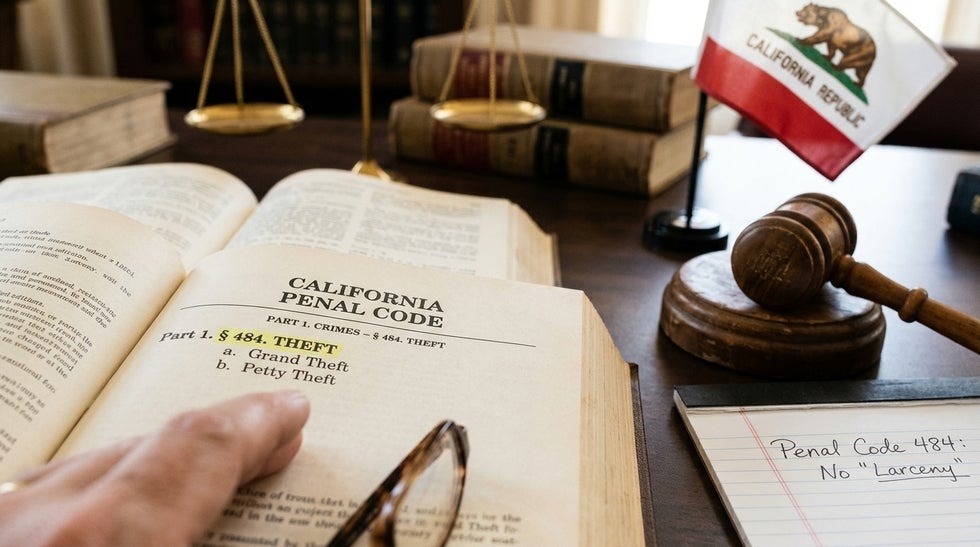
California has no crime called larceny. Larceny is the common-law word for stealing, the taking and carrying away of another person's property without consent and with intent to keep it, and many states still use it, dividing it into grand larceny and petty larceny by the value taken. California abolished the word in 1927, when it merged larceny, embezzlement, and theft by false pretenses into a single crime called theft under Penal Code 484. What another state calls grand larceny is grand theft under Penal Code 487 here: theft of more than $950, or of a vehicle, a firearm, or property taken from the person, a wobbler carrying up to three years. What another state calls petty larceny is petty theft under Penal Code 488, a misdemeanor carrying up to six months. The elements, the $950 line, and the exceptions that push a small theft into felony territory are what follow.
The Bulldog Law's theft attorneys hear the word larceny from clients who were charged elsewhere, who are reading about the law in general, or who were told by someone that a larceny charge was coming. The charge that actually arrives in California is theft, and the questions that decide it are the value, the manner of taking, and the client's record. What follows is the history that explains the vocabulary, a translation of the terms other states use, the elements of theft by larceny, the grand and petty theft thresholds with every exception, the boundary with burglary and robbery, the penalties, and the resolutions. Call (888) 928-1609 or message our team.
Why California dropped the word
At common law, stealing was three different crimes with three different sets of elements. Larceny was a trespassory taking from the owner's possession. Embezzlement was a conversion by someone the owner had entrusted. False pretenses was obtaining title by a lie. Each had technical requirements, and a defendant charged with the wrong one walked free, so a shoplifter charged with embezzlement or a swindler charged with larceny was acquitted on a pleading error. In 1927 the Legislature amended Penal Code 484 to define theft as any of the three, and Penal Code 490a provides that wherever any law refers to larceny, embezzlement, or stealing, it is to be read as theft.
The consolidation means that a California prosecutor charges theft, the jury is instructed on whichever theories the evidence supports, and the jurors need not agree on which one applies. The elements of the larceny theory survive as the elements of theft by larceny, which is the theory in most shoplifting, pickpocketing, package theft, and taking cases. Cornell's Legal Information Institute summarizes the common-law crime that other states still use.
Translating other states' terms
Clients and employers encounter the common-law vocabulary from other states, from background checks, and from federal and military law. The table translates the terms into their California equivalents.
|
Term used elsewhere |
What it means |
California equivalent |
|
Larceny |
Taking and carrying away another's property without consent, with intent to permanently deprive |
Theft by larceny, PC 484 |
|
Grand larceny |
Larceny above a value threshold (varies by state, often $1,000) or of certain property |
Grand theft, PC 487 (more than $950, or a vehicle, firearm, or taking from the person) |
|
Petty larceny, petit larceny |
Larceny below the threshold |
Petty theft, PC 488 ($950 or less) |
|
Larceny by trick |
Obtaining possession, but not title, by deception |
Theft by larceny or by false pretenses, PC 484; see also PC 532 |
|
Larceny from the person |
Taking from the victim's body or clothing without force |
Grand theft from the person, PC 487(c), any value |
|
Larceny of a motor vehicle |
Stealing a car |
Grand theft auto, PC 487(d)(1); or joyriding, VC 10851 |
|
Shoplifting |
Taking merchandise from a retail store |
Shoplifting, PC 459.5 (entry with intent, $950 or less) or petty theft, PC 484/488 |
|
Receiving stolen property |
Knowingly possessing stolen goods |
PC 496, a wobbler above $950 |
The elements of theft by larceny
Under the larceny theory, the prosecution must prove that the defendant took possession of property owned by someone else, without the owner's consent, with the intent at the time of the taking to deprive the owner of it permanently or for so long a time that the owner would be deprived of a major portion of its value or enjoyment, and that the defendant moved the property, even a small distance, and kept it for any period, however brief. Each element produces defenses. Possession by someone else: a person who takes their own property, or property they honestly believe is theirs, has not committed theft, and a good-faith claim of right, even an unreasonable one, negates the intent. Without consent: property handed over voluntarily is a false-pretenses or embezzlement question, not larceny, and an owner who permitted the taking has not been stolen from.
Intent to permanently deprive: the intent must exist at the moment of taking, so a person who took property intending to return it, and did, has committed at most the separate offense of unauthorized use, though an intent to return only after demanding a reward or to sell the item back to the owner is treated as an intent to steal. Asportation: the slightest movement suffices, so concealing merchandise in a store and walking toward the door is a completed theft, but a person who never moved the item has not completed the crime. Our petty theft page covers the elements as applied to the ordinary case.
Grand theft, petty theft, and the exceptions
Penal Code 487 makes theft grand theft when the property taken is worth more than $950, a line set by Proposition 47 in 2014, and the value is the fair market value at the time of the taking, which the defense frequently contests through receipts, resale values, and depreciation. Several categories are grand theft regardless of value. Property taken from the person of another, such as a wallet from a pocket or a phone from a hand, is grand theft under 487(c). A vehicle under 487(d)(1), covered on our grand theft auto page, and a firearm under 487(d)(2), which is a straight felony and a strike. Certain agricultural products and aquacultural products are grand theft over $250. And money, labor, or property taken by an employee from an employer is grand theft when it aggregates $950 or more over any 12 months.
Everything else is petty theft under Penal Code 488, a misdemeanor, with a first theft of $50 or less chargeable as an infraction at the prosecutor's election under Penal Code 490.1. Two provisions raise repeat petty theft. Penal Code 666 makes petty theft a wobbler for a person with a prior theft conviction who served time for it and who has a prior serious or violent felony or a sex offense registration, or three or more prior theft convictions. And Proposition 36, approved in November 2024, created Penal Code 666.1, under which a person with two or more prior theft convictions can be charged with a wobbler for a third theft of any value, and amended Penal Code 490.3 to allow the value of thefts committed by the same person as part of a common plan or across multiple victims to be aggregated to reach the $950 line, reversing the practice of charging each small theft separately. Our page on grand theft under Penal Code 487 covers the subdivisions in depth, and Penal Code 490 sets the petty theft penalty.
Theft against burglary and robbery
Larceny is the taking. Two other crimes are confused with it because they usually involve a taking as well. Burglary under Penal Code 459 is entering a building, a room within a building, a locked vehicle, or other listed structure with the intent to commit theft or any felony inside; the crime is complete on entry, and a person who enters a home intending to steal and leaves empty-handed has committed burglary. Entering a commercial establishment during business hours intending to steal $950 or less is the separate misdemeanor of shoplifting under Penal Code 459.5, created by Proposition 47, and cannot be charged as burglary.
Robbery under Penal Code 211 is taking property from a person or their immediate presence, against their will, by force or fear; it is always a felony, always a strike, and carries two to nine years, and a theft that turns into a struggle when the owner resists becomes a robbery under the doctrine that the force used to escape with the property suffices. Our comparison of burglary and robbery covers the boundary, and the theft crimes hub covers the family of offenses.
Penalties
|
Charge |
Statute |
Classification |
Custody |
Notes |
|
Petty theft, $50 or less, first offense |
PC 490.1 |
Infraction at prosecutor's election |
None; fine up to $250 |
|
|
Petty theft, $950 or less |
PC 484, 488, 490 |
Misdemeanor |
Up to 6 months county jail |
Fine up to $1,000; diversion and civil compromise common |
|
Shoplifting, $950 or less |
PC 459.5 |
Misdemeanor |
Up to 6 months |
Cannot be charged as burglary |
|
Petty theft with priors |
PC 666, 666.1 |
Wobbler |
Up to 1 year, or 16 months, 2, or 3 years |
PC 666.1 added by Proposition 36 for a third theft |
|
Grand theft, more than $950, from the person, or vehicle |
PC 487 |
Wobbler |
Up to 1 year, or 16 months, 2, or 3 years |
Reducible under PC 17(b); aggregation under PC 490.3 |
|
Grand theft of a firearm |
PC 487(d)(2) |
Felony |
16 months, 2, or 3 years |
Serious felony; strike |
|
Receiving stolen property |
PC 496 |
Wobbler above $950; misdemeanor at or below |
Up to 1 year, or 16 months, 2, or 3 years |
Resolutions and consequences
Theft is among the most negotiable categories in California criminal law and among the most damaging on a record, and both facts shape the defense. A first petty theft is routinely resolved by diversion under Penal Code 1001.95, by a civil compromise where the merchant or owner is made whole, or by an infraction plea, each of which avoids a conviction.
A grand theft with restitution and no record is frequently filed or reduced as a misdemeanor. The defenses, claim of right, lack of intent, consent, mistaken identity in a crowded store, and value, are argued at the charging stage as often as at trial. The consequence that matters most to many clients is that theft is treated as a crime of dishonesty: a conviction, even for a misdemeanor and even after expungement, appears on background checks, must be disclosed on many license applications, and bars employment in banking, retail management, and positions of trust for years.
For a non-citizen, theft is a crime involving moral turpitude and, with a sentence of a year or more, an aggravated felony, so our immigration attorneys structure every theft plea; a plea to an offense without an intent-to-deprive element, or a sentence of 364 days rather than a year, is frequently the difference. A theft committed with a forged document or a stolen identity carries the separate forgery and identity theft charges, each with its own exposure.
Frequently asked questions
What is larceny?
Larceny is the common-law name for stealing: taking and carrying away someone else's personal property, without consent, with the intent to permanently deprive them of it. Many states still use the word, and some divide it into grand larceny and petty larceny by the value taken. California does not. In 1927 California merged larceny, embezzlement, and theft by false pretenses into a single crime called theft, defined in Penal Code 484, and divides it into grand theft and petty theft. A person arrested in California for what another state would call larceny is charged with theft.
What is grand larceny in California?
There is no crime called grand larceny in California. The equivalent is grand theft under Penal Code 487: theft of money, labor, or property worth more than $950, or of a vehicle or a firearm regardless of value, or of certain agricultural products over $250, or taken from the person of the victim. Grand theft is a wobbler, punishable by up to one year in county jail as a misdemeanor or 16 months, two, or three years as a felony. Grand theft of a firearm is a straight felony and a strike.
What is petty larceny in California?
The California equivalent is petty theft under Penal Code 488: theft of property worth $950 or less, a misdemeanor punishable by up to six months in county jail and a $1,000 fine. A first-offense petty theft of $50 or less can be charged as an infraction at the prosecutor's discretion. A person with certain prior theft convictions can be charged under Penal Code 666 with petty theft with a prior, a wobbler, and under Proposition 36 a third theft offense can be charged as a felony regardless of value.
What is the difference between larceny and theft?
Historically, larceny was one of three separate crimes, alongside embezzlement and false pretenses, each with its own technical elements, and defendants were acquitted when the prosecution charged the wrong one. Theft is the modern consolidated crime that covers all three. In California the charge is always theft under Penal Code 484, and the jury can convict on any of the three theories without agreeing which one applies. Larceny is the theory that applies when the defendant took property from the owner's possession; embezzlement applies when the owner entrusted it; false pretenses applies when the owner handed it over because of a lie.
What is the difference between larceny, burglary, and robbery?
Larceny or theft is the taking itself. Burglary under Penal Code 459 is entering a building, room, or locked vehicle with the intent to commit theft or any felony inside, and it is complete on entry whether or not anything is taken. Robbery under Penal Code 211 is taking property from a person's immediate presence by force or fear, and it is always a felony and a strike. A shoplifter who takes merchandise commits theft; a person who enters a store after hours to steal commits burglary; a person who grabs a purse and shoves the owner commits robbery.
Is larceny a felony or a misdemeanor in California?
It depends on the value and the circumstances. Theft of $950 or less is a misdemeanor, with exceptions for repeat offenders. Theft of more than $950, or of a vehicle, a firearm, or property taken from the person, is grand theft, a wobbler that the prosecutor can file either way and the court can reduce. Theft of a firearm is a felony. Under Proposition 36, which took effect in 2025, a third theft conviction can be charged as a felony regardless of the amount, and the value of thefts committed as part of a common plan can be aggregated to reach the felony line.
Related reading from our attorneys
- Grand theft under Penal Code 487
- Petty theft under Penal Code 484 and 488
- Proposition 36 and the new theft rules
Charged with theft? The value and the intent are the case
The Bulldog Law's criminal defense attorneys defend petty theft, grand theft, shoplifting, and receiving cases across California, with the immigration and licensing consequences handled from the first appearance. Call (888) 928-1609 or reach us online.