
Updated September 2026 | The Bulldog Law | California Criminal Defense
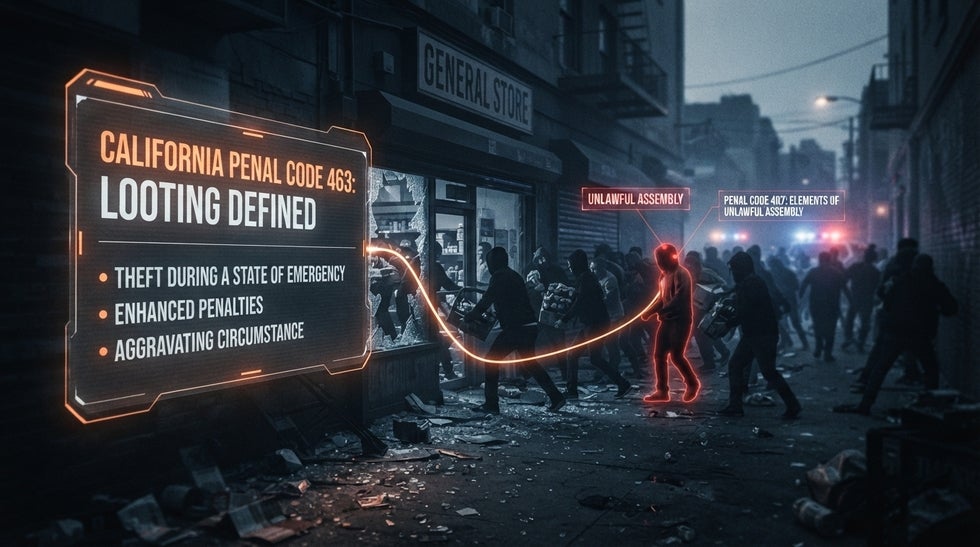
Looting in California is not a separate kind of theft. Penal Code 463 takes three existing crimes, burglary, grand theft, and petty theft, and vandalism, and attaches mandatory jail minimums when they are committed during a declared state of emergency, local emergency, or evacuation order caused by an earthquake, fire, flood, riot, or other disaster. Burglary during an emergency is a wobbler with the felony term of 16 months, two, or three years and a 180-day jail floor if probation is granted; grand theft during an emergency carries the same floor; petty theft during an emergency is a misdemeanor with a 90-day floor. Unlawful assembly, under Penal Code 407, is a different charge for a different problem: two or more people gathered to do something unlawful, or something lawful in a violent or tumultuous way, and remaining after a lawful order to disperse is its own misdemeanor. In a civil disturbance both sets of charges are filed together, often against everyone detained on the block.
The Bulldog Law's attorneys see looting and unlawful assembly charges in waves: after a wildfire evacuation, after an earthquake, and after a protest that a police department declared unlawful. The cases that arrive in those waves share a feature: they were made in bulk, in the dark, by officers arresting a crowd, and they are sorted out months later in a courtroom where the question is what each individual person actually did. What follows is what the looting statute requires, why the emergency declaration is the whole difference, how unlawful assembly and dispersal orders work, and where these cases fall apart. Call (888) 928-1609 or message our team if you were arrested in one.
Penal Code 463: theft with an emergency attached
Penal Code 463 applies when a person commits certain crimes during and within an affected county in a state of emergency declared by the Governor, a local emergency declared by a city or county, or an evacuation order, resulting from an earthquake, fire, flood, riot, or other natural or manmade disaster. The statute has three subdivisions:
Subdivision (a): second-degree burglary during the emergency. The crime is the same as ordinary burglary under Penal Code 459, entering a structure with intent to commit theft or a felony, but it is charged as looting, punished as a wobbler with the second-degree burglary felony term, and if probation is granted, the court must impose at least 180 days in county jail and may require up to 240 hours of community service. The judge may reduce or eliminate the jail minimum only by stating reasons on the record in the interest of justice.
Subdivision (b): grand theft during the emergency. Theft of property worth more than $950, or the specific property types Penal Code 487 lists regardless of value, with the same wobbler treatment and the same 180-day floor. Theft of a firearm during an emergency is a straight felony under this subdivision.
Subdivision (c): petty theft during the emergency. Theft of $950 or less, a misdemeanor punishable by up to six months in jail, with a 90-day minimum if probation is granted and 80 hours of community service.
Vandalism, damaging or destroying property, committed during the emergency is also treated as looting under subdivision (d), with the same probation minimums, and the vandalism statute supplies the felony or misdemeanor level based on the amount of damage. The through-line is that the conduct is ordinary theft or property crime; what the statute adds is the emergency, the label, and the floors.
The emergency declaration is the element
Looting requires proof that a qualifying emergency had been declared, that it covered the county where the crime occurred, and that the crime happened during it. The Governor's proclamations and local emergency declarations are public records, and they are frequently broad, covering an entire county for weeks after a fire. But they are not automatic: a store broken into during a protest in a city that never declared a local emergency is a burglary, not a looting, and the difference is a 180-day floor and a word on the record that follows the defendant forever. Our attorneys check the declaration before anything else, and where the emergency was declared after the arrest, or covered a different jurisdiction, the looting count fails.
Unlawful assembly, failure to disperse, and curfew
Penal Code 407 defines an unlawful assembly as two or more persons assembled together to do an unlawful act, or to do a lawful act in a violent, boisterous, or tumultuous manner. Participation is a misdemeanor under Penal Code 408. Once police lawfully declare an assembly unlawful and order dispersal, remaining at the scene is a separate misdemeanor under Penal Code 409, and Penal Code 416 covers the refusal to disperse when ordered by an officer. During a declared emergency, local officials may impose curfews under the Emergency Services Act, and violating one is a misdemeanor under Government Code 8665 or the local ordinance.
These are the charges that reach people who stole nothing. A protest that has turned violent is declared an unlawful assembly; a dispersal order is given, sometimes audibly and sometimes not; the crowd is kettled; everyone inside the line is arrested for 409. The defenses are specific. The assembly must actually have been unlawful, meaning violent or tumultuous, not merely loud or inconvenient; the First Amendment protects the loud part. The dispersal order must have been lawful, given by an officer with authority, and actually communicated in a way the defendant could hear and comply with. And the defendant must have had a reasonable opportunity and route to leave. Courts have thrown out mass 409 arrests where the order was inaudible, where police blocked the exits before ordering people to use them, and where the order came after the arrests began. Body camera footage and the dispatch timeline decide these cases, and our attorneys demand both in every one.
Where riot fits
Riot, under Penal Code 404, is two or more people acting together to use force or violence, or to threaten it with the immediate power to carry it out, without authority of law; incitement to riot is Penal Code 404.6. Our attorneys cover those statutes on our riot, riot participation, and incitement pages. The relationship to looting is simple: riot is about the disturbance, looting about the property, and one does not require the other. A person who broke a window during a riot is charged with riot and vandalism; if an emergency had been declared, with looting as well. A person who took nothing and hit no one, but stayed after the dispersal order, is charged with 409 and nothing else, if the arrest was sorted correctly.
How mass arrests get sorted
The distinctive feature of looting and unlawful assembly prosecutions is that the arrest usually precedes the investigation. Officers clearing a block or a store detain everyone present and book them on the same charges; the district attorney then receives dozens of nearly identical reports and a stack of body camera footage and decides who to file on. The filing decision, made in the weeks after the arrest, is where most of these cases end, and it is the point at which a defense attorney can present what the officer could not know at the scene.
Identification. In a crowd, at night, in smoke or tear gas, the question is whether this defendant is the person on the video entering the store, and the answer is often no. Clothing, position, timing, and the absence of any property in the defendant's possession at booking are the evidence.
Conduct. Presence is not theft. Filming is not theft. Walking through a broken storefront to get away from a police line is not burglary, because there is no intent to steal. The looting statute requires the underlying theft or vandalism, with all its elements, and mass arrests routinely sweep in people who satisfied none of them. Our page on aiding and abetting explains why standing near someone who stole is not a crime.
The stop. Kettling a crowd and arresting everyone is a seizure of each person, and it requires probable cause as to each one. The Fourth Amendment analysis our attorneys apply to any stop applies to mass detentions, and a detention that was based on presence in an area rather than individualized suspicion is challenged with a motion to suppress everything that followed.
The property. Looting tiers turn on value. A defendant found with a $40 item from a store where thousands were taken is, at most, a petty theft during an emergency, not a burglary, unless the prosecution can prove entry with intent, and the value of what was actually taken by this defendant is contested in every case. The markers of a weak case apply with unusual force to charges filed from a crowd.
Statements. People arrested in groups talk, to each other in the holding cell and to officers processing them, and the explanation, I only went in to see what was happening, is an admission of entry. The right to remain silent applies in a mass booking exactly as it does anywhere else.
Penalties and resolutions
A first-offense petty theft during an emergency, for a defendant with no record and no property recovered, frequently resolves as a plea to petty theft without the looting designation, or to disturbing the peace or trespass, with the 90-day floor never reached. Burglary-tier looting is harder, because the floor is real and prosecutors treat the emergency element as an aggravator by design, but a wobbler filed as a felony is reduced to a misdemeanor in negotiation when the value was low, the entry was brief, and the defendant was a follower. Unlawful assembly and failure to disperse counts are dismissed outright in large numbers once the footage is reviewed, and where they are not, they resolve as infractions or with diversion. Juveniles, who make up a large share of looting arrests, are handled in juvenile court with different rules and sealed records.
A conviction on any theft-based looting count is a crime of dishonesty, a theft offense for immigration purposes, and a record that employers see; the looting label itself carries a stigma beyond the underlying theft. Misdemeanor convictions are eligible for expungement after probation, and a felony burglary-tier looting can be reduced under Penal Code 17(b) before it is dismissed. Where the case involves a protest, the First Amendment context is raised at every stage, from the lawfulness of the dispersal order to the charging decision, and our attorneys have seen entire mass-arrest dockets dismissed when the department's own footage showed the order was never audible.
Frequently asked questions
What is looting under California law?
Looting is theft, burglary, or vandalism committed during a declared state of emergency or local emergency, or during an evacuation order. Penal Code 463 does not create a new kind of stealing; it takes the ordinary theft and burglary statutes and attaches harsher minimum penalties when the crime is committed while a disaster, riot, or emergency has been declared. The declaration is the element that makes it looting.
Is looting a felony in California?
Burglary during an emergency is a wobbler, but as a felony it carries the second-degree burglary term of 16 months, two, or three years, and if probation is granted the judge must impose at least 180 days in jail. Grand theft during an emergency is likewise a wobbler with the same 180-day floor. Petty theft during an emergency is a misdemeanor with a 90-day minimum. The minimums can be waived only if the judge states reasons in the interest of justice, and community service is required in addition.
What is unlawful assembly?
Under Penal Code 407, an unlawful assembly is two or more people gathering to do something unlawful, or to do something lawful in a violent, boisterous, or tumultuous manner. Remaining present at one after being ordered to disperse is a separate misdemeanor under Penal Code 409. These are the charges used to clear a protest that has turned violent, and they apply to people who did nothing but stay after the dispersal order.
Can I be charged with looting for being near a store that was broken into?
Not for proximity alone. Looting requires proof that you personally entered with intent to steal, took property, or damaged it, or that you aided and abetted someone who did. Being on the street, filming, or walking through a broken storefront is not theft. Prosecutors in mass-arrest situations frequently charge everyone detained in an area and sort it out later, and the sorting is where identification, video, and the absence of any property in the defendant's possession end the case.
What is the difference between looting and rioting?
Rioting under Penal Code 404 is two or more people using force or violence, or threatening it with immediate power to execute, without legal authority. It is about the disturbance. Looting is about the property: taking or destroying it during a declared emergency. A person can riot without looting and loot without rioting, and in a civil disturbance both are charged, along with unlawful assembly, failure to disperse, and curfew violations.
Related reading from our attorneys
- Riot charges under Penal Code 404
- Grand theft under Penal Code 487
- Theft crimes defense in California
Arrested in a crowd? What you did is the only question that matters
The Bulldog Law's defense attorneys represent people charged with looting, unlawful assembly, failure to disperse, and riot across California, from wildfire evacuations to protest arrests, and handle the immigration analysis in-house. Visit our criminal defense page, call (888) 928-1609, or reach us online.