
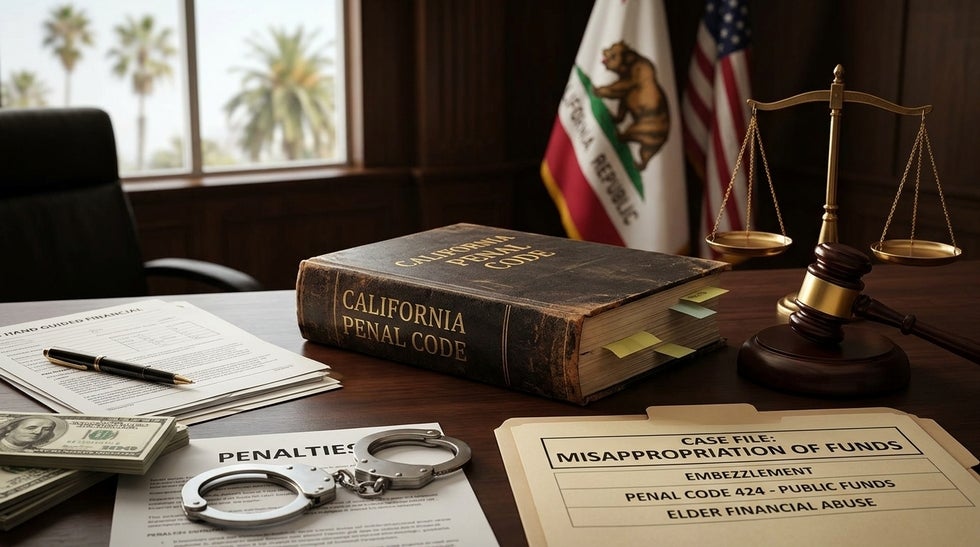
Updated October 2026 | The Bulldog Law | California White Collar Defense
When a person takes money that belongs to someone else, the stakes are high: criminal penalties, loss of trust, and often a career in jeopardy.
In California, that same conduct can land a defendant on the wrong side of several statutes, each with its own twist on intent, amount, and authority.
What Is Misappropriation of Funds and How Is It Defined in California?
Misappropriation is the intentional, unauthorized use of money or property that belongs to another person. It is a description, not a single crime, and the law looks at the specific statute that follows the complaint.
According to Cornell's Legal Information Institute, the term covers any act where a person who has lawful possession uses funds without permission. The word on the complaint matters less than the statute cited, because each statute defines the elements and penalties in detail.
General legal description of misappropriation
Misappropriation means a person who has lawful control of property takes it for themselves or another without the owner's consent. The act must be intentional and unauthorized, regardless of the amount involved.
Because the definition is broad, courts rely on the specific statute, such as Penal Code 503 for private funds or Penal Code 424 for public money, to determine the exact elements and punishment.
Why the statutory label matters more than the complaint language
Each California statute sets its own threshold for intent, amount, and authority. A prosecutor's choice of statute can shift a case from a misdemeanor to a felony.
For example, a private employee who takes $1,000 may face grand theft under Penal Code 503, while a city clerk who misuses $5,000 of city funds faces Penal Code 424 with a harsher penalty.
Embezzlement of Private Funds Under Penal Code 503
In my professional experience defending California felony cases, I've seen how the good-faith claim-of-right defense can turn a serious embezzlement charge into a lesser theft.
Penal Code 503 requires that the owner entrust the property to the defendant, that the defendant fraudulently converts it, and that the defendant intends to deprive the owner of its use. The amount determines whether the charge is grand theft (above $950), a wobbler, or petty theft.
When the total takings from one employer exceed $100,000, the court may add the aggravated white-collar enhancement under Penal Code 186.11, increasing the penalty and the potential fine.
Good-faith belief in authorization or a claim of right can serve as a defense to embezzlement, distinguishing it from public-fund offenses that do not allow this defense.
|
Statute |
Threshold |
Penalty |
|---|---|---|
|
Penal Code 503 |
Grand theft > $950 |
Up to 4 years |
|
Penal Code 186.11 |
Aggravated white-collar |
Additional 2 years |
|
Penal Code 368 |
Financial elder abuse |
Up to 4 years |
|
Penal Code 424 |
No minimum |
2 - 4 years, lifetime disqualification |
For instance, a nonprofit treasurer who misappropriates a grant account faces Penal Code 503, while a city employee who misuses petty cash faces Penal Code 424.
In 2023, we discussed how the mechanics of embezzlement hinge on the specific facts of each case, and how the distinction from public-fund offenses can be the deciding factor.
When a defendant claims they believed the funds were theirs, the court will examine the evidence of intent and the nature of the trust relationship.
In many cases, the defense hinges on whether the defendant truly intended to deprive the owner or simply acted under a mistaken belief of authorization. Readers comparing related California statutes also review our guide on elder abuse and financial exploitation under Penal Code 368.
For more on carrying a concealed firearm under Penal Code 25400, see our detailed analysis at carrying a concealed firearm under Penal Code 25400.
Misappropriation of Public Money Under Penal Code 424
In my professional experience defending California felony cases, I've seen how public-fund offenses carry harsher penalties and a lifetime disqualification from office.
Penal Code 424 lists seven prohibited acts, from appropriating money without authority to making false entries in an account. The statute applies to officers, employees, contractors, and nonprofit grant administrators.
Because there is no minimum amount, even a few hundred dollars can trigger a charge. The intent standard is criminal negligence: a public official who sincerely believes an expenditure is permitted can still be convicted if that belief was negligent.
Penalties range from two to four years, a fine, and a lifetime disqualification from holding any office in the state, which can end a career in public service.
District attorneys' public integrity units and the Attorney General often pursue these cases after a state controller or grand jury audit uncovers irregularities.
Defenses focus on whether the money was truly public, whether the defendant was charged with its receipt or disbursement, and whether the use was authorized by a resolution, budget, or policy.
When the defendant's belief in authorization was reasonable, the court may find the intent element lacking, reducing the charge to a lesser offense.
For more on California grand theft charges under Penal Code 487, see our complete guide at California grand theft charges under Penal Code 487.
Elder Financial Abuse and Fiduciary Misuse Under Penal Code 368 and Related Civil Remedies
In my practice I have defended dozens of cases where seniors or dependent adults suffered financial exploitation. The pattern often involves a trusted fiduciary who moves money without proper authority, triggering both criminal and civil actions.
Understanding Penal Code 368 is essential because it treats the abuse of a person 65 or older, or a dependent adult, as a wobbler crime, allowing a judge to impose either a misdemeanor or a felony sentence.
Statutory elements and penalties of PC 368
To prove the charge, prosecutors must show the victim was 65 or older, the defendant held a position of trust, and the money was taken for personal benefit. The law also covers “undue influence” or “fraudulent conversion.”
When convicted, the court may impose up to three years in county jail or a felony term of up to four years, plus fines and restitution; the felony option carries enhanced penalties under California's sentencing guidelines.
Civil side: WIC 15610.30 damages and probate accounting
The Welfare and Institutions Code 15610.30 allows victims to recover actual losses, attorney fees, and, in cases of bad-faith conduct, treble damages. This civil remedy runs parallel to the criminal case.
Probate courts require a detailed accounting of the fiduciary's handling of the estate, and that accounting serves as both civil evidence and a basis for criminal charges under PC 503/506.
Fiduciary roles that trigger PC 503/506 alongside PC 368
Trustees, conservators, guardians, agents under a power of attorney, and attorneys who misuse client funds face embezzlement charges under Penal Code 503 and 506. The dual filing reflects the seriousness of breaching fiduciary duty.
Defendants often argue they believed the transaction was authorized; a good-faith belief can defeat the fraudulent-intent element, but the court examines any written resolutions, policies, or prior approvals. Readers comparing related California statutes also review our guide on violating a protective order under Penal Code 273.6.
Federal Misappropriation Crimes: 18 U.S.C. §§ 666, 641, 656, and 664
When the money involved comes from a federal source, state statutes no longer apply and the case moves to federal court. I have seen agencies coordinate with the FBI to investigate these complex schemes.
Federal law defines misappropriation differently, but the penalties can far exceed California's maximums, especially when large sums or vulnerable beneficiaries are involved.
18 U.S.C. 666: Misuse of federal funds by state/local agents
Section 666 targets agents of state or local governments who receive more than $10,000 in federal aid and then embezzle at least $5,000. The statute carries up to ten years imprisonment and substantial fines.
Because many California cities and nonprofits rely on federal grants, investigators often start with a audit from the state controller before the U.S. Department of Justice steps in.
18 U.S.C. 641, 656, and 664: Other federal theft statutes
Section 641 criminalizes theft or conversion of any federal property, while 656 focuses on bank officers who embezzle, allowing up to 30 years behind bars. Section 664 protects employee pension and welfare plans from theft.
Each provision requires proof that the defendant knowingly took or converted federal assets, and sentencing guidelines weigh the loss amount, the defendant's role, and any prior offenses.
Enforcement agencies and sentencing considerations
Investigations are led by inspectors general, the FBI, or the U.S. Attorney's Office, and they often involve grand-jury subpoenas. Sentencing follows the United States Sentencing Guidelines, which adjust penalties based on the monetary loss.
Defendants may face concurrent state and federal charges, so coordination between the Attorney General's office and local district attorneys becomes critical for a unified defense strategy. Penal Code 288 felony defense in California illustrates how overlapping statutes can complicate plea negotiations.
Civil-Criminal Overlap, Defenses, and Practical Steps for Accused Parties
In my experience, the line between civil liability and criminal prosecution often blurs when funds are misused. Victims may pursue restitution while prosecutors seek incarceration, creating parallel tracks that require coordinated responses.
Clients frequently ask whether returning the money eliminates criminal risk; the answer depends on the underlying statute, the amount involved, and whether the conduct satisfies the intent element.
When misappropriation becomes a civil case versus a criminal case
A civil action typically arises when a plaintiff seeks monetary recovery, such as under WIC 15610.30 or a breach-of-fiduciary-duty claim. Criminal charges require proof beyond a reasonable doubt that the defendant acted with fraudulent intent.
Even if a defendant repays the full amount, the state may still pursue charges if the conduct meets statutory elements, because the public interest in deterring theft remains top.
Key defenses across statutes and how to raise them
Common defenses include lack of intent, authorized use, or a reasonable belief that the transaction complied with policy. Raising these defenses early forces the prosecution to prove the specific intent required by each code.
For example, under Penal Code 424 a defendant can argue they acted in good faith, while under Penal Code 368 they may show the victim was not 65 or older, negating the elder-abuse element.
Practical steps for anyone accused of fund misuse
First, preserve all digital and paper records, emails, accounting software logs, and bank statements, because evidence can be destroyed quickly. Second, contact an experienced criminal defense attorney before speaking with investigators.
Finally, consider reporting the issue to the district attorney or the Attorney General's office, and explore settlement options that may include restitution, as this can sometimes reduce sentencing exposure. Violating a protective order under Penal Code 273.6 serves as a reminder that related offenses can compound penalties.
How The Bulldog Law Protects Clients Facing Misappropriation Charges in California
Our California criminal defense team reviews every document, transaction record, and police report to spot weaknesses in the prosecution's case. We move quickly to safeguard your constitutional rights and keep the charges from escalating.
From the first phone call to trial, we negotiate with prosecutors, challenge illegal evidence, and build a solid defense strategy. Call (888) 928-1609 for a confidential case review.
Full statutory definitions and statewide court rules are maintained by Cornell's Legal Information Institute and Penal Code 503 for criminal proceedings across all 58 California counties.
Frequently Asked Questions
What are the most common ways misappropriation of funds occurs in California organizations?
Employees often divert cash receipts, falsify expense reports, or transfer electronic payments to personal accounts without authorization. Trustees and conservators may also misuse assets by failing to disburse them as required.
Public officers frequently appropriate money meant for city projects, loan funds without approval, or make false entries in official ledgers, actions covered by Penal Code 424.
How can a California business prove that embezzlement took place?
Proof requires showing a trusted individual had lawful possession of property and then fraudulently appropriated it for personal use. Financial statements, audit trails, and witness testimony are key evidence.
The prosecution will cite Penal Code 503 to define embezzlement and must show the intent to permanently deprive the owner of the property.
What penalties does California impose for misappropriation of funds over $950?
When the misappropriated amount exceeds $950, the conduct is charged as grand theft, a wobbler that can carry up to three years in county jail or state prison.
If the conduct involves public money, Penal Code 424 imposes a straight felony with two, three, or four years in state prison, a fine, and permanent disqualification from public office.
Which California statutes define misuse of public or private funds?
Public-fund misuse is defined in Penal Code 424, which covers any officer or person handling public money who appropriates it without authority.
Private-fund embezzlement falls under Penal Code 503, while related civil actions may rely on conversion or breach-of-fiduciary-duty statutes.
What steps should victims in California take to report fund misappropriation?
Victims should preserve all records, notify the appropriate supervisory agency, and file a police report or complaint with the district attorney's office.
Prompt reporting helps prosecutors evaluate the case, and the documentation can also support any parallel civil action for restitution.
How does California law differentiate between misdemeanor and felony embezzlement?
If the stolen value is $950 or less, the crime is typically a misdemeanor theft. Above that threshold, it becomes grand theft, which may be charged as a felony.
Under Penal Code 503, the same statutory language applies, but the penalty range shifts from up to one year in county jail to up to three years in state prison.
Does repaying the misappropriated money eliminate criminal liability?
Restoration of the funds does not erase the crime. Neither Penal Code 512 nor 513 provide a defense for embezzlement, and Penal Code 424 has no restoration defense at all. However, repayment is a strong mitigating factor that prosecutors often consider when negotiating reduced charges or probation.