
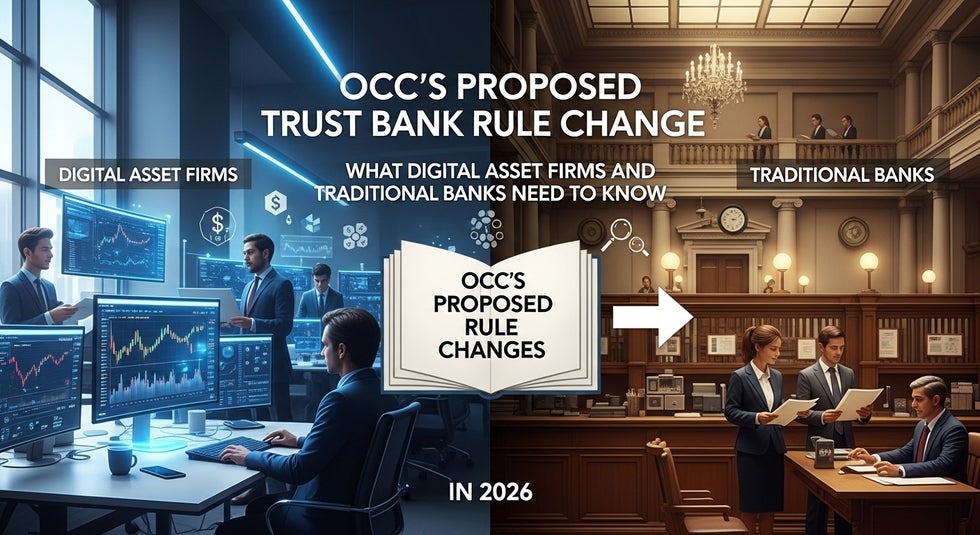
A quiet but consequential regulatory fight is playing out in Washington right now, and its outcome could reshape how digital asset firms access the national banking system for years to come. In January 2026, the Office of the Comptroller of the Currency proposed a rule change that would alter the foundational language defining what national trust banks are permitted to do.
The comment period closed last week with fifteen responses on record, and the divide between supporters and opponents reveals just how much is at stake on all sides.
For financial institutions, digital asset companies, and the attorneys who advise them, this proposed rule is not a technicality. It is a policy battle over charter access, competitive boundaries, and the future structure of banking in the United States. Understanding the legal landscape clearly, and having skilled counsel to navigate it, matters now more than ever.
What the OCC Is Actually Proposing
The proposed rule change centers on a targeted but significant substitution of language. Currently, certain provisions in the OCC's regulations use the term "fiduciary activities" when describing what national trust banks are expected to perform. The OCC wants to replace that phrasing with "the operations of a trust company and activities related thereto."
The agency's position is that this is a clarification rather than an expansion. The OCC argues that national banks have been misreading the existing language in a way that artificially constrains what national trust charters permit. In the OCC's view, a national trust bank was never required to limit itself exclusively to fiduciary services, and the proposed language change would bring the regulation into alignment with that original intent.
Critics see it very differently. For the Conference of State Bank Supervisors, the American Bankers Association, and a coalition of traditional banking interests, this is not a clarification. It is a substantive expansion that opens the door for institutions that do not perform traditional fiduciary functions to operate under a national trust charter, accessing federal preemption and the competitive advantages that come with it.
The Fiduciary Question at the Heart of the Dispute
To understand why this debate is so charged, it helps to understand what "fiduciary" actually means in this context. A fiduciary relationship involves a legal duty to act in the best interest of another party, such as a trustee managing assets on behalf of a beneficiary. Traditional trust companies built their business models around exactly this kind of relationship, administering wills, estates, trusts, and similar arrangements.
Custody is a different matter. When a firm holds digital assets or securities on behalf of a client, it is performing a safekeeping function, not a fiduciary one. The client retains ownership and control, and the custodian's obligations, while real, are not the same as those of a fiduciary. This distinction has historically meant that custody is classified as a mainstream banking service rather than a trust service.
This is precisely why the new wave of digital asset firms seeking national trust charters has attracted controversy. Most of these firms are not administering trusts or managing estates. They are providing custody of digital assets, a service that is genuinely valuable and increasingly in demand but that does not fit neatly into the traditional model of what a trust bank does. Critics, including the ABA and CSBS, argue that allowing these firms to operate as national trust banks is effectively a backdoor route to acquiring bank-like powers without meeting bank-level regulatory requirements.
The ABA has pushed this concern far enough to request that the OCC prohibit these new national trust banks from using the word "bank" in their name at all, unless they operate as a subsidiary of a fully chartered bank. That is a remarkable ask, and it signals just how seriously the traditional banking sector is treating this regulatory moment.
Why This Is a Rerun of a 2025 Controversy
This fight did not begin in January 2026. In the middle of 2025, a group of digital asset firms applied for national trust bank charters, triggering substantial opposition from traditional banks on essentially the same grounds. Those institutions argued then, as their successors argue now, that firms primarily offering custody rather than fiduciary services were misusing the trust charter framework to gain competitive advantages that the regulatory structure never intended to provide them.
The OCC's January 2026 proposal can be read as a direct response to that controversy. Rather than leaving the question to be litigated charter by charter, application by application, the agency has chosen to address the definitional ambiguity at the regulatory level. Whether that move will succeed depends heavily on how the comment record is evaluated, how courts interpret the administrative process if challenges follow, and ultimately how the political environment surrounding banking regulation continues to evolve.
For institutions on both sides of this debate, the regulatory uncertainty itself creates legal risk that needs to be actively managed.
The Legal Stakes for Digital Asset Firms
If you operate a digital asset business and are considering a national trust bank charter, or if you have already applied for one, the proposed rule change has direct implications for the legal foundation of your strategy. A favorable final rule would significantly strengthen the argument that your custody operations fall squarely within the scope of a national trust charter. An unfavorable outcome or a successful legal challenge to the rule could leave your charter in a contested position.
This is not a moment to wait and see. The comment period has closed, which means the rulemaking record is being shaped without your input if you have not already engaged. The next phase of this regulatory process will involve the OCC evaluating the comments received, potentially issuing a final rule, and almost certainly facing legal challenges from one or more of the opposing trade groups. Institutions that have legal counsel tracking this process and positioned to respond quickly will be far better placed than those that engage only after a final rule is issued.
At Bulldog Law, we work with financial institutions and emerging technology companies navigating exactly this kind of regulatory crossroads. Understanding how a proposed rule change affects your charter strategy, your existing operations, or your competitive position requires counsel that follows these developments closely and translates them into actionable legal advice. You can learn more about our approach to financial services representation on our legal blog.
What Traditional Banks and State Regulators Should Be Doing Now
The opposition side of this debate, led by the ABA and CSBS, has made its position clear in the comment record. But the regulatory process does not end with comments. If the OCC proceeds toward a final rule that adopts the proposed language change, opponents will face a decision about whether to challenge the rule through litigation.
An Administrative Procedure Act challenge to a final OCC rule of this kind would center on whether the agency exceeded its authority, whether the rulemaking process was procedurally sound, and whether the agency's reasoning was adequate to justify the change. These are live legal questions with real merit on both sides, and the outcome of any such challenge would turn heavily on the quality of legal strategy brought to it.
For state bank regulators and traditional banking institutions concerned about the competitive and structural implications of this rule, early legal analysis of the grounds for challenge, the strength of the administrative record, and the strategic timing of any legal action is valuable groundwork that pays dividends later. Our financial regulatory resources address how institutions can engage effectively when regulatory changes threaten their competitive standing.
A Regulatory Moment That Demands Legal Clarity
The OCC's proposed rule change is small in its textual footprint but large in its practical consequences. Replacing "fiduciary activities" with "the operations of a trust company and activities related thereto" sounds like an editing exercise. In the context of digital asset banking, charter competition, and the ongoing negotiation between federal and state regulatory authority, it is anything but.
Whether you are a digital asset firm building a charter strategy, a traditional bank protecting your competitive landscape, or an institution somewhere between those poles trying to understand where you stand, the regulatory environment around national trust charters in 2026 is one that rewards informed, proactive legal engagement.
The firms and institutions that come out of this transition best positioned will be those that understood the legal stakes clearly, engaged counsel who tracked the regulatory process with precision, and made decisions based on sound legal analysis rather than guesswork. If your institution is navigating any aspect of this landscape, reach out and visit our blog for ongoing updates and analysis as this rulemaking process continues to develop.