
By the The Bulldog Law Criminal Defense Team • Reviewed by a licensed California criminal defense attorney
Penal Code § 273a punishes ENDANGERMENT willfully causing or permitting a child to suffer unjustifiable pain or mental suffering, or, while having care or custody, willfully causing or permitting the child to be placed in a situation where their person or health MAY BE endangered - and it requires NO injury: the RISK is the crime. The statute splits on likelihood: where the circumstances were likely to produce great bodily harm or death, it's a WOBBLER a felony carrying 2, 4, or 6 years; where not, a misdemeanor (up to one year) with mandatory minimum four-year probation terms, classes, and sometimes protective orders that reorganize a family overnight.
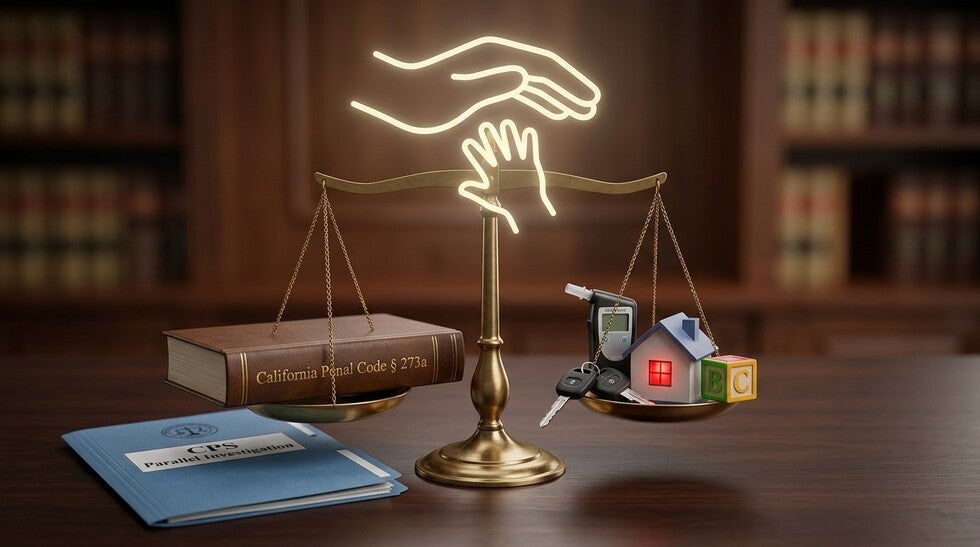
Three realities define how § 273a actually enters lives: it is AUTO-CHARGED in two scenarios a DUI arrest with a child in the car, and domestic-violence incidents that occurred in a child's presence (where the non-striking parent is often charged for “permitting” exposure); its “permitting” prong runs on CRIMINAL NEGLIGENCE aggravated, reckless departure from ordinary care, NOT the momentary lapses every parent alive has survived which is exactly where these cases get defended; and every criminal filing arrives with a SECOND case attached: a CPS dependency proceeding in juvenile court, with different rules, different stakes (custody itself), and the absolute need for coordinated defense across both. This guide from The Bulldog Law's criminal defense team covers the elements, the charging patterns, the CPS parallel, and the defenses that protect both the case and the family.
How § 273a Cases Actually Start
- DUI with a child in the vehicle the most common trigger: the endangerment count is added nearly automatically alongside the DUI (and VC enhancements), converting a driving case into a child-welfare case with CPS notification and making the DUI defense and the 273a defense one coordinated project.
- Domestic violence in a child's presence children who witnessed, heard, or were nearby during an incident generate 273a counts against the alleged aggressor AND, painfully often, “failure-to-protect” theories against the other parent the charging pattern that most demands early, clear-eyed defense of the family as a unit.
- The car cases - children left in vehicles: California's Kaitlyn's Law makes brief, low-risk instances an infraction, while heat, duration, and hazard push cases into misdemeanor and felony 273a the line is circumstances, and reconstructing them (temperature data, elapsed time, visibility, the errand's reality) is the defense.
- Access cases - guns, drugs, hazards: firearms reachable by children (the secure-storage protocol protects here too), drugs and paraphernalia in the home (possession counts stack with 273a), pools, dogs, and home hazards prosecutions built on what COULD have happened, which is precisely where the criminal-negligence standard pushes back.
- Medical, supervision, and lifestyle judgments treatment decisions, co-sleeping incidents, kids briefly unsupervised, messy-home reports: the gray zone where mandated-reporter referrals become criminal files, and where the difference between imperfect parenting and criminal negligence is the entire case.
- What § 273a is NOT: actual corporal injury to a child is its own statute (§ 273d, “child abuse”); discipline within lawful, reasonable bounds remains a parental right; and the elder-and-dependent-adult mirror of this whole structure lives in 368.
The Criminal-Negligence Line and the CPS Parallel Case
THE STANDARD: for “permitting” theories, the prosecution must prove CRIMINAL negligence conduct so aggravated, reckless, or grossly departing from ordinary care that it amounts to disregard for the child's life and California juries are instructed that ordinary carelessness, inattention, or error in judgment is NOT enough. That instruction is the defense's backbone: the turned back at the playground, the misjudged babysitter, the single chaotic morning are parenting, not crime and presenting the full context (the family's actual functioning, the isolated nature of the event, the response once danger appeared) is how charged accidents become declined files and reduced counts.
THE PARALLEL CASE: every significant § 273a filing triggers a CPS/dependency track in juvenile court safety plans, detention hearings, case plans, reunification services governed by lower standards of proof, faster timelines, and stakes (custody) that can exceed the criminal case's. The two tracks feed each other: statements made to social workers appear in the criminal file; criminal pleas drive dependency findings so the coordination rules are absolute: counsel before interviews on EITHER track, no case discussions at monitored visits or on recorded lines, compliance with the case plan treated as evidence-in-your-favor being manufactured daily, and plea decisions made only with the dependency consequences mapped (and, for non-citizens, the immigration ones a “crime of child abuse” is its own deportability ground). SENTENCING SHAPE: felony convictions carry 2/4/6 with enhancements where injury occurred; misdemeanors carry the mandatory four-year probation architecture classes, orders, conditions which is why even “small” 273a resolutions deserve negotiation over the CONDITIONS, since a protective order separating a parent from their child is a sentence no jail-day count measures. The defense endgame across all of it: reunify the family, resolve the criminal count at the lowest true level diversion and reductions where the facts support them and leave a record that relief can later clean.
Frequently Asked Questions
Is it child endangerment to leave my child in the car?
It depends entirely on circumstances and California grades them: brief, low-risk instances (child six or older present, or short benign stops) fall under Kaitlyn's Law as an infraction; heat, long duration, running engines, and hazardous settings push cases into misdemeanor 273a; and genuinely dangerous conditions hot interiors, extended absence support felony filings, since the statute punishes likelihood of great bodily harm, not outcome. Defense is reconstruction: actual elapsed time, temperature data, the child's age and condition, sightlines, and the errand's reality regularly shrink charged narratives. If it's happened to you, preserve receipts, footage, and timing evidence immediately the objective record usually reads calmer than the report.
Does a DUI with my child in the car mean a child endangerment charge?
Almost automatically the 273a count is standard practice alongside the DUI, and it changes everything: CPS is notified (opening the parallel dependency track), the case is charged as a child-welfare matter rather than a driving matter, and a felony filing is possible where facts were aggravated. It also means the defenses merge: the DUI's weaknesses (stop legality, testing, rising-BAC) undercut the endangerment theory built on it, and endangerment-specific arguments (the actual risk level, the child's restraint and condition) work alongside. Resolutions that protect both tracks reductions, classes credited across cases, conditions that keep the family intact are negotiated, not offered. Treat the first week as decisive: counsel on both tracks, statements to no one.
Will CPS take my children over a 273a charge?
A charge triggers CPS involvement investigation, possibly a safety plan or dependency petition but removal is neither automatic nor the norm: courts must pursue the least disruptive option, services and reunification are the system's default posture, and most families navigate to intact or restored custody with counsel and compliance. The rules that protect you: no substantive interviews (criminal or CPS) without counsel, treat the case plan as evidence you're building in your favor, document everything, and never discuss the criminal facts at monitored visits or on recorded calls. The criminal and dependency cases must be defended as one strategy what's said or pled in either lands in both and families who get coordinated help early keep or regain custody at far higher rates.
Can child endangerment charges be dropped if it was an accident?
That's the exact line the law draws and the defense's home ground: ‘permitting' endangerment requires CRIMINAL negligence, a gross and reckless departure from ordinary care, while accidents, momentary lapses, and honest misjudgments are by jury instruction - not crimes. Cases decline, reduce, and dismiss when the full context is presented early: the event's isolated nature, the family's genuine functioning, the immediate protective response, corroborating witnesses and records. Custody-dispute accusations (a major source of 273a reports) add motive evidence to the mix. What forfeits winnable cases: unprepared statements ‘explaining' to detectives or social workers, and default pleas taken to ‘end it quickly' that quietly carry four years of conditions and a dependency finding. Present the accident as what it was through counsel, with the record and the standard does the rest.
Section 273a judges parents at their worst moment against a standard - criminal negligence - that ordinary human error does not meet, while a second courtroom decides the family's shape in parallel. Both cases are winnable; neither forgives improvisation. The Bulldog Law's criminal defense team defends § 273a and coordinates the dependency track statewide. Contact the firm online or call (888) 928-1609 - 24/7.