
Updated November 2026 | The Bulldog Law | California Criminal Defense
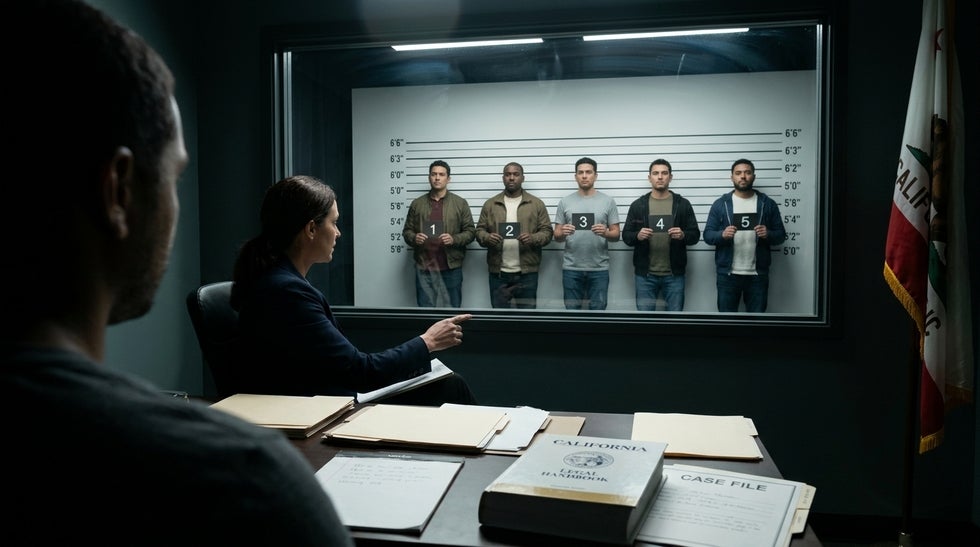
A police lineup asks a witness to pick the person who committed a crime from a group, in person or in photographs. Since 2020, California law has required every agency to follow specific procedures designed to prevent mistaken identifications, including having the lineup run by an officer who does not know which person is the suspect and recording the witness's exact words. A suspect has a right to a lawyer at an in-person lineup held after charges are filed. When police ignore the rules or steer the witness, the identification can be excluded or discredited, and in a case that rests on one witness that is often decisive.
Eyewitnesses are persuasive and frequently wrong. Our attorneys treat every identification as evidence to be tested, starting with how it was obtained.
Three ways police obtain an identification
|
Procedure |
How it works |
Main risk |
|
Photo lineup (six-pack) |
The witness views six photographs, one of the suspect and five fillers, together or one at a time |
A suspect photo that stands out; an officer who knows which one is the suspect |
|
Live lineup |
The suspect stands with fillers behind one-way glass |
Fillers who do not resemble the description; cues from officers |
|
Field showup |
Soon after the crime, a single detained person is shown to the witness, often in handcuffs near a patrol car |
Inherently suggestive: there is only one choice |
A fourth kind, identification for the first time in the courtroom, is the least reliable of all, because the defendant is seated at the defense table.
California's lineup law: Penal Code 859.7
Penal Code 859.7 requires all law enforcement agencies and prosecutors' offices in California to adopt regulations for photo and live lineups that meet minimum standards based on decades of research.
|
Requirement |
Why it matters |
|
The witness gives a description of the perpetrator before the lineup |
Fixes the memory before it can be shaped by seeing the suspect |
|
The lineup is administered blind or blinded: the officer does not know which person is the suspect, or cannot see which photo the witness is viewing |
Prevents intentional or unconscious cues |
|
The witness is told the perpetrator may or may not be in the lineup, that he or she should not feel compelled to choose, and that the investigation will continue either way |
Reduces the pressure to pick someone |
|
Fillers generally fit the witness's description, and the suspect does not unduly stand out |
A fair test of memory instead of a process of elimination |
|
Only one suspect is included in each lineup |
Keeps the odds of a chance pick meaningful |
|
Witnesses are separated and do not view the lineup together |
Prevents one witness from influencing another |
|
If the witness identifies someone, the officer immediately asks for the witness's level of confidence in the witness's own words |
First-time confidence is informative; later confidence is not |
|
Nothing is said to the witness that validates or undermines the choice |
Feedback inflates certainty |
|
The procedure is recorded on video and audio, or audio alone if video is not feasible, with the reason documented |
Lets a judge and jury see what happened |
A violation does not automatically exclude the identification. It gives the defense a concrete record to use in a motion to suppress and in front of the jury, which may be told how the procedure departed from the law.
Your rights as a suspect
- Right to counsel at a live lineup after charges. In United States v. Wade, the Supreme Court held that a lineup conducted after formal charges is a critical stage of the prosecution, and the accused is entitled to have a lawyer present. The lawyer observes and documents; he or she does not run the procedure.
- No right to counsel at a photo lineup. The suspect is not there, so the right does not attach. The recording required by California law is the substitute.
- No right to refuse. Appearing in a lineup, giving a voice sample, or wearing particular clothing is physical evidence, not testimony. A person in custody can be compelled, and a refusal can be offered as evidence of awareness of guilt.
- Voluntary requests can be declined. If you are not under arrest and a detective asks you to come in for a lineup or to provide a photograph, you are not required to agree. Speak with a lawyer before answering.
- The right to ask for a lineup. Under Evans v. Superior Court, a defendant can ask the court to order a lineup when identification is genuinely in dispute and a fair lineup could show the witness cannot pick him or her out. The motion has to be made promptly.
When an identification violates due process
The constitutional test has two steps. First, was the procedure police arranged unnecessarily suggestive? Second, if so, is the identification still reliable under all the circumstances? Courts weigh five factors from the Supreme Court's decisions:
- The witness's opportunity to view the person at the time of the crime.
- The witness's degree of attention.
- The accuracy of the witness's earlier description.
- The level of certainty shown at the identification.
- The time between the crime and the identification.
In Perry v. New Hampshire, the Court limited this review to cases where the police themselves created the suggestive circumstances. An identification made suggestive by chance, such as a witness seeing the suspect in a news photograph, goes to the jury, where the defense must expose its weakness.
Field showups deserve particular attention. They are permitted when held promptly, on the reasoning that a fresh memory and the chance to release an innocent person quickly justify the suggestiveness. A showup conducted hours later, after the witness heard police say they had caught someone, or with the person displayed in handcuffs beside recovered property, is open to challenge.
Why eyewitnesses get it wrong
Memory is reconstructed each time it is recalled, and it absorbs information acquired afterward. Research accepted by California courts identifies recurring causes of error.
- Stress and weapon focus. Fear narrows attention, and a gun draws the eye away from the face.
- Short exposure, distance, and lighting. Most crimes are over in seconds.
- Cross-racial identification. People are less accurate identifying faces of a race other than their own.
- Delay. Memory for a stranger's face declines quickly.
- Suggestion after the event. Conversations with other witnesses, media coverage, and police comments change what is remembered.
- Inflated confidence. Certainty grows with repetition and positive feedback. In People v. Lemcke (2021), the California Supreme Court directed changes to the standard jury instruction because telling jurors to consider a witness's certainty, without explanation, risked implying that confidence equals accuracy.
A witness can be completely sincere and completely mistaken, which is a different problem from dishonesty; see our article on whether eyewitnesses lie on purpose.
How the defense challenges an identification
- Obtain the recording and the paperwork. The video, the lineup itself, the admonition form, the witness's first description, and the confidence statement.
- Compare the description with the client. Height, build, age, clothing, tattoos, and facial hair that do not match.
- Move to exclude. A pretrial motion argues that the procedure was unnecessarily suggestive and the identification unreliable. If the out-of-court identification is excluded, the prosecution must show any in-court identification has an independent source.
- Call an expert. California courts have held that when an eyewitness identification is the key evidence and is not substantially corroborated, excluding qualified expert testimony on the factors affecting accuracy can be an abuse of discretion.
- Ask for the instruction. The jury is given a list of factors for evaluating identification testimony and is reminded that the prosecution must prove identity beyond a reasonable doubt.
- Prove where the client was. An identification case is the natural setting for an alibi, and for physical or forensic evidence pointing elsewhere.
An unreliable identification is one of the signs a case will be dismissed or acquitted. Challenges based on an unlawful stop that led to a showup are raised through a motion to suppress.
Frequently asked questions
What is a police lineup?
A police lineup is an identification procedure in which a witness is shown a suspect together with other people who are not suspects, called fillers, and asked whether he or she recognizes the person who committed the crime. It can be done in person or, far more often today, with photographs.
What is a six-pack photo lineup?
It is a photo array of six pictures, usually two rows of three, containing one suspect and five fillers. It is the most common identification procedure in California. The suspect's photograph should not stand out from the others in any way, such as background, size, clothing, or how closely the people match the witness's description.
Can you refuse to participate in a police lineup?
Not lawfully once a court orders it, or if you are in custody. Standing in a lineup, speaking words for voice identification, or being photographed is not testimony, so the Fifth Amendment does not apply, and a refusal can be described to the jury as evidence of awareness of guilt. If you are not under arrest and police ask you to come in voluntarily, you may decline and should speak with a lawyer first.
Do you have a right to a lawyer at a lineup?
At an in-person lineup held after formal charges have been filed, yes. A lawyer may attend and observe. There is no right to counsel at a photo lineup, because the suspect is not present. If police hold a post-charge live lineup without counsel and without a valid waiver, the identification can be excluded.
What makes a lineup unfair or suggestive?
Anything that points the witness toward the suspect: fillers who do not match the description, a suspect who is the only one with a distinctive feature, an officer who knows which person is the suspect and signals it, comments before or after the choice, showing the same suspect in more than one procedure, or letting witnesses view the lineup together.
Can an identification be thrown out?
Yes. If the procedure police arranged was unnecessarily suggestive and the identification is not otherwise reliable, it violates due process and the judge can exclude it. Even when it is admitted, the defense can show the jury how the procedure fell short of California's requirements and can call an expert on memory and identification.
How reliable is eyewitness identification?
Less reliable than jurors tend to assume. Mistaken identification has played a part in a large share of convictions later overturned by DNA evidence. Accuracy drops with stress, the presence of a weapon, brief exposure, poor lighting, delay, and when the witness and the suspect are of different races. A witness's confidence in court is not a dependable sign of accuracy.
Can a defendant ask for a lineup?
Yes. Under the California Supreme Court's decision in Evans v. Superior Court, a defendant may ask the court to order a lineup when identification is a material issue and there is a reasonable likelihood of mistaken identification that a lineup would help resolve. The request must be made early in the case.
Related reading from our attorneys
- Do eyewitnesses lie on purpose?
- Presumption of innocence and reasonable doubt
- Nine signs your case will be dismissed
Picked out of a lineup? How the identification was made is the first thing to examine
The Bulldog Law's criminal defense attorneys obtain the lineup recordings in every identification case and litigate suggestive procedures before trial. Call (888) 928-1609 or reach us online.