
Updated September 2026 | The Bulldog Law | Federal and California Criminal Defense
Racketeering is committing crimes as part of an enterprise, and a RICO charge is the federal statute that punishes it. Under 18 U.S.C. 1962, the government must prove an enterprise, which can be a corporation, a gang, or any group associated in fact; a pattern of racketeering activity, meaning at least two predicate crimes from a list of roughly 35, committed within ten years of each other; and that the defendant conducted or participated in the conduct of the enterprise's affairs through that pattern. Section 1962(d) makes it a separate crime to conspire to do any of that, and no completed predicate act is required. Each count carries up to 20 years, or life where a predicate act does, and mandatory forfeiture of everything the enterprise produced. California has no true RICO statute; its Control of Profits of Organized Crime Act, Penal Code 186, is a forfeiture law, and organized-crime prosecutions in this state are charged federally or through the gang and conspiracy statutes.
The Bulldog Law's federal defense attorneys handle RICO cases the way the statute is actually used, which is not the way most people picture it. The famous prosecutions, mob families in the 1980s, and more recently hip-hop labels, street gangs, and political operations, get the attention. The everyday RICO indictment in a California federal courthouse names fifteen or twenty people, a handful of whom ran something and the rest of whom drove, delivered, deposited, or dated. The statute's reach is the reason the second group is in the indictment, and the statute's elements are the reason many of them should not be. What follows is what racketeering means, how a RICO case is assembled, and where it comes apart. Call (888) 928-1609 or message our team if you have been named or contacted.
Where the word comes from
A racket was a Prohibition-era term for an organized criminal scheme that looked, from the outside, like a business: protection payments, numbers games, loan sharking, bootlegging. A racketeer ran one. Congress borrowed the word in 1970 when it passed the Racketeer Influenced and Corrupt Organizations Act as part of the Organized Crime Control Act, aimed at the Mafia's infiltration of legitimate businesses and unions. The statute defined racketeering activity by listing existing crimes, made it a federal offense to commit a pattern of them through an enterprise, and attached penalties and forfeiture provisions far heavier than the underlying crimes carried on their own. Within two decades prosecutors had discovered that the definitions were broad enough to reach nearly any organized criminal conduct, and civil plaintiffs had discovered the treble damages provision. RICO is now used against street gangs, fraud rings, drug organizations, corrupt officials, and, in civil court, against businesses accused of fraud.
The three elements of a RICO charge
An enterprise
Section 1961(4) defines an enterprise as any individual, partnership, corporation, association, or other legal entity, and any union or group of individuals associated in fact although not a legal entity. The second half is what matters in criminal cases. A street gang is an enterprise. A group of people who ran a fraud scheme together is an enterprise. In Boyle v. United States, decided in 2009, the Supreme Court held that an association-in-fact enterprise needs only a purpose, relationships among those associated with it, and longevity sufficient to pursue the purpose; it does not need a hierarchy, a name, rules, or any structure beyond what the pattern of crimes itself implies. That holding made the enterprise element easy to plead, and it is rarely the element that fails. What still has to be proven is that the enterprise existed separately from the pattern of crimes, and that it affected interstate commerce, which in practice means almost anything.
A pattern of racketeering activity
Racketeering activity is any of the crimes listed in Section 1961(1): murder, kidnapping, gambling, arson, robbery, bribery, extortion, and drug dealing under state law; and a long list of federal offenses including mail fraud, wire fraud, bank fraud, money laundering, obstruction, witness tampering, counterfeiting, trafficking, and immigration fraud. A pattern requires at least two such acts, the last within ten years of a prior one. The Supreme Court added a gloss in H.J. Inc. that prosecutors still have to satisfy: the acts must be related, and they must amount to or threaten continued criminal activity. Two isolated crimes years apart are not a pattern. A scheme that ran for months, or an organization whose regular way of doing business was criminal, is.
The predicate acts are where a RICO indictment shows its seams. Each one is a crime the government must prove as it would in a standalone prosecution, with all its elements, and many indictments rest on predicates, a state extortion count, a wire fraud theory, that would not survive on their own. Our fraud and drug attorneys attack the predicates first, because two failed predicates take the pattern with them, and the pattern takes the RICO count.
Conduct or participate in the enterprise's affairs
Section 1962(c), the workhorse subsection, requires that the defendant conducted or participated, directly or indirectly, in the conduct of the enterprise's affairs through the pattern. In Reves v. Ernst and Young, the Supreme Court read that language to require participation in the operation or management of the enterprise: some part in directing its affairs. Outsiders who provide services, and insiders who merely take orders, may fall outside it. Reves is the defense's best friend in a multi-defendant RICO case, because it separates the people who ran the enterprise from the people who worked for it, and the government routinely charges the second group under a subsection written for the first.
RICO conspiracy: the charge that needs no crime
Section 1962(d) makes it unlawful to conspire to violate the other subsections. In Salinas v. United States, the Supreme Court held that a RICO conspirator need not commit, or even agree to commit, any predicate act personally; it is enough to agree to participate in the enterprise knowing that others will commit the pattern. No overt act is required. That rule is the reason the indictment lists twenty names. A person who agreed to drive, or to hold money, or to let the enterprise use an apartment, with knowledge of what the enterprise did, can be convicted of RICO conspiracy and face the same 20-year maximum as the leader.
The defense to conspiracy is the agreement. What did this client actually agree to, with whom, knowing what. The government's proof is usually inference from association: phone contacts, presence, social media, a shared address. The same evidentiary rules that govern ordinary conspiracy and aiding and abetting apply, and the same weaknesses. Our attorneys have had RICO conspiracy counts dismissed against clients whose entire connection to the enterprise was a sibling.
Why prosecutors reach for RICO
The statute does things for the government that ordinary charges cannot, and understanding them explains the shape of the case.
Joinder. RICO lets the government try everyone associated with the enterprise together, in one trial, with the acts of each admissible against all as part of the enterprise's pattern. A defendant charged with a single fraud sits through weeks of testimony about murders he never heard of, and juries struggle to keep the evidence sorted.
Evidence. Because the enterprise is an element, the government may prove its history, structure, and other crimes, evidence that would be excluded as irrelevant or unfairly prejudicial in a standalone prosecution. In gang cases, this is the vehicle for everything from tattoos to rap lyrics.
Limitations. The statute of limitations for RICO is five years from the last predicate act charged, which resurrects crimes that would otherwise be time-barred. A 2014 fraud becomes prosecutable in 2026 if a related act occurred in 2022.
Penalties and forfeiture. Twenty years per count, stacked on the predicates, and forfeiture under Section 1963 of any interest acquired or maintained through the violation, any interest in the enterprise, and any proceeds. The forfeiture is mandatory, reaches property held by third parties, and can be frozen before trial, which affects the defendant's ability to pay for a defense.
Leverage. All of the above make RICO the charge that produces cooperation. The lower-level defendants, facing 20-year exposure for driving, become witnesses, and the case against the people at the top is built from their testimony.
California: Penal Code 186 and the gang statutes
California enacted the Control of Profits of Organized Crime Act in 1982, Penal Code 186 through 186.8, and it is sometimes called California's RICO. It is not. The act defines criminal profiteering activity by a list similar to the federal predicates and a pattern as two or more incidents within ten years, but what it authorizes is forfeiture: a prosecutor who obtains a conviction for a listed felony can petition to seize the proceeds and property acquired through the pattern. It creates no separate crime and no enhanced sentence. The criminal charges in a California organized-crime case are the underlying felonies, conspiracy under Penal Code 182, and, where a gang is involved, the Penal Code 186.22 gang enhancement and the Penal Code 182.5 gang conspiracy offense, both narrowed considerably by Assembly Bill 333 in 2022, which raised the proof required for a criminal street gang and its pattern. California prosecutors who want RICO's tools refer the case to the U.S. Attorney, which is why nearly every racketeering prosecution in this state is in federal court.
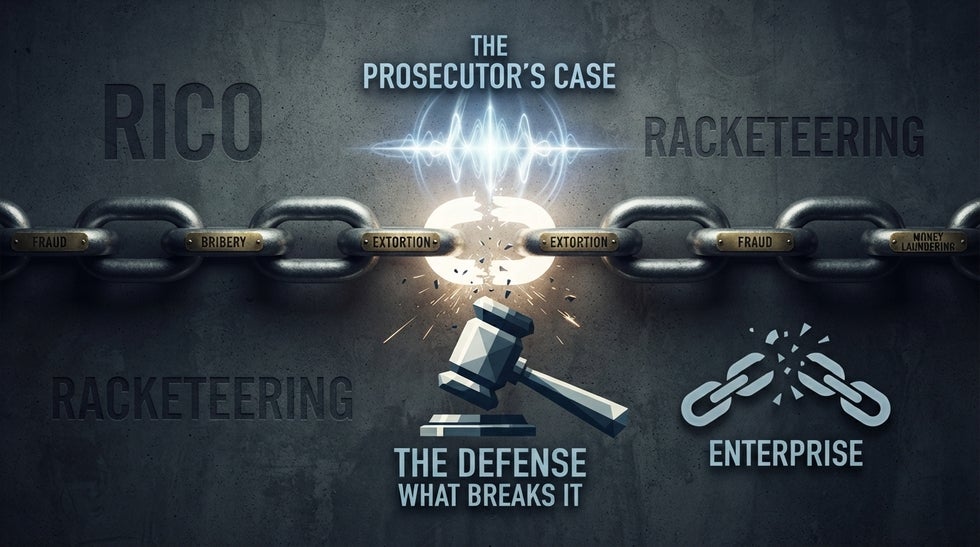
Defenses that break RICO cases
No enterprise, or no separate enterprise. Where the alleged enterprise is nothing but the defendants and the crimes, some courts still require proof of an organization with existence apart from the pattern. Boyle narrowed this, but it did not eliminate it.
No pattern. Two predicates that are unrelated, or that lack continuity, are not a pattern. A closed-ended scheme of short duration, or acts separated by years with no connection, has produced dismissals.
Failed predicates. Each predicate is a full crime with its own elements and defenses. Attacking them individually is where most RICO defense work happens, and it is where the signs of a weak case show up first: a state extortion predicate that does not meet the state's definition, a wire fraud theory with no scheme to defraud, a drug count with a suppressible search.
No operation or management. Under Reves, a defendant who provided services or followed instructions did not conduct the enterprise's affairs. Bookkeepers, lawyers, drivers, and low-level members are the beneficiaries.
No agreement, for conspiracy. Association is not agreement. Knowledge of the enterprise is not agreement to join it. Withdrawal, communicated and followed by disengagement, ends a conspirator's liability for later acts.
Severance. A defendant charged with one predicate should not be tried alongside the murders; motions to sever are routinely denied and occasionally granted, and the denial is preserved for appeal.
Limitations and forfeiture. The five-year period is measured from the last act charged against the specific defendant, not the enterprise, and forfeiture is limited to property actually connected to the violation, a limit the government tests constantly.
Nearly every RICO case also involves the question of what the client said to agents at the door. The right to remain silent applies to a RICO investigation exactly as to any other, and the interview in which a client explained that he only drove is the interview that made him a conspirator.
Sentencing, civil RICO, and immigration
RICO sentences are computed under the federal guidelines, which use the underlying predicate offenses as the base: a RICO built on fraud is sentenced like fraud, with the loss amount driving the range, and one built on drug trafficking or violence is sentenced accordingly, with a floor for the RICO count itself. Our page on federal sentencing explains the guidelines process, and restitution to victims of the predicate crimes is mandatory.
The same statute supports civil suits. Section 1964(c) lets any person injured in business or property by a RICO violation sue for treble damages and attorney's fees, and businesses, investors, and competitors use it against alleged fraud schemes, sometimes in parallel with the criminal case. A criminal conviction is powerful evidence in the civil case, which is one more reason the plea decision in a RICO prosecution is made with counsel who sees both.
For a non-citizen, a RICO conviction is an aggravated felony, and so is a conviction for most of the predicate acts; the immigration consequences are as severe as any in the code, and our immigration attorneys are part of the defense team from the first appearance.
Frequently asked questions
What is racketeering in simple terms?
Racketeering is running a criminal enterprise, or running a legitimate one through crime. The word comes from rackets, the Prohibition-era term for organized schemes like protection payments and loan sharking. In federal law it means committing a pattern of listed crimes, two or more within ten years, as part of an enterprise. The crimes themselves are ordinary: fraud, extortion, drug dealing, bribery, robbery. Racketeering is the charge for doing them as part of an organization.
What is a RICO charge?
A charge under the Racketeer Influenced and Corrupt Organizations Act, 18 U.S.C. 1962. It requires an enterprise, which can be a business, a gang, a union, a family, or any group of people associated in fact; a pattern of racketeering activity, meaning at least two predicate crimes from a list of about 35 within ten years; and proof that the defendant conducted or participated in the enterprise's affairs through that pattern. Section 1962(d) adds conspiracy to do any of it, which requires no completed crime at all.
What is the sentence for racketeering?
Up to 20 years in federal prison for each RICO count, or life if any predicate act carries a life sentence, plus mandatory forfeiture of everything acquired through the enterprise and any interest in it. Sentences are calculated under the federal guidelines using the underlying predicate crimes, so a RICO count built on drug trafficking is sentenced like drug trafficking, and one built on murder is sentenced like murder.
Does California have a RICO law?
Not one that works like the federal statute. California's Control of Profits of Organized Crime Act, Penal Code 186 through 186.8, is mainly a forfeiture law: it lets prosecutors seize the proceeds of a pattern of criminal profiteering. The criminal charges in a California organized-crime case come from the underlying offenses, the conspiracy statute, and, in gang cases, the Penal Code 186.22 enhancement and Penal Code 182.5 gang conspiracy. The RICO-style prosecutions you read about in California are almost always federal.
Can you be charged with RICO without committing a crime yourself?
Yes, through 1962(d) conspiracy. The Supreme Court held in Salinas v. United States that a RICO conspirator need not commit or agree to commit any predicate act personally; agreeing to participate in the enterprise knowing that others will commit the pattern is enough. That rule is why RICO indictments sweep in drivers, girlfriends, accountants, and bookkeepers, and why the first question our attorneys ask is what the client actually agreed to, not what the enterprise did.
Related reading from our attorneys
- Federal criminal defense: wire fraud, RICO, and drug conspiracy
- The Penal Code 186.22 gang enhancement
- Embezzlement and misappropriation in California
Named in a RICO indictment? The elements are the defense
The Bulldog Law's federal defense attorneys represent clients in racketeering, RICO conspiracy, and related fraud, drug, and gang prosecutions in the federal courts across California, from target letters through trial and sentencing, with forfeiture and immigration handled in-house. Visit our criminal defense page, call (888) 928-1609, or reach us online.