
Updated October 2026 | The Bulldog Law | California Criminal Defense
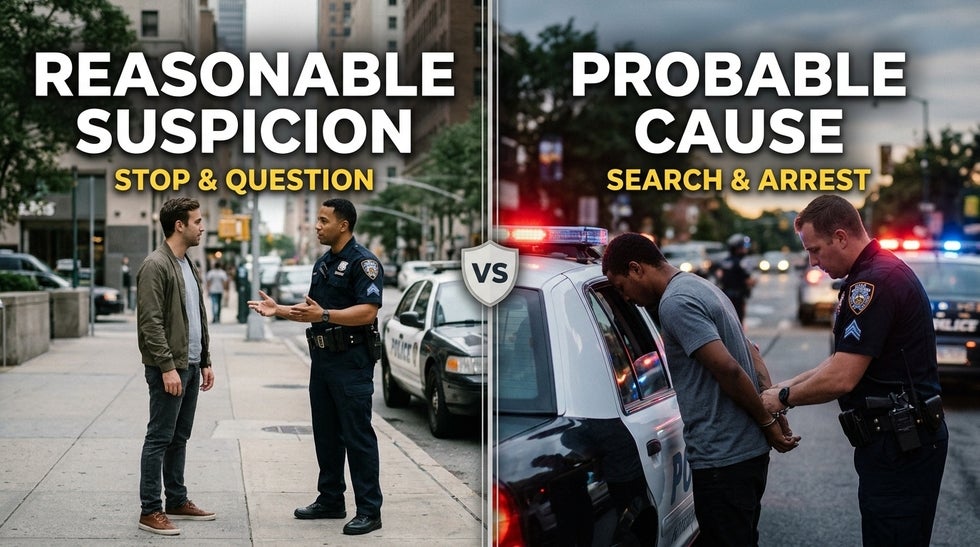
When a police officer pulls you over or stops you on the street, the difference between a brief, lawful encounter and a full-blown arrest often hinges on two constitutional standards that dictate what the officer may do and what evidence can later be used against you.
Understanding Reasonable Suspicion Under the Fourth Amendment
In my practice, I see many cases where officers claim they had “reasonable suspicion,” yet the facts fall short of the legal threshold.
1968 marked the Supreme Court's landmark decision in Terry v. Ohio, establishing that an officer may briefly detain a person when specific, articulable facts suggest criminal activity.
The Court requires the officer to point to concrete observations, not vague hunches, and to limit the stop's scope to confirming or dispelling the suspicion. This standard protects citizens while giving police enough leeway to intervene before danger escalates.
Legal definition and origins of reasonable suspicion
Reasonable suspicion means a police officer can point to specific behavior that would lead a reasonable person to suspect criminal involvement. The doctrine arose from Terry v. Ohio, where the Court balanced public safety against personal liberty.
Key elements include the officer's training, the time and place of the encounter, and any reliable information received. Penal Code 148 criminalizes resisting a lawful detention, underscoring the importance of staying compliant during a valid stop.
What police may do during a Terry stop
During a Terry stop, an officer may ask for identification, request a brief explanation of behavior, and, if there is a reasonable belief the person is armed, conduct a limited pat-down of outer clothing for weapons.
The frisk must be strictly for safety, not a general search for evidence. If the officer exceeds this scope, the intrusion becomes unlawful, and any discovered evidence may be suppressed under Penal Code 148.
Penal Code 148 and the crime of resisting a lawful detention
Resisting or delaying an officer under Penal Code 148 is a misdemeanor that can add criminal liability to the original stop. The statute applies only when the detention is lawful; unlawful stops do not trigger this charge.
Even if you believe the stop is improper, the safest response is to comply and later challenge the detention in court. Courts evaluate whether the officer had the required reasonable suspicion before imposing any penalties.
Probable Cause in California: Standards and Police Powers
In my experience, the line between a permissible stop and an illegal arrest often collapses when officers lack probable cause. The 1983 Supreme Court decision defined probable cause as a fair probability, based on the totality of circumstances, that a crime occurred or evidence exists.
Probable cause powers include making an arrest without a warrant, obtaining a search warrant, and conducting a warrantless vehicle search when safety demands. Penal Code 836 authorizes warrantless arrests, while Penal Code 1524 governs search warrant issuance.
Probable cause definition and Supreme Court guidance
The Court emphasized that probable cause does not require certainty, only a reasonable belief supported by reliable facts. This standard applies to arrests, searches, and the affidavit that justifies a warrant.
Judges assess the totality of circumstances, weighing each piece of information without a strict formula. Cases such as Illinois v. Wardlow illustrate how courts interpret behavior in context.
Statutory applications: PC 836, PC 1524, PC 817
Under Penal Code 836, an officer may arrest without a warrant if probable cause exists. For a search warrant, the officer must submit an affidavit meeting the requirements of Penal Code 1524.
The affidavit must contain a clear statement of probable cause, as required by Penal Code 817. Failure to meet these statutory thresholds often results in evidence suppression at a motion to suppress hearing.
Consequences of lacking probable cause
If an officer proceeds without probable cause, any evidence obtained is typically excluded under Penal Code 1538.5. This protection preserves constitutional rights and can lead to case dismissal.
Defendants also benefit from a mandatory judicial probable cause determination within 48 hours after a warrantless arrest, ensuring prompt review of the officer's actions. Evading a police officer under Vehicle Code 2800 may trigger additional charges, but does not replace the need for lawful cause.
|
Standard |
Legal Basis |
Police Power |
Typical Penalty for Violation |
|---|---|---|---|
|
Reasonable suspicion |
Terry v. Ohio |
Brief detention, frisk |
Misdemeanor under Penal Code 148 |
|
Probable cause |
1983 Supreme Court ruling |
Arrest, search warrant |
Suppression under Penal Code 1538.5 |
|
Warrantless arrest |
Penal Code 836 |
Arrest without warrant |
Potential felony if unlawful |
|
Search warrant |
Penal Code 1524 |
Search with judicial approval |
Evidence exclusion if invalid |
The Ladder of Police Encounters: From Consensual Talk to Arrest
Clients often misunderstand how each level of police interaction builds on the previous one. A consensual encounter requires no justification, but once an officer perceives a threat, the encounter escalates to a detention, then to an arrest, each demanding a higher legal standard.
After a lawful detention, the officer must obtain probable cause within 48 hours to justify continued custody or an arrest. Failure to do so can lead to evidence suppression and dismissal of charges.
Consensual encounters and citizen rights
During a consensual encounter, an officer may approach anyone in a public place and ask questions. You may decline to answer and walk away without any legal consequence.
Because no suspicion is required, the interaction remains voluntary. However, once the officer signals that you are not free to leave, the encounter transforms into a detention. Readers comparing related California statutes also review our guide on how a California preliminary hearing works.
Detention requirements and reasonable suspicion
A detention occurs when a reasonable person would not feel free to leave. At this point, the officer must have articulated reasonable suspicion to justify the stop.
If the officer lacks that specific, articulable basis, the detention is unlawful, and any evidence gathered may be suppressed under Penal Code 1538.5.
Arrest, warrantless and warrant-based, under probable cause
Arrest requires probable cause, whether supported by a warrant or performed warrantlessly under Penal Code 836. The officer must show a fair probability that the suspect committed a crime.
When a warrant is needed, the affidavit must meet Penal Code 1524 standards. Resisting arrest under Penal Code 148 in Humboldt County can add criminal charges, but does not excuse an unlawful arrest.
Facts That Count: Evidence Supporting Each Standard
In my practice, I see officers rely on specific facts to justify a stop. Understanding which facts count helps defendants challenge unlawful detentions before a judge.
Courts compare each fact pattern against the reasonable suspicion vs probable cause examples standard; a clear match can support a lawful stop, while vague cues often fail. Learn more about sealing a California arrest record under Penal Code 851.91.
Fact patterns supporting reasonable suspicion
A detailed description that matches a suspect near the crime scene, such as height, clothing, and vehicle, gives officers concrete grounds to stop a person for questioning.
When an officer observes a traffic violation or erratic driving, the stop is justified; the Supreme Court's Terry ruling permits a brief detention. See Cornell's summary for authority. Penal Code 148 criminalizes resistance.
Fact patterns that courts reject for reasonable suspicion
Simply being in a high-crime neighborhood does not create reasonable suspicion; courts have repeatedly rejected location alone as a basis for a stop without additional specific behavior.
Nervousness, avoiding eye contact, or refusing consent to a search are also insufficient. The odor of cannabis, after legalization, no longer supports a stop. facts that do not count.
Fact patterns that meet the probable cause threshold
If an officer sees contraband in plain view, such as drugs on a table, that observation alone creates probable cause for a search and possible arrest under Penal Code 817.
A reliable informant who provides detailed, corroborated information can meet the threshold; courts treat that as a probable cause hearing foundation. See Cornell's summary for the case.
How Courts Test Reasonable Suspicion and Probable Cause
In my experience, the suppression hearing is the arena where the court decides whether the police had the proper legal basis. The process follows Penal Code 1538.5 rules.
During a motion to suppress, the prosecution bears the burden to prove justification step by step; see how a California preliminary hearing works for related procedures.
Motion to suppress and Penal Code 1538.5
The judge reviews the officer's testimony, body-worn camera footage, and dispatch logs to determine if each intrusion matched the required standard at the time it occurred.
Exigent circumstances require the state to show an emergency that justified bypassing a warrant; otherwise, any evidence discovered later is suppressed in the case under California law.
Judicial inquiry: totality of circumstances and timing
The court applies the totality of circumstances test, weighing all observations, training, and timing to decide if the officer's belief was reasonable before the intrusion began.
When evaluating a frisk, judges require a specific belief the person was armed; this is the classic stop and frisk analysis that cannot rely on later discoveries.
Frequently Asked Questions About Police Stops in California
In my daily practice, clients often ask how the Fourth Amendment protects them during police encounters. The distinction between reasonable suspicion and probable cause shapes every interaction.
Understanding reasonable suspicion vs probable cause helps you know when officers may stop you, search you, or arrest you, and what rights you retain under California law.
What distinguishes reasonable suspicion from probable cause?
Reasonable suspicion requires specific, articulable facts pointing to criminal activity, allowing a brief detention. Probable cause demands a higher level of certainty, justifying an arrest or a search warrant.
A terry stop is a brief detention based on reasonable suspicion that the person is involved in criminal activity and may be armed under California law.
When can an officer conduct a Terry stop without a warrant?
An officer may conduct a Terry stop without a warrant when they have reasonable suspicion supported by specific observations, such as a traffic violation or a credible tip indicating illegal behavior.
If the stop escalates to a full arrest, the officer must show probable cause; resisting a lawful detention violates Penal Code 148 and can lead to charges.
How The Bulldog Law Protects Your Rights When Police Exceed Reasonable Suspicion or Probable Cause
Our California criminal defense team reviews every body-camera clip, dispatch log, and witness statement to pinpoint where the police crossed the legal line. We move quickly to suppress unlawful detentions and keep charges off your record.
From the first phone call we safeguard your constitutional rights and build a strong defense strategy. Call (888) 928-1609 for a confidential case review and let us fight for you.
Frequently Asked Questions
What is the legal threshold for reasonable suspicion under California law?
Reasonable suspicion requires specific, articulable facts that would lead a reasonable officer to suspect criminal activity. The officer must be able to state those facts at a suppression hearing, not just a vague hunch.
The standard is lower than probable cause; it permits a brief detention or vehicle stop but not a full search or arrest. Failure to meet this threshold can result in evidence being suppressed.
How does probable cause differ from reasonable suspicion in California courts?
Probable cause means facts would lead a reasonable person to believe a crime occurred and the suspect committed it, or that evidence is in a particular place. This higher standard justifies arrests, search warrants, and warrantless vehicle searches.
Reasonable suspicion is merely a possibility and only allows limited detention and a protective pat-down if the officer suspects the person is armed. The two standards are distinct and not interchangeable.
When can a California police officer conduct a Terry stop without a warrant?
An officer may conduct a Terry stop when he has reasonable suspicion that the person is involved in criminal activity and may be armed and dangerous. The stop must be brief and limited to confirming or dispelling the suspicion.
If the officer also reasonably suspects the individual is armed, a limited pat-down of outer clothing is allowed. Any longer detention or full search requires probable cause or a warrant.
What are the consequences if evidence is obtained without probable cause in California?
Evidence gathered without probable cause is typically suppressed under the exclusionary rule, meaning it cannot be used at trial. This can lead to dismissal of charges or a significantly weaker prosecution case.
Also, the court may award attorney's fees and costs to the defendant if the illegal search is deemed egregious, reinforcing the importance of proper legal standards.
How do California courts evaluate the totality of circumstances for probable cause?
Courts look at all facts known to the officer at the time, assessing whether a reasonable person would believe a crime occurred and that the suspect was responsible. This includes observations, statements, and any corroborating evidence.
The evaluation is not a mathematical formula but a holistic view; isolated facts rarely satisfy probable cause unless they collectively point to criminal activity.
What rights do California citizens have during a stop based on reasonable suspicion?
Citizens may ask if they are free to leave and may refuse consent to a search. They retain the right to remain silent and to request an attorney if the encounter escalates toward arrest.
If the officer exceeds the limited scope, such as conducting a full search or holding the person longer than necessary, the detention may be challenged and any resulting evidence suppressed.
Can resisting a lawful detention under Penal Code 148 lead to criminal charges?
Yes. Penal Code 148 makes it a misdemeanor to willfully resist, delay, or obstruct a peace officer performing a lawful detention. Penalties can include up to six months in county jail and a fine of up to $1,000.
Even if the original detention lacked proper legal basis, resisting it can create separate criminal liability, underscoring the need for legal counsel before responding to police actions.