
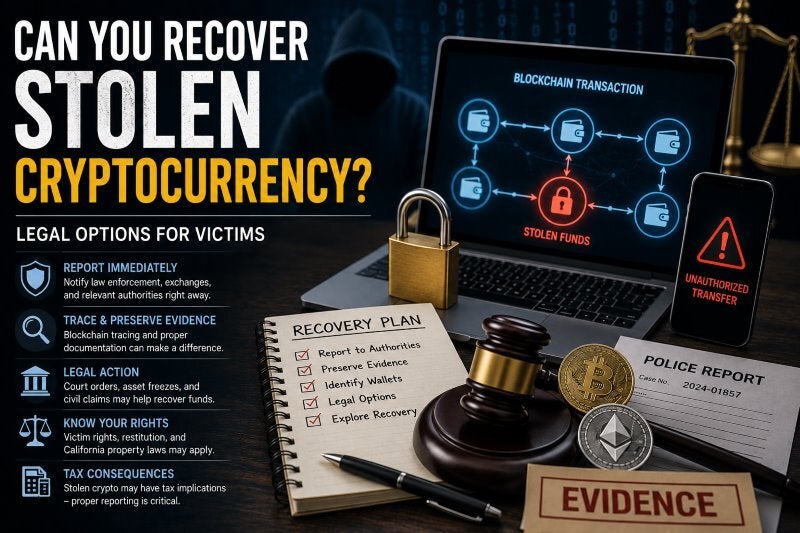
Recover stolen cryptocurrency efforts should begin immediately after a wallet drain, exchange hack, phishing attack, fake investment platform, SIM swap, seed phrase compromise, or romance-related crypto scam. Crypto transfers can move quickly across wallets, bridges, mixers, decentralized exchanges, and offshore platforms, but fast action can sometimes improve the chance of identifying the path of funds, freezing assets, preserving evidence, and pursuing legal claims.
No lawyer, investigator, exchange, or private recovery company can guarantee that stolen crypto will be returned. Recovery depends on the facts, including how quickly the theft is reported, whether the funds touch a compliant exchange, whether law enforcement becomes involved, whether the thief can be identified, and whether there are assets that can realistically be frozen or seized.
Can you recover stolen cryptocurrency after a scam or hack?
Sometimes, yes. Stolen cryptocurrency can occasionally be traced, frozen, seized, or returned through law enforcement action, civil litigation, exchange cooperation, asset forfeiture, or restitution proceedings. The most realistic recovery path usually depends on whether the funds can be connected to a wallet, exchange account, identifiable person, business entity, or laundering network.
Blockchain transactions are public on many networks, which can help investigators follow the flow of funds. However, tracing alone does not return the asset. A victim typically needs legal authority, exchange cooperation, law enforcement involvement, or a court order to interrupt the movement of funds or compel information from third parties.
Cases involving large thefts, organized laundering, or public boasting by hackers may attract law enforcement attention. High-profile enforcement matters involving hackers tied to stolen digital assets show that careless communications, wallet clustering, and blockchain evidence can sometimes help investigators connect suspects to stolen funds.
Immediate steps after cryptocurrency is stolen
Victims should act quickly but carefully. The first priority is to stop additional losses. That may include disconnecting compromised wallets, revoking malicious token approvals, moving remaining assets to a clean wallet, changing exchange passwords, enabling stronger authentication, securing email accounts, and preserving devices for forensic review.
Victims should preserve all evidence before accounts, websites, chats, or social media profiles disappear. Important records include wallet addresses, transaction hashes, screenshots, exchange confirmations, IP notices, email headers, chat logs, phone numbers, website URLs, invoices, fake platform dashboards, seed phrase exposure details, and any communications with the scammer.
A victim should report the theft to the relevant exchange or platform as soon as possible. If stolen crypto is sent to a centralized exchange, the exchange may require a police report, transaction hash, wallet address, proof of ownership, and identity verification before it will consider freezing an account. Exchanges may not act without legal process, but early notice can still matter.
How to recover stolen cryptocurrency through law enforcement
Law enforcement reporting can create an official record and may open the door to subpoenas, warrants, asset freezes, forfeiture, and victim compensation procedures. Victims commonly report crypto theft to local law enforcement, the FBI Internet Crime Complaint Center, and, in appropriate cases, federal agencies involved in cybercrime or financial crime enforcement.
The report should be specific. A vague statement that “my crypto was stolen” is usually less useful than a timeline with wallet addresses, transaction hashes, token amounts, platform names, suspect communications, screenshots, and any known exchange deposit addresses. Investigators need facts that can be entered into blockchain tracing tools and legal process requests.
California criminal law may also matter when stolen property is identified or comes into official custody. Victims who can prove ownership may need to understand California procedures for reclaiming stolen property if assets, devices, or related property are held in connection with a criminal case.
When property is delivered or released through a criminal process, proof of ownership and accurate documentation can be critical. California victims should also consider how stolen property release rules in criminal cases may affect timing, declarations, records, and disputes over who is entitled to recovered property.
Civil lawsuits and emergency court orders
Civil litigation may be appropriate when the thief, exchange account, business entity, promoter, wallet operator, or laundering participant can be identified or connected to a jurisdiction where a court can act. Potential claims may include fraud, conversion, civil theft theories, unjust enrichment, negligence, breach of contract, aiding and abetting, or other remedies depending on the facts.
In urgent cases, victims may seek temporary restraining orders, preliminary injunctions, asset preservation orders, subpoenas, or discovery aimed at identifying defendants and freezing traceable assets. Courts generally require evidence, not speculation. A victim should be prepared to show ownership, the theft pathway, the relevant wallet addresses, and the risk that funds will be dissipated.
Civil litigation is not always cost-effective. If stolen assets have moved through non-custodial wallets with no identifiable defendant or have been laundered through foreign criminal infrastructure, a lawsuit may produce limited results. But where funds touch a known exchange, payment processor, domain host, platform operator, promoter, or identifiable wrongdoer, legal process may help uncover information that a victim cannot obtain alone.
Sentencing, restitution, and victim rights
If a criminal prosecution occurs, victims may have rights to restitution, notice, participation, and documentation of losses. Restitution can be complicated in crypto cases because token values change, multiple victims may claim the same seized pool, and law enforcement may recover only part of the stolen assets.
Victims should not assume that a criminal conviction automatically makes them whole. They may need to submit proof of loss, ownership records, transaction evidence, and updated contact information to the relevant agency or court. In some cases, forfeited assets may be distributed through a remission or restitution process rather than a direct return of the same tokens.
California lawmakers and prosecutors continue to focus on stolen property, digital theft, and organized fraud. Broader policy discussions involving enhanced penalties for stolen property transactions reflect the seriousness of theft-related conduct, although each crypto case still turns on the charged offenses, evidence, and applicable sentencing rules.
Insurance claims for stolen cryptocurrency
Some victims first look to homeowners, renters, cyber, business, crime, or exchange insurance coverage. Coverage depends on the policy language. Many consumer policies limit or exclude losses involving money, securities, electronic funds, business property, fraud, voluntary transfers, or digital assets. A policy may also impose notice deadlines, proof-of-loss requirements, cooperation duties, and exclusions for intentional acts or computer fraud.
Victims should not assume that a denial is always correct, but they should also avoid assuming that crypto theft is automatically covered. Policy wording, how the theft occurred, whether the insured voluntarily transferred assets, and whether the policy recognizes digital assets all matter. California policyholders facing a denied claim should examine homeowners insurance limits for stolen cryptocurrency before accepting an insurer's position or missing an appeal deadline.
Tax consequences of stolen cryptocurrency
A stolen crypto loss may have tax consequences even when no funds are recovered. The tax treatment depends on whether the loss was personal, investment-related, or connected to a trade or business. For investment-related thefts, a taxpayer may need to analyze whether the loss arose from a transaction entered into for profit and whether the taxpayer has a reasonable prospect of recovery.
The amount of any deductible theft loss is generally not the highest market value the asset once reached. Tax analysis often begins with basis, prior income reporting, insurance or restitution prospects, and the year the loss is discovered or sustained. Victims should be careful before claiming a theft loss, abandonment loss, worthless asset loss, or capital loss without records that support the position.
Taxpayers should connect the theft analysis with cryptocurrency loss reporting rules because a stolen asset, a sold asset, a worthless asset, and a scam-related transfer may be reported differently depending on the facts.
Future reporting forms may not fully capture theft events, wallet drains, DeFi losses, or private wallet activity. Victims should understand how Form 1099-DA digital asset reporting may create mismatches if a platform reports sales or transfers without reflecting that assets were stolen or that basis records are incomplete.
Special issues for staking, DeFi, and yield losses
Stolen cryptocurrency cases often involve more than a simple wallet drain. A victim may have earned staking rewards, provided liquidity, farmed rewards, lent assets, bridged tokens, or interacted with smart contracts before the theft occurred. Each activity can affect tax basis, income reporting, and the amount of loss that can be documented.
If stolen assets included prior staking income, victims should coordinate theft reporting with staking rewards tax treatment because previously reported income may establish basis in reward tokens that were later stolen, sold, or transferred.
DeFi thefts can be especially difficult because a malicious approval, fake front end, bridge exploit, liquidity pool failure, or smart contract vulnerability may not look like a traditional theft. Victims involved in swaps, liquidity pools, lending, and yield farming should align their recovery evidence with DeFi tax reporting for complex wallet activity so that legal claims and tax positions do not contradict each other.
IRS audit risk after a crypto theft
A crypto theft can create audit risk if the taxpayer's return does not match exchange records, wallet flows, reported income, or later tax forms. For example, an exchange may show withdrawals to an outside wallet without knowing those assets were later stolen. A tax return may report a large loss without enough support. A victim may also have unreported staking, DeFi, or trading income before the theft occurred.
When the IRS contacts a taxpayer after a crypto loss, the response should be organized and evidence-based. The taxpayer may need to show wallet ownership, transaction history, basis, fair market values, police reports, exchange notices, recovery efforts, and why the claimed tax treatment is legally supportable. Victims dealing with an examination should approach crypto tax audit defense after IRS contact as a legal matter, not just a spreadsheet correction.
Investors preparing future filings should also watch how broker reporting, basis records, and crypto enforcement develop. Planning around crypto tax rules for 2026 investors can help victims avoid compounding the harm of a theft with inconsistent or unsupported tax reporting.
Avoiding recovery scams after crypto theft
Victims are often targeted a second time by fake recovery companies, impersonators, and supposed blockchain investigators who promise guaranteed recovery for an upfront fee. Some claim to work with law enforcement, exchanges, or hackers. Others send fake screenshots showing that funds have been located, then demand additional payments for taxes, unlock codes, gas fees, or compliance deposits.
Warning signs include guaranteed recovery, pressure to pay immediately, refusal to identify licensed professionals, requests for seed phrases or private keys, claims that a court order has already been obtained, or instructions to send more crypto to recover the original loss. A legitimate recovery strategy should focus on evidence preservation, lawful reporting, legal process, and realistic risk assessment.
Recover stolen cryptocurrency lawyers in California
Recover stolen cryptocurrency matters require fast evidence preservation, careful legal strategy, and realistic expectations. Depending on the facts, a victim may need blockchain tracing, exchange notices, law enforcement reports, civil litigation, insurance analysis, tax planning, audit defense, or participation in a restitution or forfeiture process.
Bulldog Law helps California crypto victims evaluate legal options after hacks, phishing attacks, wallet drains, investment scams, DeFi exploits, and stolen digital asset disputes. The firm does not promise recovery, but it can help identify practical next steps, protect legal rights, organize evidence, communicate with relevant parties, and pursue available remedies when cryptocurrency theft creates financial, legal, and tax consequences.