
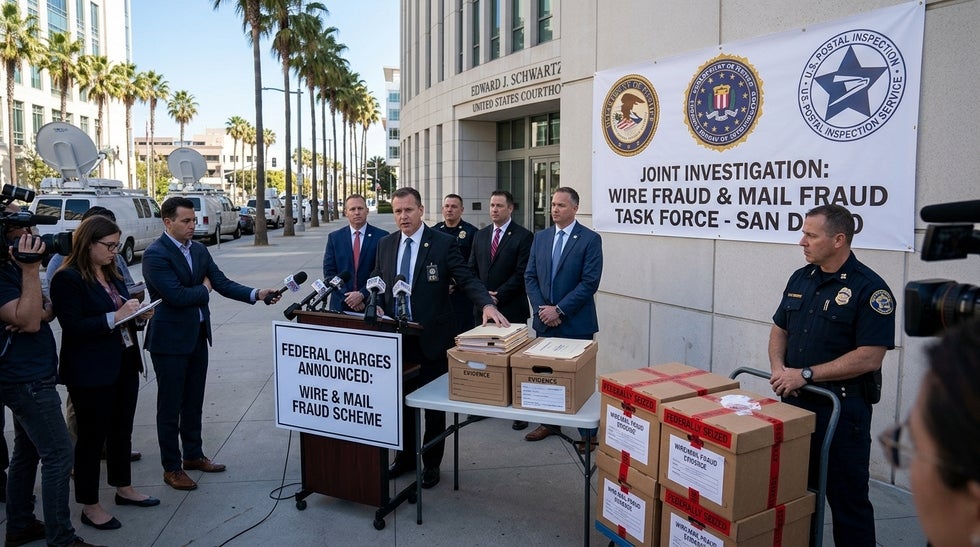
How 18 U.S.C. § 1341 and § 1343 Work in the Southern District, Why Almost Any Fraud Becomes Federal, and Where the Defense Begins
You sent an email confirming a business deal that went sideways. You made a phone call about an investment that your partner now claims was fraudulent. You processed a wire transfer that federal investigators say was part of a scheme. None of these acts felt criminal when they happened. But in federal court, each one can be charged as a separate count of wire or mail fraud each carrying up to 20 years in federal prison.
Wire fraud and mail fraud are two of the most broadly applied federal statutes in the United States. They are the government's go-to charges whenever a scheme to defraud involves an email, a phone call, a text message, a wire transfer, or a piece of U.S. mail. In San Diego, the U.S. Attorney's Office for the Southern District uses § 1341 and § 1343 in prosecutions ranging from real estate fraud schemes near the border to telemarketing fraud operations, investment scams targeting military families, and construction fraud cases throughout the county.
The Bulldog Law covers federal fraud defense strategy and Southern District developments on blog. This article explains exactly what wire and mail fraud charges require, why they are so broad, and how experienced defense attorneys challenge them in San Diego federal court.
What Wire Fraud and Mail Fraud Actually Require Under Federal Law
Despite carrying penalties of up to 20 years per count, wire and mail fraud have deceptively simple elements. Understanding what the government must prove is the foundation of every defense.
Wire Fraud 18 U.S.C. § 1343
Wire fraud requires: (1) a scheme or artifice to defraud or to obtain money or property by means of false or fraudulent pretenses; (2) the defendant's knowing and willful participation in that scheme with intent to defraud; and (3) use of interstate wire communications including phone calls, emails, text messages, wire transfers, or internet communications in furtherance of the scheme. The wire communication does not need to be fraudulent itself. It only needs to be used in furtherance of a scheme that was fraudulent.
Mail Fraud 18 U.S.C. § 1341
Mail fraud has identical elements except that the third element requires use of the U.S. Postal Service or a private carrier including FedEx, UPS, and DHL in furtherance of the scheme. A single piece of mail sent as part of a fraudulent scheme can constitute a separate count. In complex fraud prosecutions, San Diego federal prosecutors routinely charge dozens of counts one for each email, wire transfer, or letter creating enormous cumulative sentencing exposure.
THE BREADTH PROBLEM: Almost every modern business transaction involves an email, a phone call, or a wire transfer. This means that almost any fraud scheme however characterized under state law can be federalized through wire and mail fraud charges. The mere use of email in connection with a disputed business arrangement can transform a civil dispute into a federal criminal case.
What “Scheme to Defraud” Actually Means
Courts have interpreted “scheme to defraud” broadly. It includes not just schemes to obtain money or property through false statements, but also schemes to deprive victims of “honest services” under 18 U.S.C. § 1346. Honest services fraud which covers undisclosed self-dealing and kickbacks in business relationships is frequently charged alongside § 1341 and § 1343 in San Diego cases involving real estate agents, mortgage brokers, and government contractors.
The 20-Year Maximum and When It Doubles
The base maximum sentence for wire and mail fraud is 20 years per count. When the fraud involves a financial institution or occurs in connection with a federally declared disaster or emergency, the maximum increases to 30 years. When the fraud is connected to TARP funds or affects a financial institution's assets, additional enhancements apply. In San Diego, fraud cases involving PPP loans, SBA disaster relief funds, or bank-related schemes routinely draw enhanced charging decisions from the U.S. Attorney's Office.
Wire and Mail Fraud Prosecutions Specific to San Diego
The Southern District of California sees wire and mail fraud charges across a distinctive range of schemes driven by San Diego's specific economic landscape:
Military and Veteran Targeting Schemes
San Diego's massive military community home to more active duty personnel than any other U.S. city has made it a repeated target for investment fraud, mortgage fraud, and benefits fraud schemes. The Southern District prosecutes these cases with particular aggression, often adding enhanced penalties when military families or veterans were among the victims. We have defended clients accused of targeting military communities and know exactly how these prosecutorial priorities shape charging and sentencing decisions.
Real Estate and Mortgage Fraud
San Diego's high-value real estate market generates significant federal mortgage and real estate fraud prosecutions. Inflated appraisals, straw buyer schemes, equity stripping operations, and foreclosure rescue fraud all involve wire communications and generate § 1343 charges alongside state fraud counts. When mortgage applications are processed through federally insured lenders which is nearly universal federal bank fraud under 18 U.S.C. § 1344 is also charged.
PPP and Pandemic Relief Fraud
Southern District federal prosecutors aggressively pursued Paycheck Protection Program (PPP) and Economic Injury Disaster Loan (EIDL) fraud cases following the COVID-19 pandemic. These cases many of which targeted San Diego small business owners who submitted inflated or inaccurate loan applications were charged as wire fraud and bank fraud, carrying substantial sentencing exposure. Many of these cases are still being prosecuted or appealed in the Southern District today.
Telemarketing and Online Fraud
San Diego's proximity to the border and its large bilingual population have made it a hub for telemarketing fraud operations targeting both English and Spanish-speaking consumers. Federal task forces routinely investigate these operations, and the wire communications involved phone calls, emails, and automated messages generate voluminous wire fraud counts that prosecutors use to build pressure for plea agreements.
How the Southern District U.S. Attorney Builds Wire and Mail Fraud Cases
Grand Jury Subpoenas and Document Production
Wire and mail fraud investigations in the Southern District begin with grand jury subpoenas to banks, email providers, phone carriers, and business entities. These subpoenas produce thousands of pages of financial records, communications, and business documents before a target is even aware they are being investigated. We advise clients who receive grand jury subpoenas on their rights, the scope of required production, and how to respond in ways that protect privileged communications.
Financial Analysis and Loss Calculation
Federal prosecutors retain forensic accountants to analyze the financial records and calculate the loss amount attributed to the scheme. Loss amount is critical in federal fraud cases because it drives the Federal Sentencing Guidelines calculation far more than any other factor. A loss under $250,000 produces a dramatically different Guideline range than a loss over $1.5 million. We retain independent forensic accountants to challenge the prosecution's loss methodology, offset calculation, and attribution of losses to specific conduct by our client.
Cooperating Witnesses
Complex wire fraud prosecutions in San Diego almost always involve at least one cooperating witness a co-defendant who has agreed to testify in exchange for a reduced sentence. These witnesses have every incentive to maximize their cooperation value by attributing maximum conduct to others. We investigate every cooperating witness's agreement, criminal history, prior inconsistent statements, and the specific information they provided to the government to expose bias and fabrication.
Where Wire and Mail Fraud Cases Are Prosecuted in San Diego
Federal wire and mail fraud charges under 18 U.S.C. § 1341 and § 1343 are prosecuted in the United States District Court for the Southern District of California:
U.S. District Court Southern District of California
333 West Broadway, San Diego, CA 92101
U.S. Attorney's Office: 880 Front Street, San Diego, CA 92101
The Southern District's Financial Crimes and Cyber Section handles wire and mail fraud prosecutions. These prosecutors are experienced in complex multi-defendant fraud cases and routinely coordinate with the FBI, IRS Criminal Investigation, and the U.S. Postal Inspection Service on investigation and prosecution.
Defense Strategies for Wire and Mail Fraud Charges in San Diego
The Bulldog Law's federal white collar defense practice builds wire and mail fraud defenses around attacking intent, challenging the scheme characterization, and aggressively contesting the loss calculation that drives sentencing:
Negating Fraudulent Intent
The government must prove you acted with specific intent to defraud that you knew your representations were false and intended to cause financial harm. Good faith belief in the truth of your statements is a complete defense. Business optimism, honest mistakes, failed investments, and disputed performance are not fraud. We build the good faith defense through your business records, communications that demonstrate honest intent, and expert testimony on industry standards.
Challenging the Scheme Characterization
Not every failed business arrangement is a “scheme to defraud.” The prosecution must prove that the scheme was designed from the outset to deceive not that a legitimate business relationship later went wrong. We present evidence of the legitimate business purpose behind the arrangement, the defendant's genuine belief in its viability, and the external factors that caused failure rather than fraud.
Attacking the Loss Calculation
In the Federal Sentencing Guidelines, loss amount is the single largest driver of the Guideline range in fraud cases. We challenge the prosecution's loss calculation by presenting evidence of actual loss versus intended loss, legitimate offsets and credits that reduce the net loss, and the unreliability of the government's methodology. Reducing the loss calculation even modestly can reduce the Guideline range by years.
Challenging the Use of Wire or Mail
The government must prove that a wire communication or mailing was used “in furtherance” of the fraudulent scheme. Incidental communications that were not specifically designed to advance the scheme do not satisfy this element. We analyze every charged communication for its connection to the alleged scheme and challenge counts where the nexus is tenuous or the communication was merely coincidental to the business relationship.
Statute of Limitations Defense
The statute of limitations for wire and mail fraud is generally 5 years from the last act in furtherance of the scheme extended to 10 years when the fraud affects a financial institution. In complex, multi-year schemes, the limitations period can bar prosecution of early conduct even when later conduct remains timely. We evaluate every charged act for limitations issues that can eliminate entire counts from the indictment.
Contacted by Federal Agents About Fraud? Do Not Wait to Get Counsel
- Do not speak to FBI agents, IRS Criminal Investigation, or U.S. Postal Inspection Service investigators without an attorney present. Unlike state investigations, federal wire and mail fraud investigations frequently begin with an “interview request” before any arrest. These interviews are not voluntary in any meaningful sense. Every statement you make becomes evidence in a federal prosecution.
- Do not destroy, alter, or delete any business records, emails, financial documents, or communications. Evidence destruction constitutes obstruction of justice a separate federal felony that is prosecuted independently of the underlying fraud charges. Preserve everything.
- If you have received a target letter from the U.S. Attorney's Office, you are formally on notice that you are a target of a federal grand jury investigation. Contact The Bulldog Law immediately. A target letter is an opportunity to engage with the investigation proactively with counsel before charges are filed.
- Identify all business records, contracts, communications, and financial documents that support your account of the transactions at issue. The documentation of your legitimate business purpose and good faith is the foundation of your defense.
- Do not contact alleged victims, co-defendants, or witnesses. Contact with potential witnesses after a federal investigation is opened can be charged as obstruction or witness tampering charges that add years to sentencing exposure and signal to the U.S. Attorney's Office that you are a flight risk or danger to the investigation.
- Call The Bulldog Law at (888) 928-1609. Getting federal defense counsel involved before charges are filed is the single most important step you can take. Pre-indictment representation gives us the opportunity to present exculpatory evidence to the U.S. Attorney's Office and, in some cases, prevent charges from being filed at all.
Defending Wire and Mail Fraud Cases in San Diego, Carlsbad, and Chula Vista
The Bulldog Law represents clients facing wire and mail fraud charges throughout the Southern District of California from our San Diego law office. Federal fraud cases arise from business activity in every community across San Diego County.
San Diego
The core of San Diego's federal fraud prosecution activity centers on the city's financial, real estate, and defense contracting industries. Cases involving Sorrento Valley tech companies, downtown commercial real estate, and defense contractor billing irregularities near the naval and Marine Corps installations are regularly prosecuted in the Southern District courthouse on West Broadway. The Bulldog Law appears there regularly and knows the AUSA teams who handle complex fraud cases.
Carlsbad
North County San Diego's Carlsbad and Encinitas corridor is home to significant biotech, clean energy, and professional services industries that generate federal fraud investigations related to securities offerings, government contracts, and business-to-business transactions. These cases are prosecuted in the Southern District and frequently involve the FBI's San Diego Field Office. We handle North County federal fraud cases with the same depth of forensic accounting and legal analysis we bring to every matter.
Chula Vista
Chula Vista's large military and immigrant communities make it a frequent location for federal fraud investigations targeting military benefits fraud, immigration fraud, and consumer financial fraud. Cases from this area particularly those involving wire transfers across the border and telemarketing operations targeting Spanish-speaking consumers are prosecuted in the Southern District with the support of HSI and the U.S. Postal Inspection Service.
We also serve clients in Poway, La Mesa, Lemon Grove, Solana Beach, and all surrounding communities. See our complete San Diego County coverage area for full details.
San Diego Office
501 West Broadway, Suite 800 San Diego, CA 92101 Phone: (888) 928-1609
Frequently Asked Questions: Wire and Mail Fraud in San Diego
Why is almost every fraud case in San Diego also a federal wire fraud case?
Because virtually every business transaction in the modern economy involves an email, a phone call, a text message, or a wire transfer all of which qualify as “wire communications” under § 1343. The moment a fraudulent scheme uses any interstate electronic communication, it becomes wire fraud. Federal prosecutors in the Southern District use this breadth to federalize state fraud cases whenever the conduct justifies federal prosecution priority which typically means larger schemes, repeat conduct, or cases involving federal interests like military victims or federally insured financial institutions.
How does the loss amount affect sentencing in a Southern District fraud case?
Loss amount is the dominant driver of the Federal Sentencing Guidelines calculation in fraud cases. Under U.S.S.G. § 2B1.1, each tier of loss adds a specified number of offense levels to the base level. A loss of $6,500 adds 2 levels. A loss of $1.5 million adds 16 levels. A loss over $65 million adds 22 levels. Each additional offense level typically adds months to years to the sentencing range. We challenge loss calculations aggressively arguing for actual rather than intended loss, applying victim credits and offsets, and disputing attributions of loss to specific conduct by our client.
What is the difference between wire fraud and bank fraud in San Diego?
Wire fraud under § 1343 covers schemes to defraud using any interstate wire communication. Bank fraud under 18 U.S.C. § 1344 specifically covers schemes to defraud a financial institution or to obtain money or assets from a financial institution through false pretenses. In practice, Southern District fraud cases involving mortgages, bank accounts, PPP loans, or credit facilities are charged with both statutes simultaneously. Bank fraud carries up to 30 years per count when the scheme causes actual loss to the bank, compared to 20 years for standard wire fraud.
What is a target letter and what should I do if I receive one?
A target letter is a formal notice from the U.S. Attorney's Office informing you that you are the target of a federal grand jury investigation and that the government is considering charging you. It is not an arrest or a charge it is an opportunity. Contact The Bulldog Law immediately upon receiving a target letter. Pre-indictment representation gives defense counsel the opportunity to evaluate the government's evidence, present exculpatory information to the AUSA, negotiate potential resolutions, and in some cases convince the government not to proceed with charges at all.
Can a failed business venture be charged as wire fraud in San Diego?
The government cannot criminalize every failed investment or disappointed business expectation. Wire fraud requires a scheme designed from the outset to deceive the intent to defraud must exist at the time the representations were made. A business that honestly failed due to market conditions, management errors, or external factors is not fraud. The critical defense question is whether the defendant genuinely believed in the viability of the business arrangement at the time. We build good faith defenses through contemporaneous business records, communications, and expert testimony that demonstrates the defendant's honest belief in the venture.
How many counts can a wire fraud indictment include?
In theory, each individual wire communication used in furtherance of a fraudulent scheme can be charged as a separate count. In complex fraud cases, Southern District indictments regularly include 20, 30, or even 50+ counts each carrying up to 20 years. While sentences typically run concurrently rather than consecutively in fraud cases, the sheer volume of counts creates enormous plea pressure and allows the government to negotiate from a position of maximum statutory exposure.
We challenge every count individually for legal sufficiency and work to reduce the count total through pre-trial motions that narrow the prosecution's case to its strongest evidence.