
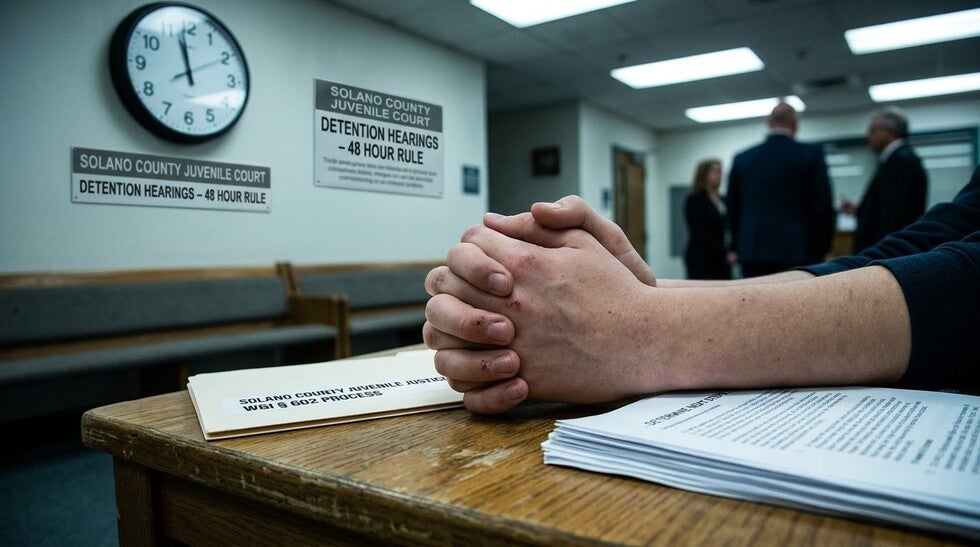
Your Child Was Arrested in Solano County.
The Probation Department's intake assessment which happens before any petition is filed, before any court appearance, often before most parents fully understand what has happened is the first moment where the defense makes a difference. Missing that moment is the mistake that's hardest to recover from.
Every parent who calls The Bulldog Law after a juvenile arrest in Solano County is carrying fears that are more specific than the charge itself. The Vallejo Filipino family whose daughter was applying to Solano Community College's nursing program and whose DACA renewal is coming up next year. The Travis AFB family whose son holds DACA status and whose future in the United States depends partly on avoiding any adjudication that affects that status.
The Vallejo Black family whose son's case carries a gang allegation that, if not contested early, could result in a PC § 707 fitness motion sending him to adult court at fifteen. The Fairfield family whose child was arrested at Rodriguez High School and who now faces a school disciplinary proceeding running alongside the criminal case.
California's juvenile justice system under Welfare & Institutions Code § 602 is designed around rehabilitation. Records are confidential by default. Diversion outcomes exist specifically because the legislature recognized that young people deserve resolution pathways that adult prosecution doesn't provide. But those pathways require active, early advocacy to access beginning with the Probation Department's intake assessment, which is where the first narrative about your child's case and their amenability to rehabilitation is established. Retaining counsel before that assessment concludes is the variable that most consistently changes outcomes in Solano County juvenile cases.
The Solano County Juvenile Process
After a juvenile arrest in Solano County, the Solano County Probation Department conducts an intake assessment that determines immediate detention versus release to parents and generates the first recommendations about diversion eligibility, petition filing, and program placement. These recommendations shape what the DA does next. We advocate for immediate release from the Probation Department's first contact and engage with the intake assessment from the earliest possible moment.
The DA then decides whether to file a W&I § 602 petition the juvenile equivalent of a criminal complaint or to refer the case to diversion without filing. A sustained petition doesn't create an adult criminal conviction, but it produces a juvenile record with real consequences for Solano College nursing and education career pathways, for DACA renewal applications, for Travis AFB family members' immigration status, and for the school enrollment and disciplinary history that follow a young person into their adult life.
What outcomes are available in Solano County Juvenile Court: Informal diversion without any petition being filed. W&I § 654 informal probation six months of supervision without a sustained petition, leaving no formal adjudication record. Formal probation with conditions. Camp or ranch program. Division of Juvenile Justice commitment for only the most serious cases involving violence and prior adjudication history.
In most first-offense Solano County juvenile cases particularly those not involving serious violence the first two options produce the outcome that protects every downstream consequence: no petition filed, or informal probation that closes without a formal adjudication. That outcome requires making the rehabilitation case to the Probation Department and the DA from the earliest stage of the process, which is why early retention matters more than anything else in determining the available options.
Vallejo's Filipino Youth DACA and Licensing Stakes
Vallejo's Filipino-American youth community whose parents and grandparents built one of California's most established Filipino communities through the Mare Island Naval Shipyard era and subsequent decades generates juvenile cases where two specific downstream consequences require simultaneous analysis alongside the juvenile proceedings. DACA renewal eligibility and Solano Community College nursing and allied health licensing pathway protection are the two dimensions that make early diversion the absolute defense priority.
Certain juvenile adjudications particularly those involving conduct classified as significant misdemeanors or felony-equivalent offenses are considered adverse factors in DACA renewal discretionary analysis by USCIS. A diversion outcome that produces dismissal without a sustained petition is substantially better for DACA renewal than a formally sustained petition. For Filipino-American DACA youth in Vallejo whose continued presence in the United States depends on DACA renewals that scrutinize criminal history, informal diversion or no-petition resolution at Solano County Juvenile Court is the outcome that protects everything.
California's Board of Registered Nursing and the Commission on Teacher Credentialing review criminal history for license applicants. A sustained juvenile petition that isn't sealed creates disclosure considerations that a diversion dismissal avoids entirely. For Vallejo Filipino youth pursuing Solano Community College's nursing and healthcare pathways one of the most common career trajectories in the community the difference between a sustained petition and a diversion dismissal is the difference between a clear path to licensure and a years-long rehabilitation process before the board.
Travis AFB Families Military Community Youth Defense
Travis AFB's military family community generates juvenile cases with specific stakes for children of active-duty service members. Military family youth whose parents hold security clearances sometimes face situations where a juvenile adjudication's background check visibility creates a disclosure situation in future clearance applications. DACA-status youth in Travis AFB families face the same DACA renewal analysis that applies throughout Solano County's immigrant community.
For military family youth, the school disciplinary parallel is often more consequential than in civilian school contexts. Base schools and DoD-dependent school systems operate under disciplinary frameworks that interact with civilian juvenile proceedings in specific ways. We coordinate juvenile defense strategy with awareness of the military family school disciplinary process in every Travis AFB community juvenile case.
Vallejo's Black Youth Gang Diversion and Fitness Challenge
Vallejo's Black youth community generates juvenile cases where gang enhancement allegations and PC § 707 fitness motions for adult court transfer create the highest stakes in Solano County's juvenile system. A fitness motion that succeeds finding a minor not amenable to juvenile rehabilitation transfers the case to adult criminal court, where the juvenile confidentiality protections disappear and the adult sentencing ranges apply.
We fight fitness motions through comprehensive rehabilitation amenability evidence: school records, community support documentation, family stability evidence, mental health evaluations where applicable, and every resource that demonstrates this young person's rehabilitation potential within the juvenile system.
For Vallejo Black youth facing gang allegations, the specific community investigation that develops the confrontation context the prior relationship between the parties, the circumstances that produced the incident, and the young person's actual gang involvement or lack thereof is central to both the fitness opposition and the underlying charge defense at the juvenile court.
Solano County's juvenile court offers gang intervention diversion programs that provide structured prosocial alternatives to formal adjudication for youth whose cases involve gang-adjacent allegations. Where these programs are available and appropriate, we pursue them as diversion pathways that avoid formal adjudication while providing the structured support that the Probation Department and juvenile court respond to.
School-Based Arrests Throughout Solano County
Solano County's school districts Vallejo City Unified, Fairfield-Suisun Unified, Vacaville Unified, and others generate school-based arrests where juvenile criminal proceedings and school disciplinary proceedings begin simultaneously. For Solano Community College-bound students, for DACA-status youth, and for any young person whose educational trajectory depends on avoiding suspension, expulsion, and the long-term educational record that school disciplinary proceedings create, both tracks require coordinated strategy. We represent Solano County minors in school disciplinary proceedings as a parallel defense component alongside juvenile court representation.
Record Sealing
Most Solano County minors who complete juvenile probation can petition to seal their records under W&I § 781, making them inaccessible to most employers, educational institutions, and the public. We pursue dispositions from the earliest stage of every juvenile case that preserve sealing eligibility keeping Solano College nursing pathway options, DACA renewal presentations, and Travis AFB military family clearance background profiles as clean as possible through every stage of the proceedings.
The Juvenile Court
Solano County Juvenile Court
600 Union Avenue, Fairfield, CA 94533
What Families Need to Do Now
- Ask to be present with your child immediately. Parents have the right to be present during law enforcement questioning of a minor in California.
- Invoke your child's right to remain silent explicitly. A juvenile has the same Fifth Amendment protection as an adult, and it must be invoked clearly.
- Call The Bulldog Law at (888) 928-1609 before the Probation Department's intake assessment concludes. Early engagement shapes the first recommendation that everything else follows from.
- Contact your child's school immediately to determine whether a parallel disciplinary process has begun.
- If your child is DACA-status or from a Filipino or immigrant family, contact The Bulldog Law about immigration implications at the first consultation.
Vallejo: Vallejo office | Fairfield: Fairfield office | Vacaville: Vacaville office | Suisun: Suisun City office | (888) 928-1609
What Parents Ask
How does a Solano County juvenile adjudication affect DACA renewal for Vallejo's Filipino youth?
Certain juvenile adjudications involving conduct classified as significant misdemeanors or felony-equivalent offenses are considered adverse factors in DACA renewal discretionary analysis by USCIS. The specific offense and how it was resolved both matter to the renewal evaluation. A diversion outcome producing dismissal without a sustained petition is substantially better for DACA renewal presentations than a formally sustained petition at Solano County Juvenile Court. We address DACA renewal implications at the first consultation in every Solano County juvenile case involving a DACA-status minor, treating diversion as the absolute top priority where the client qualifies.
How does a juvenile adjudication affect Solano College nursing or healthcare licensing?
California's Board of Registered Nursing and related healthcare licensing boards review criminal history for license applications. A sustained juvenile petition that isn't sealed creates disclosure considerations in licensing board applications that a diversion dismissal avoids entirely. A sealed record is inaccessible to most licensing boards as well. We pursue informal diversion or no-petition outcomes wherever possible for Solano Community College-bound students, and we pursue sealing petitions as soon as eligibility is established to protect the nursing, allied health, and other healthcare licensing pathways that these students' careers depend on.
When can Solano County try a minor as an adult?
The Solano County DA can file a PC § 707 fitness motion when the charge involves specified serious offenses including murder, rape, robbery, and other serious violent felonies and the minor is at least fourteen years old. The Juvenile Court must find the minor not amenable to juvenile rehabilitation. We fight fitness motions through comprehensive rehabilitation amenability evidence school records, family support documentation, community ties, mental health evaluations, and the complete picture of this young person's life and through the confrontation context investigation that demonstrates the specific circumstances of the incident. Keeping the case in Juvenile Court keeps the record confidential, the outcomes rehabilitative, and the long-term pathway to a productive adult life open.
For more on Solano County juvenile diversion programs, Vallejo Filipino DACA youth defense, Travis AFB military family juvenile cases, Vallejo Black youth gang diversion and fitness challenges, Solano College licensing implications, record sealing, and juvenile defense at Solano County Juvenile Court, visit The Bulldog Law criminal defense blog.